

Silymarin Nanocrystal Dissolution After Homogenization: Separate Size from Release
Silymarin nanocrystal dissolution after homogenization should be evaluated with matched active loading, a validated separation method and a defined release test. A lower particle-size reading does not prove that more drug has dissolved, nor does it establish oral absorption or clinical benefit. Keep solid particles, dissolved material and total recoverable active distinct throughout the comparison. A useful development trial follows the feed into the final dosage-form route, checks storage effects and confirms that the analytical method is not counting suspended nanocrystals as dissolved drug. This guide addresses formulation development and equipment trial planning, not treatment advice or a validated pharmaceutical manufacturing process.
Decide which development question the trial must answer
A silymarin nanosuspension can be investigated for faster release, improved handling, better redispersion after drying or a specific final formulation. Select one primary objective and identify the supporting measurements. If the objective is dissolution, define the medium, dose, sampling times and comparison material before choosing a homogenization condition. A size-only screening result is an intermediate observation, not the final decision.
Keep the material identity clear. Record the source lot, assay basis and relevant composition information rather than treating every material labeled silymarin as interchangeable. State whether the analytical result represents selected marker compounds or another defined measure. Using one assay basis for the starting material and a different basis for the processed product makes an apparent improvement difficult to interpret.
The distinction between drug nanocrystals and nanoemulsions is important here. A nanocrystal suspension contains a solid drug phase; an emulsion contains dispersed liquid droplets. A milky appearance or a small hydrodynamic diameter does not identify the material state by itself. Confirm the formulation route and include appropriate solid-state characterization.
Read the experimental evidence with its method limits
A stabilizer-free silymarin study prepared nanocrystals by high-pressure homogenization and examined size, solid-state properties, dissolution, short-term physical stability and absorption-related endpoints. The study provides direct evidence that a homogenization route can be investigated for this compound. It does not establish that a different silymarin lot or CAS PETER configuration will reproduce its results. Its release procedure used a dialysis arrangement with surfactant in the receiving medium, an important detail when interpreting simplified descriptions of release in water.
A separate silymarin nanoparticle study used continuous crystallization, followed by formulation and drying investigations. Its preparation route differs from top-down homogenization. The useful comparison is methodological: additives and downstream handling can affect redispersion and release, so particle formation should not be evaluated independently of the complete formulation. The paper also distinguishes dissolution measurements from further absorption questions.
The trial recommendations below are proposed controls for a new development program. They are not a reproduction of either paper, a prediction of bioavailability, or a statement that all silymarin formulations require the same stabilizer.
Build a feed record before pressure processing
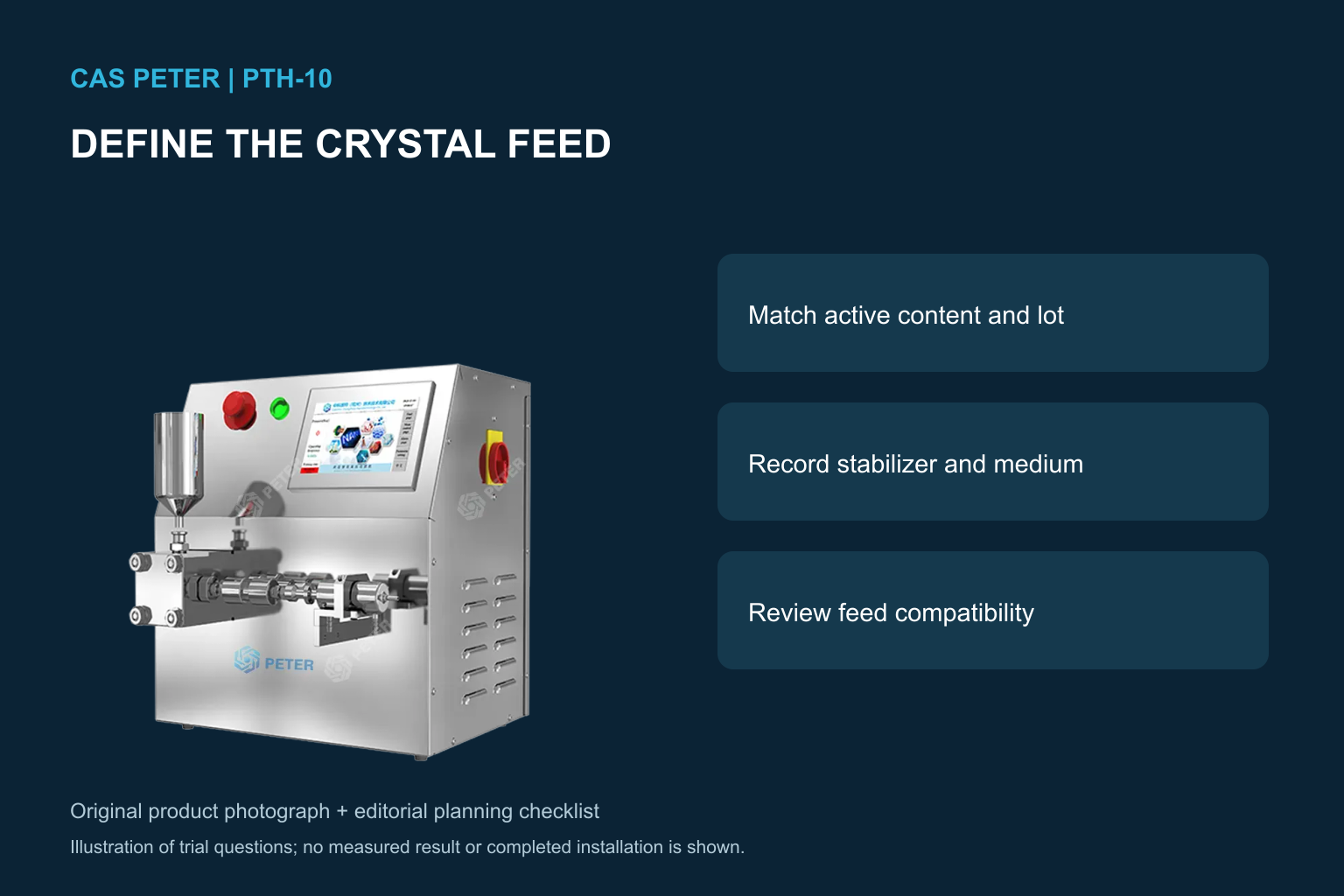
Document drug concentration, liquid medium, stabilizer identity and level, wetting method, mixing order, temperature and predispersion history. Inspect for persistent coarse material and record any screening or rejected solids. Confirm that the feed can be processed through the proposed flow path without using pressure as a substitute for adequate wetting and feed preparation.
Discuss the actual formulation with the equipment supplier. Solvents, pH, solids, viscosity and cleaning requirements affect configuration review. The CAS PETER PTH-10 product page is a real laboratory-equipment reference for that discussion. Its inclusion does not confirm solvent compatibility, a pharmaceutical qualification package or a particular size-reduction result for this feed. Obtain configuration-specific information before running valuable material.
Keep a predispersion control and, where the study design needs it, an excipient-containing control without the pressure treatment. These controls help distinguish effects of wetting or additives from effects of the mechanical process. Record the actual quantities entering the trial, including material held back for analysis, so that later recovery comparisons use a consistent starting amount.
Compare limited process conditions and retain representative samples
Run a small, justified set of treatments with matched feed preparation. Record pressure, pass history, temperature before and after processing, cooling, hold time and recovered material. Avoid increasing both stabilizer concentration and processing intensity in the same comparison unless the experiment is explicitly designed to separate their effects.
Collect representative samples without preferentially taking the best-dispersed layer. If the suspension settles during handling, define a reproducible sampling procedure and document whether remixing is permitted. A sample drawn from the top of a partially settled bottle may describe only a selected fraction, even if the instrument measurement itself is precise.
Measure particle-size distributions with a method suitable for the suspension and report how the sample was diluted. Keep the medium and dilution history consistent, and check for coarse material with complementary observations where appropriate. The DLS and laser diffraction guide explains why different techniques and sample preparations should not be treated as interchangeable size measurements.
Validate the distinction between dissolved and particulate material
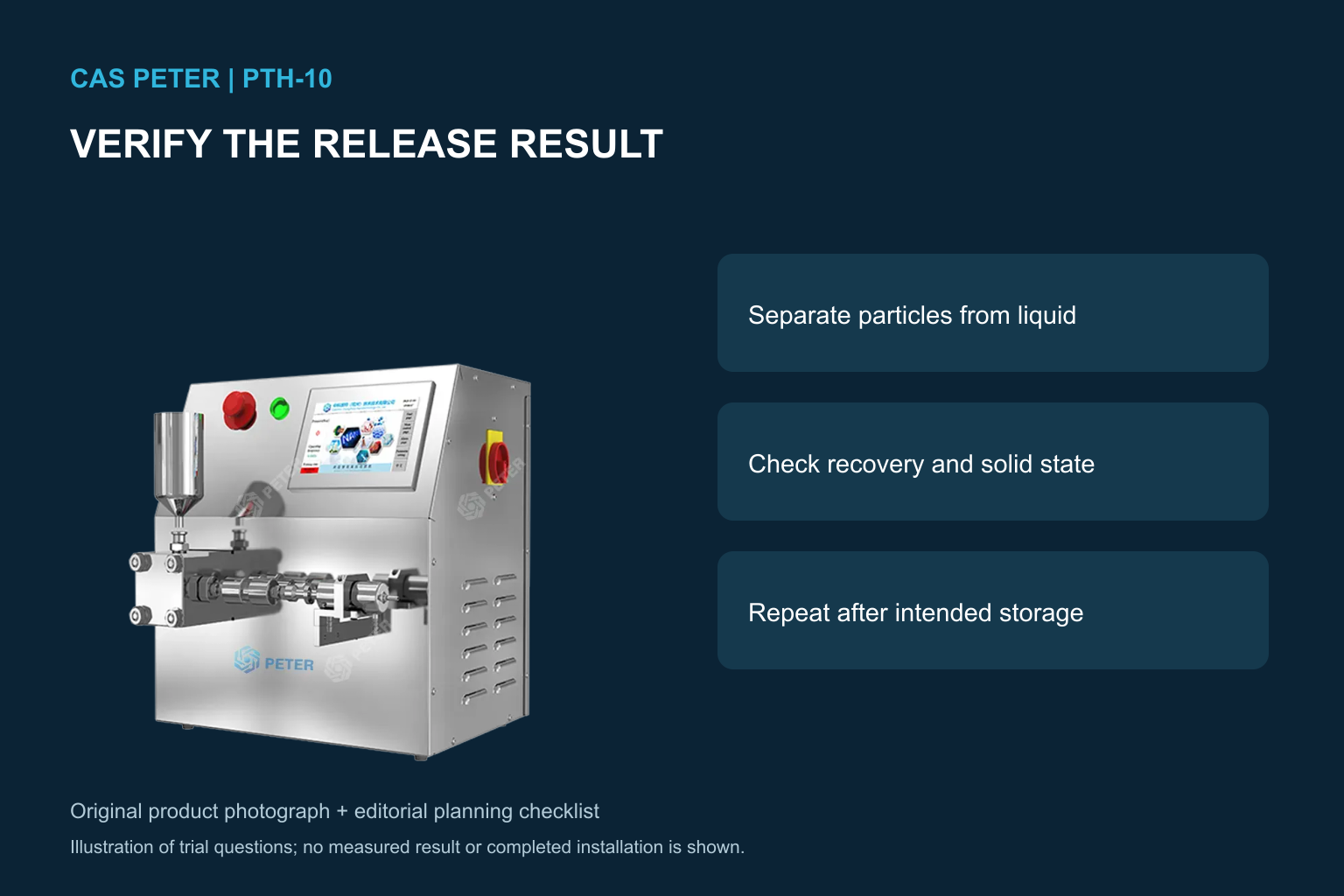
The analytical method must show what is being measured. A filter can adsorb drug, allow some particles through or produce a result influenced by preparation conditions. A nominal pore size alone does not prove that the resulting liquid contains only molecularly dissolved material. Review separation suitability for the actual particle population and medium, and use recovery controls rather than assuming quantitative passage of dissolved drug.
Keep separate aliquots for dissolved-fraction measurement and total-content measurement. If a strong solvent is added before removing suspended crystals, those crystals may dissolve during sample preparation. The resulting assay can be useful for total active content, but should not be reported as the amount that had already dissolved in the test medium.
Check blanks, spiked recovery and the stability of prepared analytical samples. State how the selected chromatographic method resolves the relevant markers and possible interferences. If a mass balance is poor, investigate sampling, container losses, separation and chemical change before interpreting the dissolution curve. A release percentage is only as credible as its dose basis and analytical recovery.
Design the release comparison around a defined medium
Match the active dose, medium volume, temperature and agitation across candidate and control samples. Record the medium composition, including surfactants, buffers or other solubilizing components. Those components belong in the result description; “release in water” can be misleading when the actual receiving medium contains a dissolution aid.
Choose sampling times that answer the development question and document volume replacement. Where a membrane method is used, consider whether membrane transport or drug interaction with the apparatus could influence the observed profile. Compare results only within the scope that the validated method supports. A curve obtained with a dialysis bag is not automatically equivalent to one obtained by direct sampling and filtration.
Separate dissolution rate from an equilibrium-solubility investigation. The first follows release over time under specified conditions; the second requires a justified equilibration and separation approach. Neither test, by itself, demonstrates absorption in humans. Keep any cell or animal findings from the literature separate from the equipment trial’s own measured endpoints.
Review particle state, storage and downstream handling
| Development observation | Control or follow-up | Decision boundary |
|---|---|---|
| Smaller size with little change in measured release | Review medium, separation recovery and solid state | Do not select size reduction as proof of improved dissolution |
| High apparent dissolved fraction after solvent addition | Compare preparation order and a separate total-content assay | Confirm whether the assay measured total drug instead |
| Faster release with a different additive level | Compare matched additive controls | Avoid assigning the whole effect to homogenization |
| Fresh suspension performs well but stored material does not | Recheck size, assay and release after defined storage | A fresh result does not qualify the intended holding period |
| Dry product redisperses poorly | Compare before and after the drying route | Treat downstream formulation as a separate development step |
This qualitative table proposes checks rather than published acceptance limits. The two cited experimental studies use different preparation and formulation routes, which is why their numerical results should not be combined into one process specification.
Use suitable solid-state methods to investigate whether processing or drying changes the material being compared. Explain the role of each method and avoid identifying crystallinity from appearance alone. If drying is part of the intended route, compare the feed suspension with the reconstituted final product under a defined redispersion procedure. The final product must be tested as it will be used, not only after intensive laboratory treatment.
Store samples in the intended or a justified development container, with documented light and temperature conditions. Repeat relevant measurements after the proposed holding period. A short physical-stability observation supports only that interval and those conditions. It cannot establish a commercial shelf life or replace the broader pharmaceutical development program.
Hand over a reproducible development result
A useful result package contains the feed identity, assay basis, process record, material recovery, particle distributions, solid-state evidence, separation validation and release curves. Include individual runs where available, method deviations and the extent of storage testing. Describe the process candidate as selected for further development when unresolved formulation or qualification work remains.
The emulsion and dispersed-system processing overview offers broader equipment context; its liquid-droplet examples should not be used as evidence that a crystalline drug follows the same processing limits. The NPTEL lesson below introduces colloidal stability, useful background for reading a nanosuspension result. It does not establish a silymarin dissolution method, clinical effect or machine specification.

Educational source: NPTEL-NOC IITM. Watch the lesson on YouTube.
Frequently asked questions
Does a smaller silymarin nanocrystal size prove faster dissolution?
No. Compare release under a defined method with matched active loading, medium and analytical recovery. Size is one characterization result, while dissolution is a separate measured endpoint influenced by formulation and test conditions.
Can total drug content be reported as the dissolved fraction?
No. A total-content assay may deliberately dissolve suspended particles during preparation. Dissolved-fraction measurement needs a suitable separation procedure before an analytical solvent changes the sample state.
Can a published release improvement be promised for a PTH-10 trial?
No. Literature findings belong to the tested material, formulation, apparatus and analytical method. A new feed requires configuration review and its own measured trial; dissolution results also do not establish clinical benefit.