

Beetroot Juice Homogenization: Verify Betalain Retention Beyond Color
Beetroot juice homogenization should be evaluated by measuring betalain retention alongside visible color, physical uniformity and the complete temperature history. A redder or smoother sample does not establish that more pigment survived. For a useful production trial, compare the same juice lot before and after processing, control cooling and sampling delays, and repeat the chemical and physical measurements during storage. This guide explains how to separate those questions without assuming that a published pressure setting is suitable for another juice, another machine or another commercial package.
Define the pigment question before selecting pressure
A beverage producer may want less sediment, a more consistent appearance, or better retention of the red colorant. These are related business goals, but they require different acceptance measurements. Write down which problem is limiting the product and which other properties must remain acceptable. A pressure condition that improves the appearance but loses unacceptable pigment should not pass a pigment-retention specification.
Keep the pigment species clear. Betalains include red-violet betacyanins and yellow betaxanthins. An overall color measurement combines optical effects from several components and from suspended material. It cannot automatically replace an assay of either pigment group. The laboratory should state whether it reports an individual compound, a group expressed as an equivalent concentration, or a chromatographic signal relative to a control.
For broader equipment context, see the food homogenization guide. The present trial addresses pigment and color evidence in beetroot juice rather than a general claim that homogenization preserves every food component.
What the directly relevant research establishes
A beetroot juice HPH study compared pressure, repeated processing and cooling. Pigment losses occurred in the investigated juice, and cooling limited degradation. Its important practical contribution is the need to examine the thermal history together with pressure. The paper does not establish a universal pressure that maximizes pigment retention in every beetroot formulation.
A separate study of stored beetroot juice concentrate examined temperature and light conditions. Betalain degradation increased with storage temperature and time in that concentrate. Concentrate storage is a different experiment from flow-through homogenization of a beverage. Use it to justify a controlled storage comparison, not to transfer a shelf-life equation or expiration date into a different product.
Together these studies support a bounded decision: measure the actual pigment result, keep the processing history visible, and check the intended storage conditions. They do not demonstrate microbial safety for your process, health benefits for consumers, or the performance of a particular CAS PETER model.
Prepare one representative juice lot
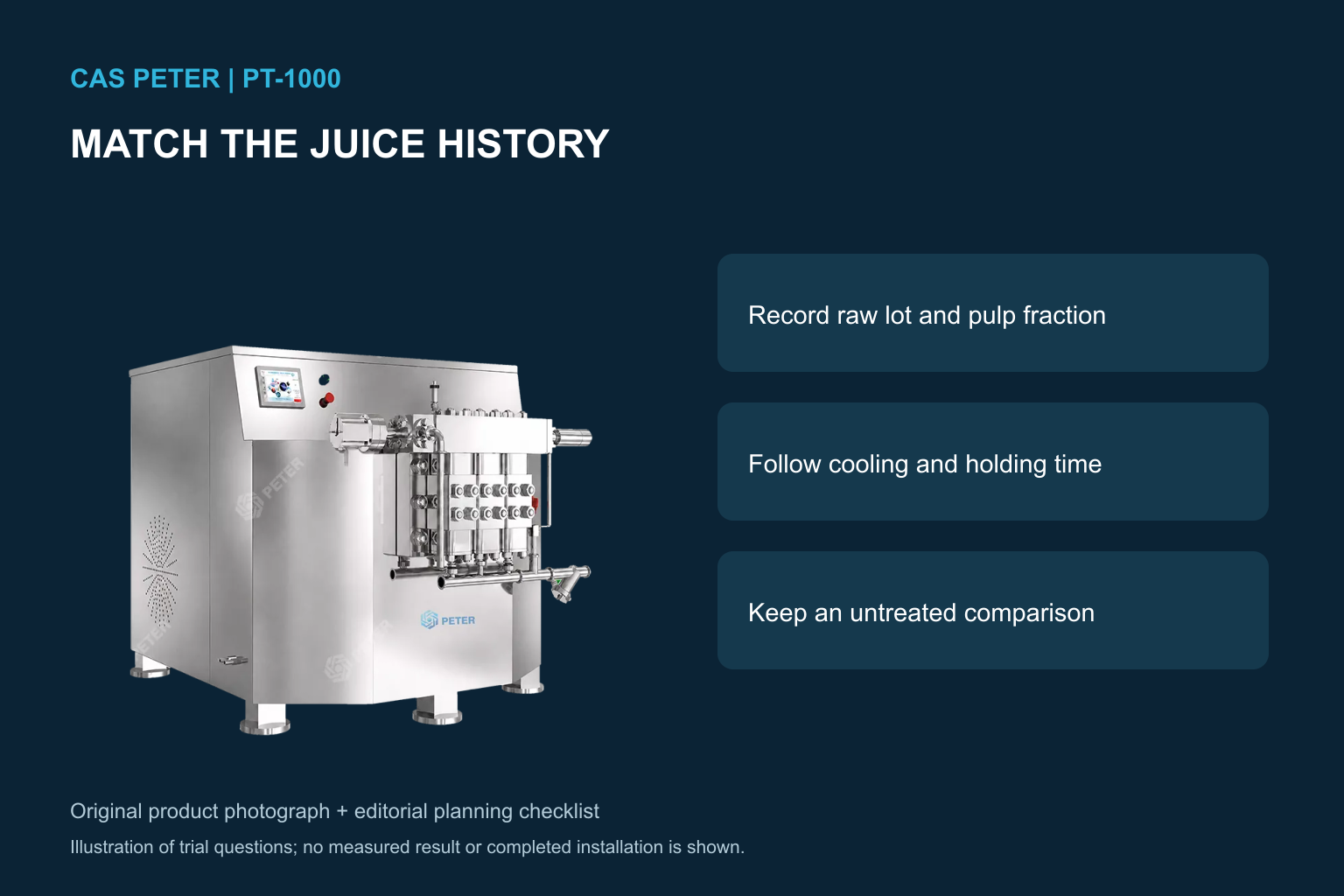
Record the raw-material lot, juice preparation, solids removal, formulation and initial holding time. Split a mixed parent batch into the comparison streams rather than preparing each stream from different roots. Otherwise agricultural variation may be mistaken for an equipment effect. Keep a retained untreated sample under an explicitly defined time and temperature history.
Specify the pulp fraction that reaches the machine. Removing coarse material can change both the pigment accounting and the appearance of the remaining juice. If a screen or settling step is part of the commercial process, include it consistently. Report any material discarded before homogenization so that a higher concentration in the liquid is not confused with a higher recovery from the original material.
Record water, acid, sweetener and any other additions by mass. A change in dilution changes pigment concentration even if the absolute quantity is unchanged. Use the same formulation in every comparison stream. Where the final recipe differs from the trial juice, reserve a later verification in the complete beverage rather than claiming that the intermediate settles the product decision.
Separate pressure from heat and holding time
Prepare a short trial matrix that changes one process question at a time. Pressure, pass count and cooling conditions should be recorded separately. An additional pass also adds handling and elapsed time. A comparison that changes all of them together may identify a promising process but cannot isolate the reason for the result.
Record inlet and outlet temperature, collection time and the time at which each sample reaches the defined storage condition. Avoid describing a run simply as cooled if the product spent an unrecorded interval warm in a collection vessel. If laboratory resources permit, include a temperature-history comparison that helps distinguish heating from the full homogenization treatment.
The guide to homogenization temperature rise explains why the cooling question belongs in process development. Actual cooling capacity, material compatibility and operating limits must be confirmed for the proposed equipment and feed. Do not borrow another study’s settings as operating instructions.
Define a maximum acceptable sampling delay before starting. Take the untreated and processed samples through the same container, transport and laboratory queue wherever practical. When that is impossible, record the differences. A late assay can reflect changes after the machine rather than changes at the processing step itself.
Measure color and pigment on compatible samples
Use a written color method with a consistent sample presentation. Cell path, background, mixing and the presence of sediment can affect the reading. Record the instrument settings and whether the sample was measured whole, clarified or diluted. A clarified sample and a whole juice are different test materials and should not share an unqualified result label.
Ask the analytical laboratory to document extraction, dilution, calibration and recovery checks for its betalain method. Include the starting juice and the processed juice in the same analytical batch when possible. If matrix interference is suspected, investigate it before interpreting a small apparent improvement as increased retention.
For a mass-based assessment, use pigment concentration together with the recovered stream quantity and every relevant dilution. State the calculation basis in the report. A concentration ratio can be useful when composition and recovered quantities are truly comparable; it is not automatically a complete pigment mass balance. Keep processing loss and analytical loss as separate questions.
Do not use a total antioxidant assay as a substitute for a betalain assay. It addresses a different endpoint. If antioxidant activity is a development target, report it separately with its own method and boundary rather than attributing all changes to pigment retention.
Use a decision table that exposes trade-offs
The following table is a proposed trial interpretation framework, not a table of published performance limits. Its purpose is to connect each observation to the next useful check.
| Observation in matched samples | What remains uncertain | Next comparison |
|---|---|---|
| Appearance becomes more uniform, but pigment assay decreases | Optical improvement may coexist with chemical loss | Review temperature history and pigment recovery before accepting the condition |
| Pigment concentration rises after processing | Dilution, stream recovery or extraction may differ | Reconcile added water, sample preparation and recovered mass |
| Color changes while the pigment result is similar | Suspended material or measurement presentation may differ | Repeat whole-juice and clarified measurements with consistent labels |
| Immediate results pass, but stored samples diverge | Packaging and storage history may affect the outcome | Compare matched packages at the intended storage conditions |
| Extra passes do not improve the specified endpoint | Additional treatment may have no useful return | Retest the simpler condition with independent batches |
Set acceptance values from the product brief, analytical capability and customer requirements. Do not convert these qualitative checks into invented industry limits. Report repeatability so the decision does not depend on a difference smaller than ordinary test variation.
Carry the trial into storage and the actual package
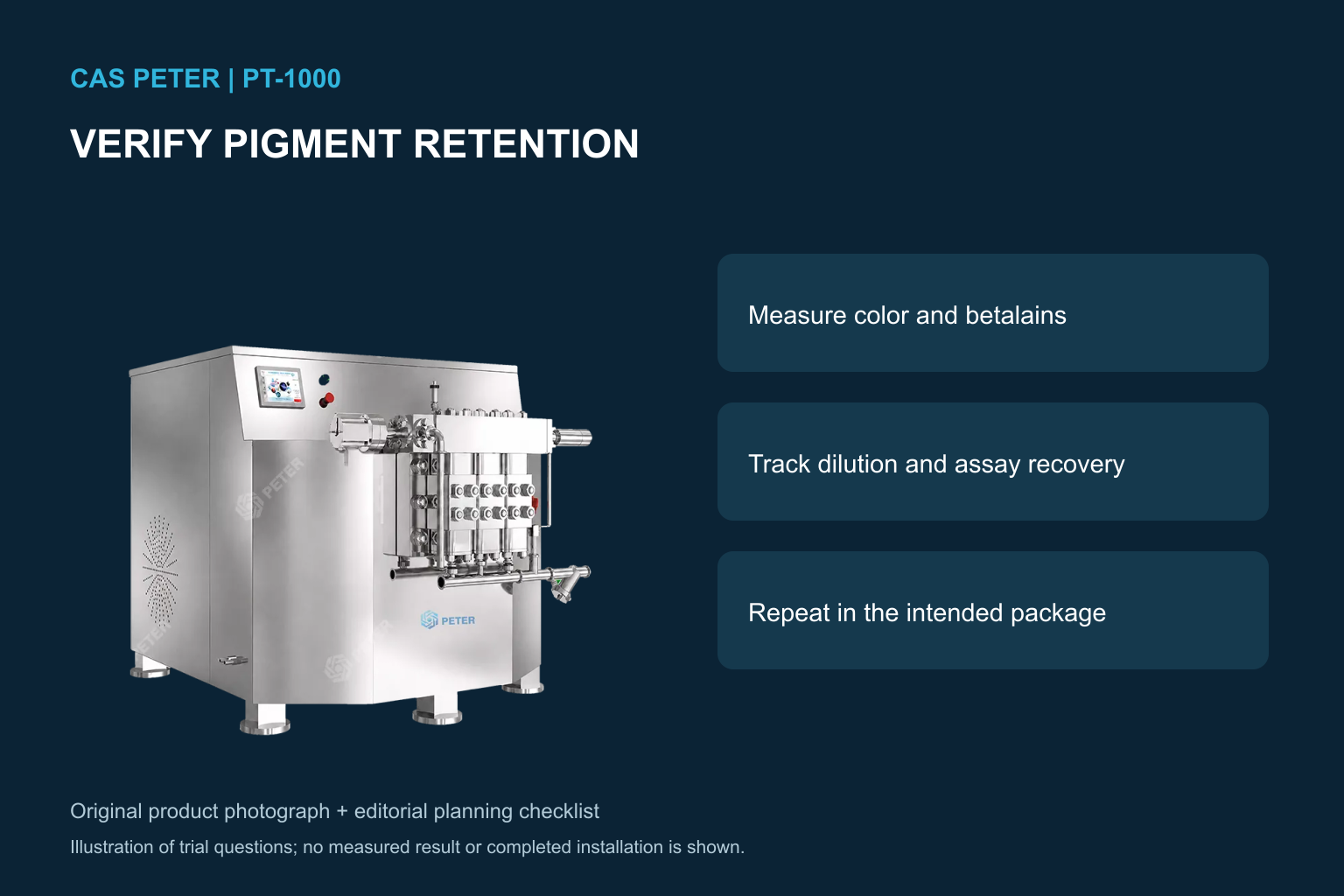
Keep process-day retention and storage retention as separate entries. Measure a clearly defined initial sample and later samples from matched packages. Record fill quantity, headspace, closure, light exposure and actual temperature history. Opening one bottle repeatedly is a different exposure from opening a fresh bottle at every sampling point.
Use the intended commercial package for the final comparison. A laboratory tube can help screen conditions but does not reproduce every storage variable. If an accelerated comparison is used, identify it as a stress test. Do not declare a commercial shelf life from that test without an appropriate validation for the product and its quality and safety requirements.
The blueberry pigment-retention article provides a complementary example of separating an analytical pigment endpoint from appearance. Its anthocyanin findings should not be treated as betalain data. The useful shared principle is the discipline of matched sampling, not a transferable recipe for unrelated pigments.
This NPTEL food-rheology lesson helps explain the separate physical-flow measurements used when comparing juices. It is background education on rheology, not a betalain preservation protocol or evidence of microbial inactivation.

Educational source: NPTEL IIT Kharagpur. Watch the lesson on YouTube.
Connect equipment selection to the verified process
The CAS PETER PT-1000 product page is a production-equipment reference for discussing a larger-scale juice process. The photograph accompanying this article identifies that catalogue model; it does not show a documented beetroot installation or prove compatibility with a particular recipe. Confirm the configuration and operating envelope with the supplier before a trial.
Prepare an inquiry containing feed preparation, pulp and solids information, viscosity at relevant temperatures, batch quantity, desired throughput, pressure-trial scope and available cooling utilities. Include cleaning requirements and the sample quantities needed by the laboratory. Explain which physical and pigment endpoints must pass together, so equipment discussion follows the actual product target.
When moving from a laboratory result to production, repeat the comparison with the expected residence and holding history. Record the recovered quantity, start-up material and any rejected stream. Preserve the traceability between raw lot, processing record, package and assay. A production decision should be reviewable from those linked records rather than from one attractive photograph.
Frequently asked questions
Does a brighter red juice prove better betalain retention?
No. Visible color is influenced by sample presentation and suspended material as well as pigments. Compare a defined color method with a suitable betalain assay on matched samples, and account for dilution before interpreting the result.
Should additional homogenizer passes always be used?
No. Additional passes change the treatment history and can add heat and handling time. Compare each condition against the stated product target, and retain the simpler condition when extra treatment gives no verified benefit.
Can published beetroot results establish my product shelf life?
No. Published findings apply to their investigated material and conditions. Validate the intended formulation, process, package and storage conditions, with quality and microbial safety assessed through appropriate separate requirements.