

Coenzyme Q10 Homogenization: Identify the Carrier Before Comparing Stability
Coenzyme Q10 homogenization should begin by identifying what the formulation actually contains: carrier-oil droplets, lipid vesicles, or another dispersed CoQ10 system. These structures can produce similar-looking particle-size reports while requiring different evidence for stability. Record the full recipe and preparation route, then evaluate physical structure, recoverable CoQ10 and storage behavior separately. A smaller measured size is not proof of improved encapsulation, chemical retention or biological performance. For equipment trials, use a clearly defined carrier system and compare processing conditions within that system before making comparisons across different formulations.
Why the carrier definition comes before the pressure setting
A request for a “CoQ10 nanoemulsion” can leave important formulation details unresolved. Ask whether CoQ10 is dissolved in an added carrier oil, incorporated into a phospholipid vesicle, or dispersed using a different preparation route. The answer determines what the machine is being asked to change and what the laboratory must measure afterward.
Write a material description that lists the active ingredient, water phase, surfactants, carrier lipids, cosolvents and any other stabilizers. Include their basis of addition and the order of preparation. Do not use the presence of one ingredient, or the commercial name of a premix, as sufficient proof of the final structure.
The same caution applies to a size report. A hydrodynamic size measurement can be useful for comparing suitably prepared samples, but it is not a photograph of their internal architecture. Assigning a carrier category requires the recipe, processing history and appropriate structural evidence together. If the structure has not been established, describe the sample as a dispersion rather than claiming a confirmed liposome or a specific delivery mechanism.
Two studies illustrate different systems
A primary study of lipid-free nano-CoQ10 used hot high-pressure homogenization with different surfactants. It assessed particle properties using several methods, including thermal analysis and cryogenic microscopy. The formulation category matters: evidence from that system cannot simply be relabeled as evidence for carrier-oil nanoemulsions or phospholipid liposomes. Its animal findings also do not establish a human benefit for a different product.
A study of CoQ10 nanoliposomes combined an initial liposome preparation route with high-pressure microfluidic processing. It examined morphology, size, encapsulation and storage. The reported initial encapsulation results did not show a statistically significant difference between the pressure-treated groups and their untreated control, despite changes in other particle characteristics. This is a useful reminder that different endpoints can respond differently.
Neither study tests CAS PETER equipment. The liposome paper also states that industrial application and in vivo effects require further investigation. Use these papers to select questions and suitable analytical methods; do not copy their formulation, pressure schedule or storage result into a manufacturing guarantee.
Define the claim each measurement is allowed to support
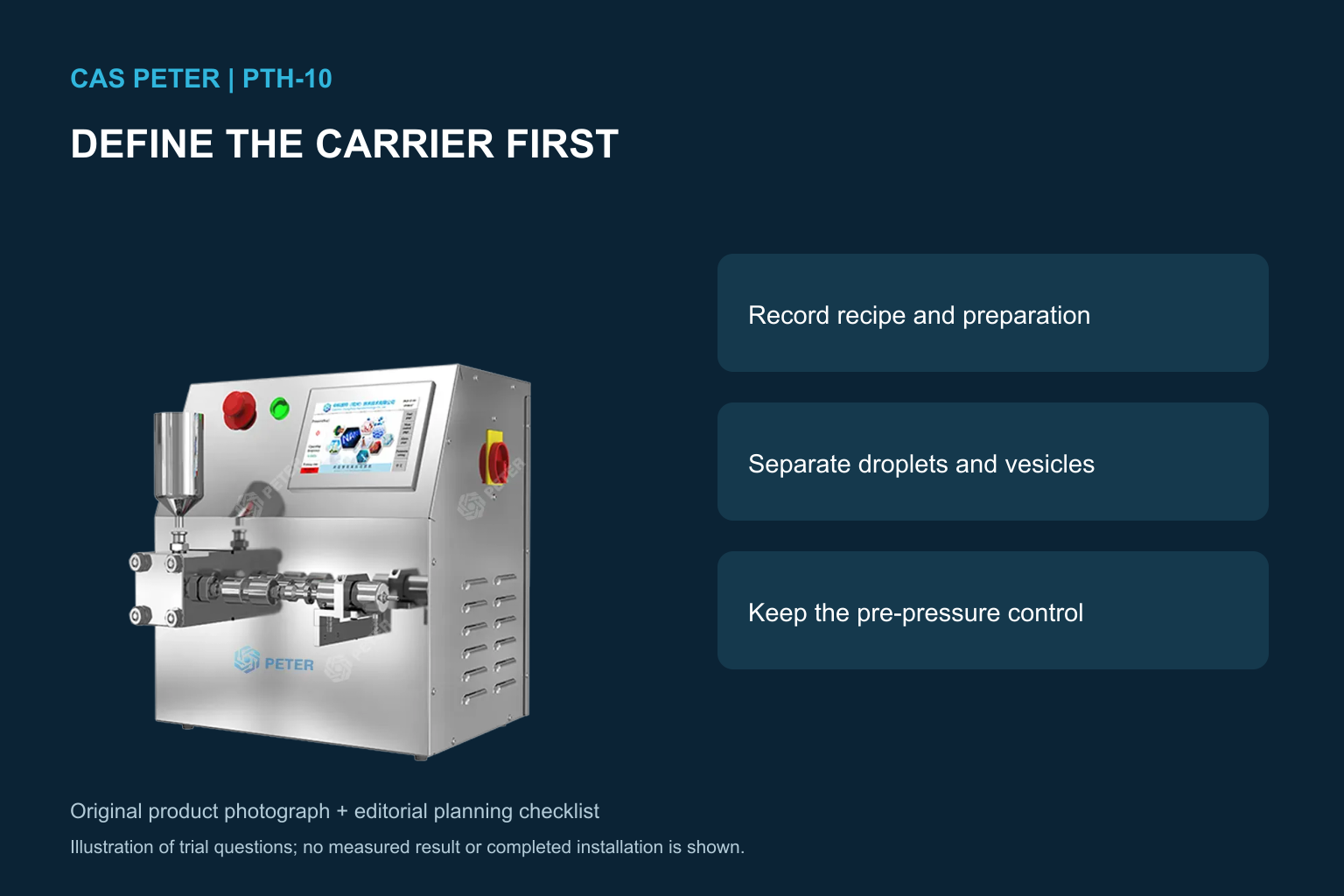
Separate the trial objectives before collecting samples. “Stable” might mean no visible separation, limited change in measured size, retention of total CoQ10, retention of an associated fraction, or acceptable performance after a downstream operation. These are different claims, and a trial can pass one while failing another.
Physical appearance is a useful observation when recorded consistently, but it does not measure the full active content. Likewise, total recoverable CoQ10 does not establish where that material resides. A carrier-associated fraction can change even if the total amount remains similar. Discuss the separation and extraction methods with the laboratory before adopting terms such as encapsulation efficiency.
For a storage comparison, write down the sample container, light exposure, temperature, headspace and sampling schedule. Use independent containers where repeated opening would change the experiment. Label observations from an accelerated condition as observations from that condition, rather than converting them into an unsupported room-temperature shelf life.
Prepare controls that keep formulation effects visible
Start with a documented parent preparation and retain a control before the pressure step. That control should have the same relevant pre-processing history as the treated material. In a multistep preparation route, do not attribute the complete result to the last machine while ignoring mixing, solvent removal, hydration or cooling performed earlier.
If surfactant or carrier composition changes, make that a separate formulation comparison. Changing pressure and emulsifier content simultaneously can produce an attractive result without revealing which change matters. A staged approach can screen recipes first and then compare equipment conditions within the most relevant recipes.
Keep the material concentration and sampling basis consistent. Small batches can be affected by material held in tubing, collection vessels or the processing unit. Record feed mass, recovered sample mass and any rinse addition. An assay expressed per milliliter may be misleading if recovery and dilution differ between groups.
Select a practical characterization sequence
| Question | Evidence to plan | What it cannot establish alone |
|---|---|---|
| What carrier is present? | Recipe, preparation history and suitable structural characterization | A size average alone does not identify the carrier |
| Did pressure processing change the distribution? | Comparable size results and a view of coarse material where relevant | A smaller mean does not prove better active recovery |
| How much CoQ10 is recoverable? | A validated total-content assay with extraction recovery checks | Total content does not locate the active inside a carrier |
| What fraction is carrier-associated? | A validated separation procedure and a clearly defined calculation | A percentage without recovery information can obscure losses |
| Does the intended product remain acceptable? | Matched storage and downstream application tests | One short observation does not validate shelf life |
This is a planning table, not a set of published acceptance limits. The linked studies support distinguishing particle structure and analytical endpoints. The actual methods and release criteria should be chosen for the specific carrier and intended product.
A sensible sequence begins with appearance and recovery records, then moves to particle characterization and active-content analysis. Reserve material for confirmatory microscopy or thermal analysis if the first results suggest a structural change. The goal is not to order every available test, but to prevent a key interpretation from resting on a measurement that cannot answer it.
Record heating and cooling as process variables
Some CoQ10 preparation routes include heating before pressure processing. Others begin with an already prepared colloidal carrier. These routes should not share an assumed thermal recipe. Confirm feed compatibility and temperature limits with the manufacturer and the formulation specialist before running the material.
Record the actual feed, outlet and collection temperatures, plus the delay before cooling or analysis. If repeated passes are used, record the history of each pass and the routing between them. A sample collected after several warm holding periods is not equivalent to one processed rapidly with controlled cooling, even if the nominal pressure is the same.
Avoid interpreting a clear sample at the processing temperature as proof that it remains unchanged after cooling. Characterize the product at its intended handling temperature and after a defined hold. If thermal analysis or microscopy is needed to investigate its physical state, retain the original preparation and document any changes introduced by sample preparation.
Read a storage result without combining different percentages
When reporting retention, identify what was compared with the initial value. Total CoQ10 concentration, recovered mass and an encapsulation-based retention index are not interchangeable. State the calculation basis and the relevant extraction or separation method so that another laboratory can interpret the number.
For example, unchanged initial encapsulation alongside a narrower size distribution would support a different conclusion from improved total active recovery. Neither result should be expanded into a claim of improved oral absorption. The liposome encapsulation measurement guide explains why fraction measurements need a defined analytical procedure.
If the product will be diluted, dried, blended or added to another formula, add that operation to the confirmation stage. Test the material in the actual receiving environment rather than assuming that stability in the original vial transfers to the finished application. The nanoemulsion stability testing guide provides broader context for keeping stress conditions and analytical endpoints separate.
Turn the formulation record into an equipment trial brief
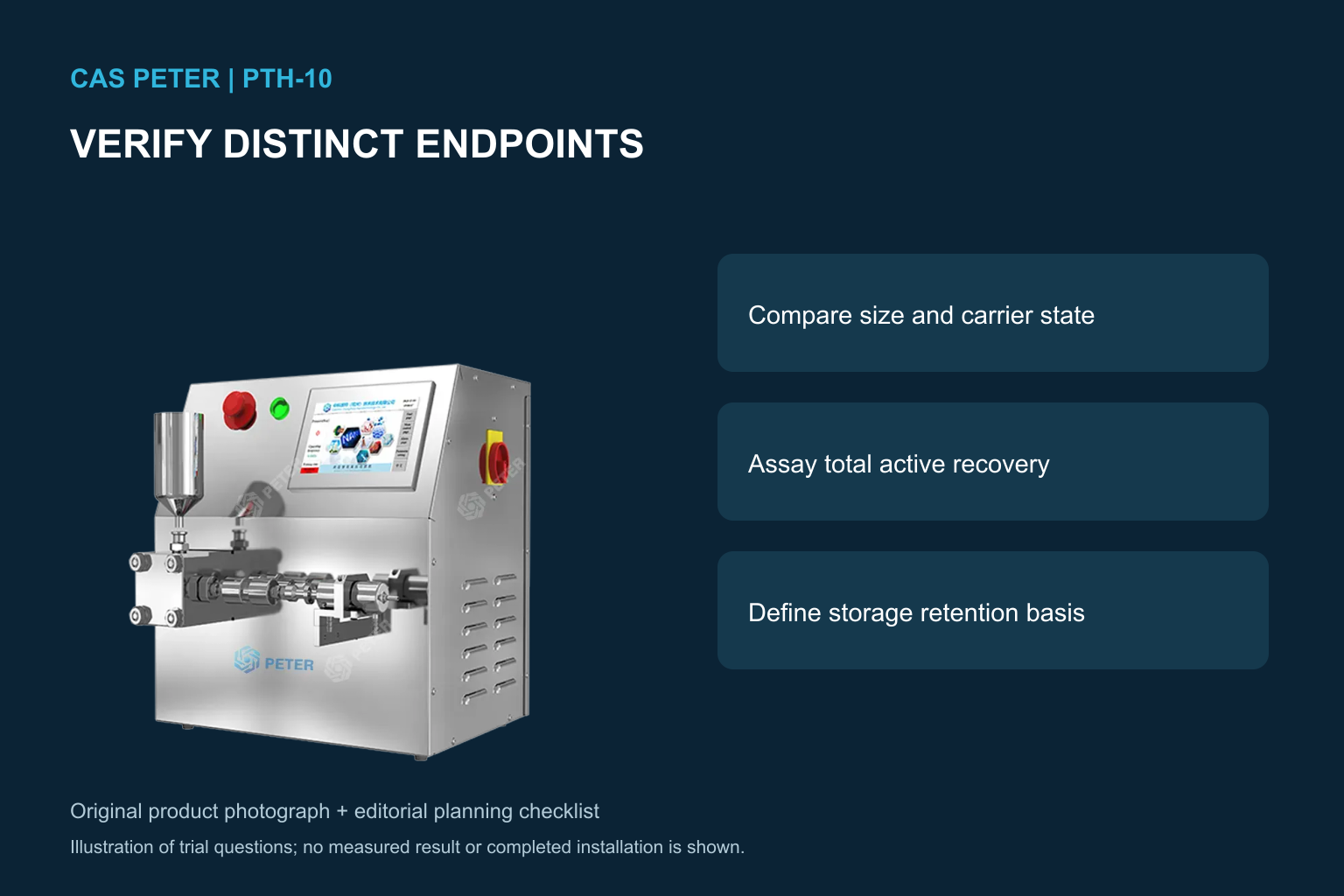
The CAS PETER PTH-10 product page provides an experimental-model starting point for a discussion with the supplier. It does not establish compatibility with every surfactant, solvent-containing preparation or liposome formulation. Confirm feed restrictions, contact materials, cleaning procedure, cooling arrangement and the installed configuration before agreeing on the trial.
Give the supplier the carrier description and the acceptance question together. A brief that asks only for the smallest possible size can encourage an unhelpful optimization target. A stronger brief states which particle, recovery and application criteria must be met, and identifies measurements that will be performed independently.
Plan sample quantities around the complete analytical schedule. Include preparation controls, processed groups, storage samples and reserve material for repeat analysis. If sample availability limits the design, reduce the number of processing conditions rather than dropping the control or the active-content measurement that makes the result interpretable.
Before scale-up, repeat the chosen condition with an independent preparation. Review recovered material, temperature history, cleaning practicality and downstream behavior along with the size report. The broader emulsion homogenization guide can help frame equipment questions, while the carrier-specific measurements remain essential to the CoQ10 decision.
Further learning: emulsion fundamentals
The following NPTEL lesson is neutral background on emulsion technology. It helps explain why formulation and interfaces matter during droplet processing. It does not identify the structure of a particular CoQ10 sample or validate an encapsulation or biological claim.
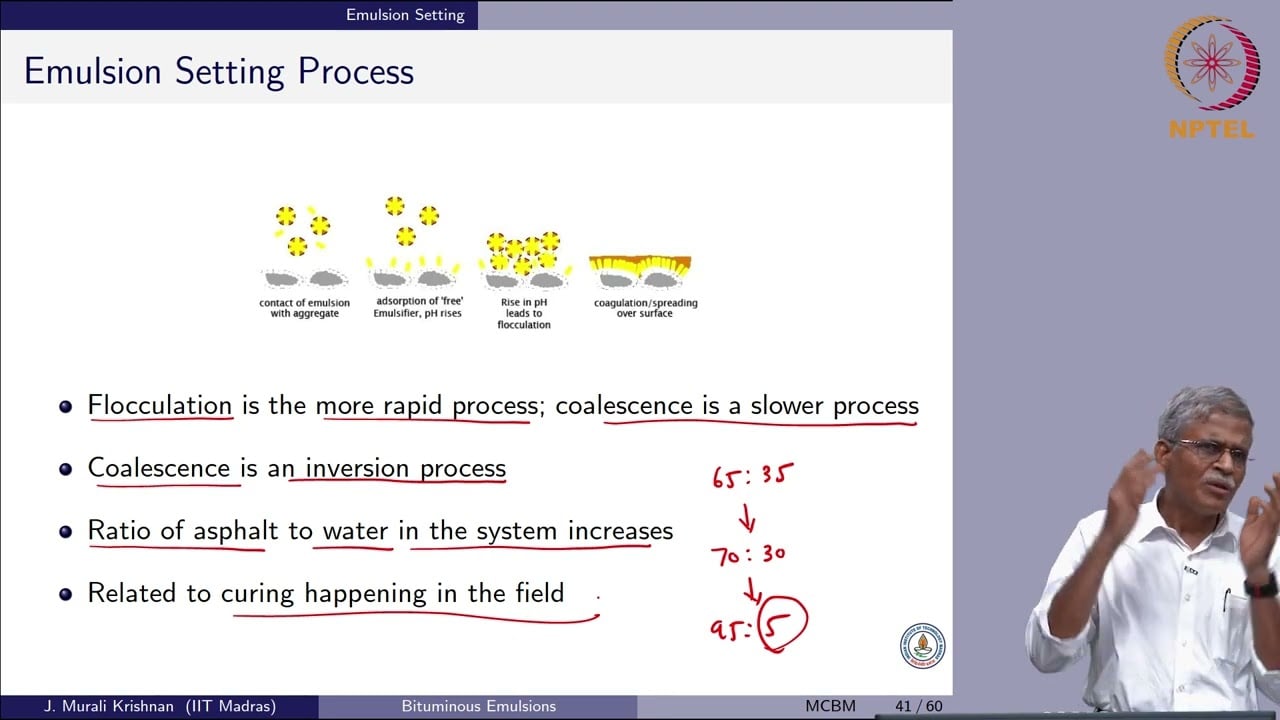
Educational source: NPTEL-NOC IITM. Watch the lesson on YouTube.
Frequently asked questions
Is every homogenized CoQ10 dispersion a nanoemulsion?
No. The formulation may involve added carrier-oil droplets, lipid vesicles or another dispersed system. Use the recipe, preparation history and appropriate structural evidence to identify the carrier rather than relying on a small size result alone.
Does smaller size prove higher CoQ10 encapsulation?
No. Size and encapsulation are separate endpoints. Encapsulation requires a suitable separation and assay procedure with a stated calculation basis. Compare it with total active recovery and physical characterization before deciding what changed.
Can a published CoQ10 processing condition be used directly?
A published condition belongs to its reported formulation, equipment and preparation route. Use it as research context, then confirm machine compatibility and design a controlled trial for the actual material instead of treating it as a validated manufacturing instruction.