

Liposome Encapsulation After Homogenization: Measure Retention Beyond Particle Size
Liposome encapsulation after homogenization must be assessed through intact cargo recovery and a validated distinction between free and vesicle-associated material. Particle size alone cannot show how much compound remains usefully retained. Compare feed and treated samples using the same analytical preparation, record recovered quantities rather than concentration alone, and repeat the relevant measurements after storage. Pressure, passes, formulation, temperature history, and downstream separation all belong in that comparison. This guide explains how to define a retention-focused trial; it does not recommend a universal liposome recipe or establish pharmaceutical suitability for a particular machine or formulation.
Define what “encapsulated” means for the compound
Begin with the compound’s intended location in the formulation. A water-soluble compound may be intended for the internal aqueous space, whereas a lipid-associated compound may partition into the membrane. Surface association and nonspecific adsorption may also influence an analytical result. Define the fraction the method will report before calling it encapsulated. The same separation test may not distinguish every location or binding state.
Use precise labels in the report: total intact compound, free compound under the selected separation method, and compound associated with the recovered vesicle fraction. If the method supports a stronger interpretation of internal encapsulation, explain the validation that supports it. Avoid upgrading a convenient analytical fraction into a structural claim without the necessary evidence.
This is a different decision from choosing between size-reduction methods. The liposome homogenization versus extrusion guide addresses that wider comparison. Here the purpose is to determine whether a selected operation preserves a useful cargo-bearing preparation while meeting its physical specification.
Read size-reduction studies with their formulation boundaries
A review of liposome formation and control factors explains that preparation and downsizing outcomes depend on process conditions and the starting lipid system. Its relevance is the need to evaluate the entire formulation, not a claim that one pressure fits all liposomes. Lipid composition, medium, initial vesicle population, and exposure history belong in the experimental record.
A quercetin-loaded liposome study evaluated high-pressure processing against both size and encapsulation outcomes. The research also uses several complementary characterization techniques. That is useful evidence for combining measurements. Its numerical optimum belongs to that particular formulation and apparatus; it cannot be applied directly to a different compound, lipid mixture, or CAS PETER model.
A smaller size can therefore be a promising intermediate observation, but the trial must still answer the cargo question. Do not infer improved loading, controlled release, biological activity, or storage stability from a size distribution. Each of those claims requires its own appropriately designed measurement and scope.
Distinguish encapsulation efficiency, loading, and recovery
Encapsulation efficiency, loading, and recovery answer different questions. State the definitions used in the project because terminology varies across methods. A practical report should identify the measured numerator, its denominator, and the point in the process to which each refers. This prevents an apparently improved percentage from concealing lost compound or lipid.
For example, a project may define encapsulation efficiency as the amount assigned to the retained fraction divided by the total amount of intact compound in the same sample, multiplied by 100. Recovery may instead compare the amount of intact compound collected after processing with the amount entering processing. These are definitions for a specific analytical plan, not universal standards. The separation and assay must support the interpretation.
Consider a deliberately hypothetical calculation: a feed contains 100 mg of intact compound, while the collected preparation contains 80 mg in total, of which 48 mg is assigned to the retained fraction. Under the definitions above, efficiency is 60% and total recovery is 80%. Only 48% of the feed amount is assigned to retained cargo. These invented numbers illustrate the arithmetic; they are not experimental results, target values, or equipment performance.
When volume changes, calculate amounts from the measured concentration and the corresponding volume, including documented dilution factors. Keep units consistent. Record removed samples, rinses, and collection losses when they materially affect the balance. A higher final concentration after evaporation or volume reduction does not establish a higher recovered amount.
Validate the free-versus-retained separation
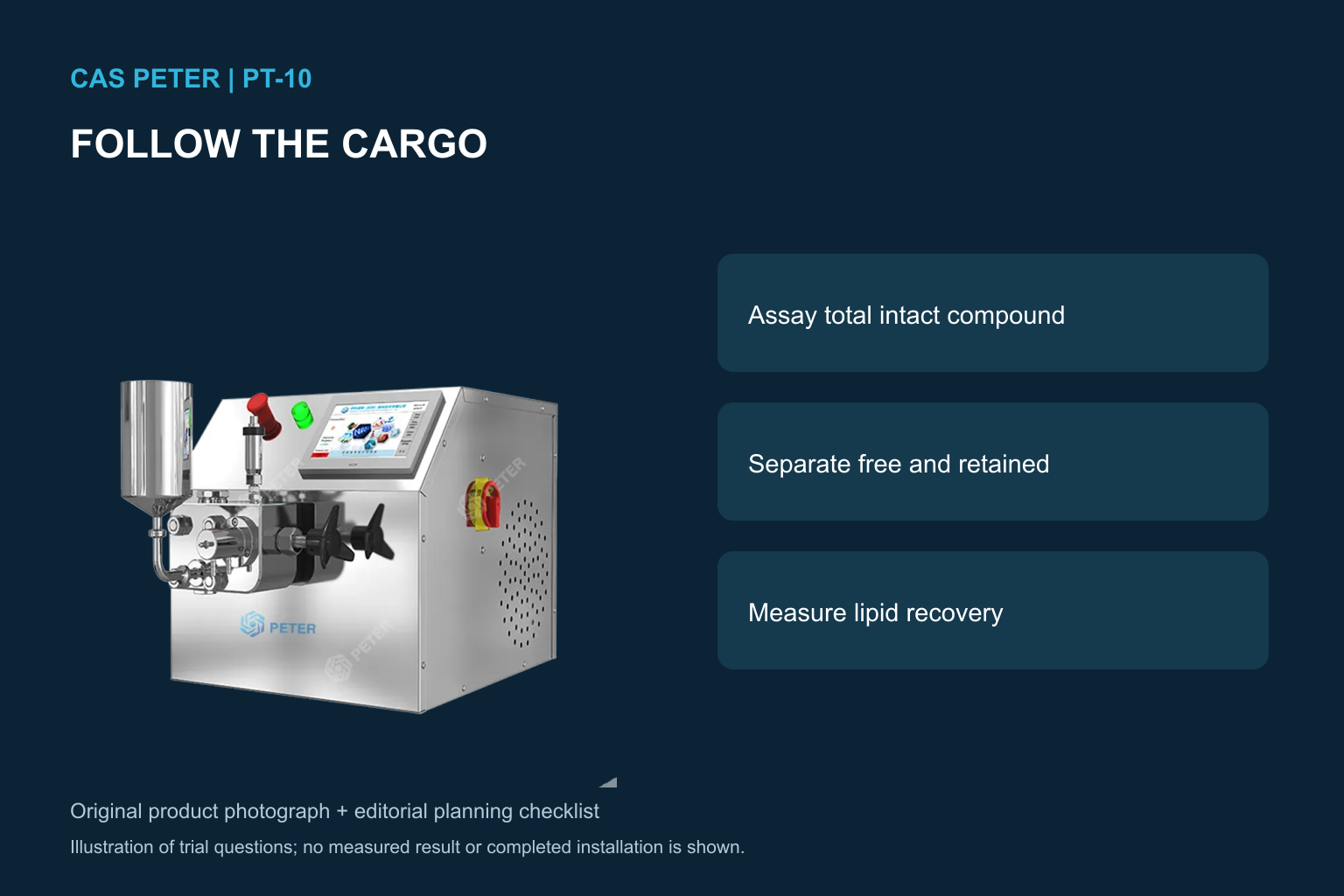
A separation method is part of the measurement, not an invisible preliminary step. Size exclusion, membrane separation, centrifugation, and other approaches can affect vesicles and compound recovery differently. Select a method suitable for the particular formulation and demonstrate its relevant performance. A protocol borrowed from another cargo is a starting candidate, not automatic validation.
Include free-compound controls to investigate adsorption and passage through the separation system. Include a suitable vesicle control to examine recovery and possible disruption during handling. Assess whether diluted or processed samples require different preparation and whether that difference changes the reported fraction. If recovery is incomplete, identify the limitation rather than silently normalizing every sample to an assumed complete balance.
Use a total-compound assay after an appropriate, validated disruption or extraction procedure. Confirm that it measures the intact compound of interest and performs acceptably in the lipid matrix. If degradation products contribute to the signal, a nominally stable concentration may conceal loss of the original compound. Address selectivity within the laboratory method before using the result to choose a processing condition.
Design the pressure comparison around a retention endpoint
Use a documented starting preparation and retain an untreated portion under matched elapsed-time and handling conditions. Record the actual process arrangement, including single-pass or recirculation operation. In a recirculated batch, the nominal pass count may not describe identical exposure for every portion of material. State how the exposure is defined rather than implying a perfectly uniform history.
Record feed and outlet conditions, collection quantity, processing time, cooling arrangement, and sampling delays. Temperature can matter to both lipid behavior and cargo stability, but the appropriate limits are formulation-specific. Agree on the allowable range through formulation evidence and equipment review. Do not assign a universal temperature threshold from the model name or from a different lipid system.
The qualitative table below organizes a retention-focused comparison. It is an editorial decision aid informed by the cited research and analytical distinctions, not a validated operating protocol.
| Measurement pair | What it helps distinguish | Required context | Possible next decision |
|---|---|---|---|
| Size distribution and intact cargo recovery | Physical refinement versus compound loss | Identical sample preparation and collection basis | Stop increasing exposure if recovery becomes unacceptable |
| Free and vesicle-associated fractions | Redistribution of cargo under the defined method | Validated separation and adsorption controls | Investigate leakage or method bias before reformulation |
| Cargo amount and lipid amount | Compound loss versus loss of the carrier fraction | Suitable assays and a common process reference | Identify which material stream requires recovery work |
| Immediate and stored measurements | Initial acceptability versus later change | Same package, medium, temperature, and time points | Move only suitable candidates into longer stability testing |
| Untreated and handled controls | Equipment exposure versus ordinary holding loss | Matched timing and transfers | Improve handling before expanding the pressure matrix |
Set the stopping rule before the comparison. A candidate condition should meet the stated size requirement while preserving the required retained amount and acceptable handling. The smallest possible size is not automatically the best endpoint. If another pass changes size only slightly while worsening the cargo balance, it needs a specific justification to remain in the process.
Combine physical measurements with structural evidence
Keep the size-distribution basis and instrument quality indicators. Report sample dilution, medium, temperature, and time after processing. Where DLS is used, retain the relevant distribution and analysis settings rather than reporting only a single favorable number. The guide to DLS and laser diffraction explains why measurement principles and sampled populations matter.
Size data do not independently prove a closed vesicle population, a particular number of bilayers, or cargo location. Select additional characterization according to the claim that matters. Microscopy or another appropriate structural method may help investigate unexpected populations, but its sample preparation also needs to be understood. A visually attractive image cannot substitute for a quantitative cargo balance.
If a retained fraction contains aggregates or other particles, acknowledge the possible interference. A separation method that retains material is not necessarily specific to intact liposomes. Use a combination of methods sufficient for the project’s decision, and narrow the conclusion when the available evidence cannot resolve the structure.
Repeat the retention check after downstream handling
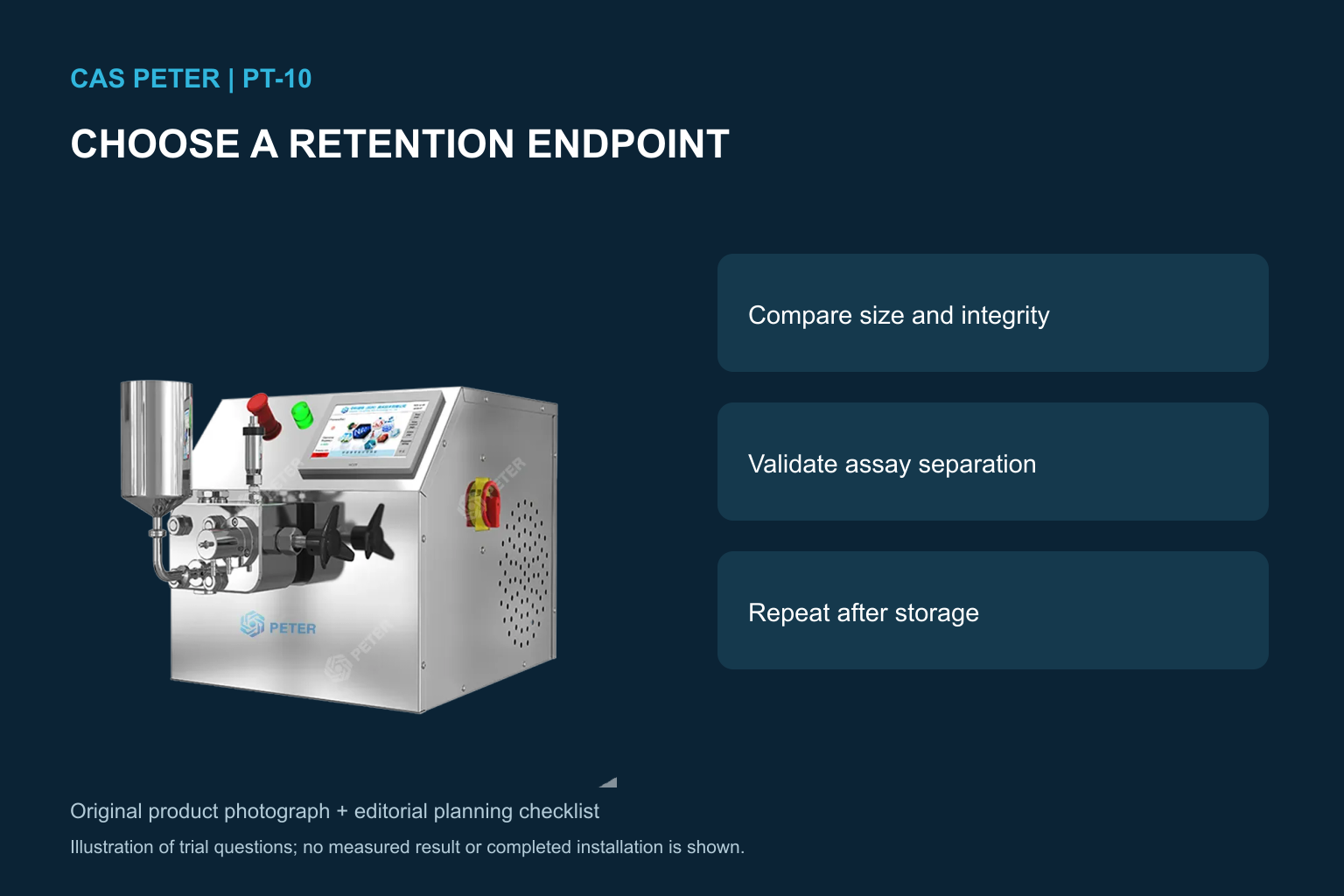
Measure after the steps that the product will actually experience: purification, concentration, dilution, transfer, filling, and storage, as applicable. Separate the process positions so that losses can be located. A satisfactory post-homogenization sample does not establish that the material remains satisfactory after membrane contact or a change in medium.
Keep the intended concentration and storage container in the comparison. Define observation times before examining the results and preserve independent containers when repeated sampling would alter the conditions. Record appearance, size, intact compound, and the retained fraction using consistent methods. Add formulation-specific quality tests when required by the intended application.
A retention result also differs from a release result. Demonstrating that compound remains associated during storage does not demonstrate an intended release profile at the point of use. Conversely, a release test performed in a challenge medium cannot automatically be interpreted as unwanted storage leakage. Label the purpose and conditions of each test so that apparently conflicting results are interpreted correctly.
Turn the findings into an equipment trial brief
The CAS PETER PT-10 laboratory homogenizer page provides a real product reference for reviewing a laboratory-scale operation. It does not demonstrate cargo retention for the formulation discussed here. Confirm feed suitability, wetted materials, cleaning, collection arrangement, working volume, and temperature-control options before scheduling a machine trial. Obtain the applicable configuration details for the actual unit.
Provide the supplier with the formulation description, starting size population, solvent or medium, batch quantity, permitted exposure conditions, and the analytical endpoint. Include any pharmaceutical or application-specific requirements explicitly rather than assuming that a general product description establishes compliance. The equipment proposal should be evaluated against the intended workflow and its evidence requirements.
The emulsion and dispersion support overview supplies broader process context, although liposomes require their own structural and cargo measurements. Retain the proposed homogenization step when the matched trial demonstrates a useful overall result. Document the tested boundary so that later changes in lipid composition or cargo trigger a review rather than inheriting an unsupported recipe.
Further learning: liposome fundamentals
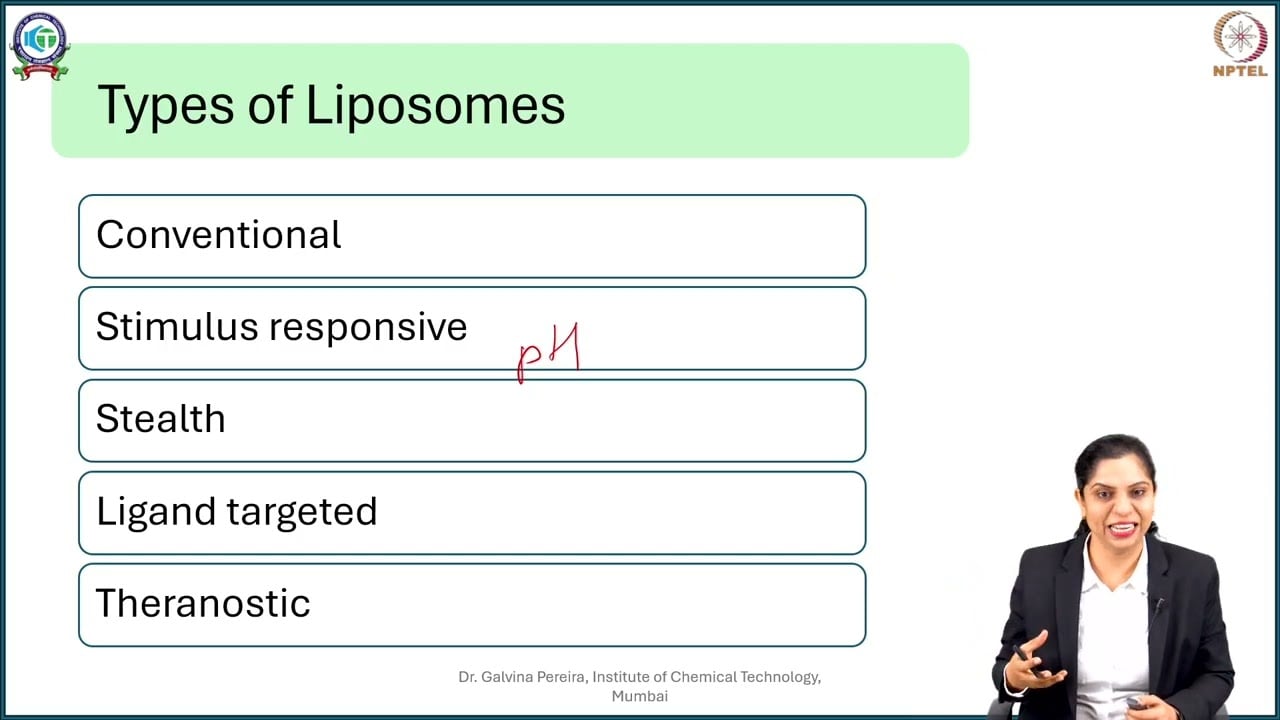
The NPTEL IIT Bombay lecture below introduces liposomes as a carrier system. It provides background for understanding the difference between a vesicle and the compound it carries. It is educational material, not a validation study for this formulation or the referenced equipment.
Educational source: NPTEL IIT Bombay. Watch the lesson on YouTube.
Frequently asked questions
Does a smaller liposome size prove better encapsulation?
No. Size measures a physical population under the measurement conditions. Evaluate intact cargo, a validated free-versus-retained separation, and recovered amounts before concluding that encapsulation improved.
Can encapsulation efficiency rise while useful cargo recovery falls?
Yes. A percentage based on the remaining preparation can rise after other material is lost. Report both the retained fraction and the amount recovered relative to the defined feed reference.
Can a published pressure optimum be reused for another liposome formula?
It should be treated as a formulation-specific research result. Different lipid systems, cargo, equipment, and thermal histories require their own controlled comparison and analytical acceptance criteria.