

Faba Bean Protein Homogenization: Compare Isolate and Concentrate Before Emulsification
Faba bean protein homogenization should be evaluated separately for protein isolate and protein concentrate before either ingredient is selected for an emulsion. Match the actual protein concentration, hydration history and water conditions, then measure dispersibility and residual solids alongside particle size. An isolate result cannot establish how a concentrate containing more non-protein material will behave. The useful purchasing question is whether a particular ingredient and process produce the required finished beverage or emulsion, with acceptable texture, separation and handling. A smaller fresh particle measurement alone does not answer that question.
Why ingredient identity comes before pressure
Two powders sold as faba bean protein can have different processing histories and compositions. Obtain the supplier’s specification, lot identification, protein basis and information on other constituents. Record whether protein content is reported on a dry or as-received basis. The same powder addition can give different amounts of actual protein, making an apparently simple isolate-versus-concentrate comparison misleading before homogenization begins.
Use two comparisons when both cost and functionality matter. A matched-protein comparison asks how the ingredients perform at equal protein content. A matched-powder comparison asks what happens at the same ingredient addition. These answer different development questions. Label them clearly and calculate the formulation from the actual lot documentation. Do not attribute a difference caused by unequal protein content solely to the homogenizer.
In the original isolate-and-concentrate research reproduced in the author’s university thesis, homogenization improved the tested isolate’s particle size and dispersibility more strongly than the concentrate. Their responses to heating also differed. This supports testing the two ingredients separately; it does not establish a universal ranking of every commercial isolate and concentrate. Extraction history, composition and the laboratory’s measurement definition remain part of that result.
Establish a reproducible hydration baseline
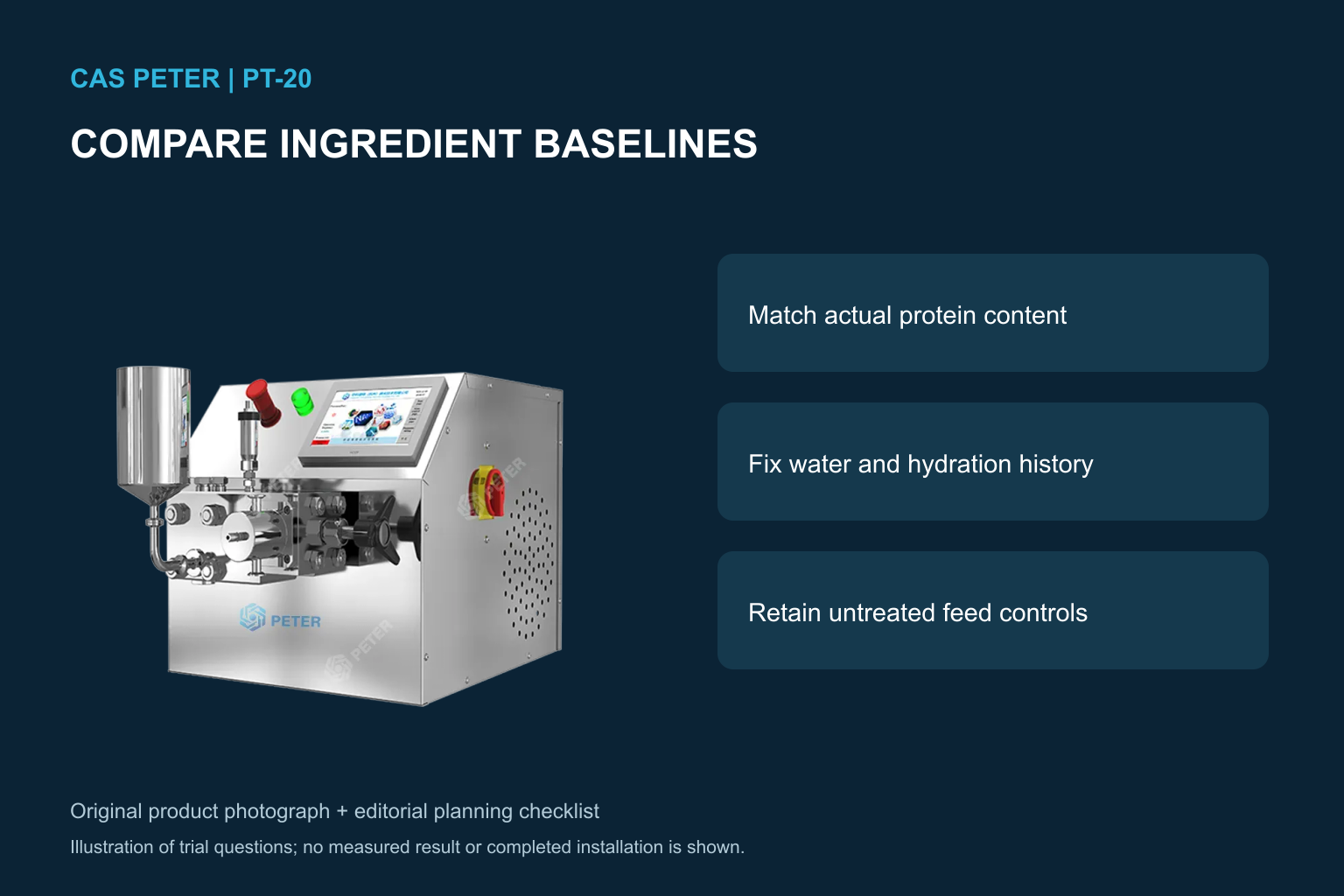
Start with the water used for development or production, documenting its source and relevant composition. Fix the powder addition sequence, mixing conditions, hydration time and temperature. Measure pH after hydration rather than assuming that the ingredient has left the water unchanged. Retain a sample of each hydrated feed before pressure processing. This baseline helps identify whether the most important change occurred during powder preparation.
Visible lumps deserve investigation before increasing pressure. They may indicate inadequate wetting, unsuitable mixing or an ingredient that cannot be hydrated under the selected conditions. Check feed suitability with the equipment supplier. Passing a visibly heterogeneous feed through a small processing passage is not an appropriate substitute for understanding the material or confirming the machine’s feed limits.
Keep the time between hydration and sampling consistent. If one sample rests overnight and another is processed immediately, their difference may reflect hydration or settling history. Record any foam and use a sampling approach that represents the bulk dispersion. A conveniently clear top sample can hide the insoluble portion that will later affect product texture or sediment formation.
Separate ingredient treatment from emulsion manufacture
A protein dispersion contains hydrated protein and potentially other solids. An oil-in-water emulsion introduces an interface that must be formed and stabilized. Homogenizing the ingredient before oil addition and homogenizing the complete emulsion are separate operations. Build the first experiment around one operation so that the interpretation remains useful.
For an ingredient-treatment experiment, compare untreated and processed protein dispersions, then prepare emulsions from them using the same downstream method. For an emulsion-process experiment, use the same hydrated protein feed and vary the complete-emulsion processing step. Avoid changing both operations simultaneously unless the purpose is explicitly to screen an entire processing route rather than identify a mechanism.
A study of ultrasound-extracted faba bean protein emulsions evaluated a specifically extracted ingredient under controlled formulation conditions. It reinforces the importance of linking ingredient history with the emulsion test. Its observations are not a pressure recipe for commercial powders, and ultrasound-assisted extraction is not a feature to assume in an ordinary purchased isolate.
The broader plant protein homogenization trial guide explains how to frame this distinction across ingredients. Use it to structure the experiment, while keeping the present comparison focused on faba bean isolate and concentrate rather than copying another pulse protein’s settings.
Use a comparison matrix with independent endpoints
The following matrix is an editorial trial framework. It provides no universal numerical acceptance limits. Choose criteria from the intended product, the analytical method and the equipment configuration before starting the experiment.
| Development question | Keep comparable | Measure separately | Decision supported |
|---|---|---|---|
| Does ingredient choice change hydration? | Water, addition method, time and temperature | pH, visible solids and representative dispersion properties | Whether preparation needs adjustment before processing |
| Does pressure improve the protein dispersion? | Actual protein concentration and sampling history | Full particle distribution, sediment and operational dispersibility | Whether the ingredient-treatment step has a useful effect |
| Does the treated protein stabilize the emulsion? | Oil phase and downstream emulsification procedure | Droplets, flocs, separation and texture | Whether ingredient treatment benefits the complete formula |
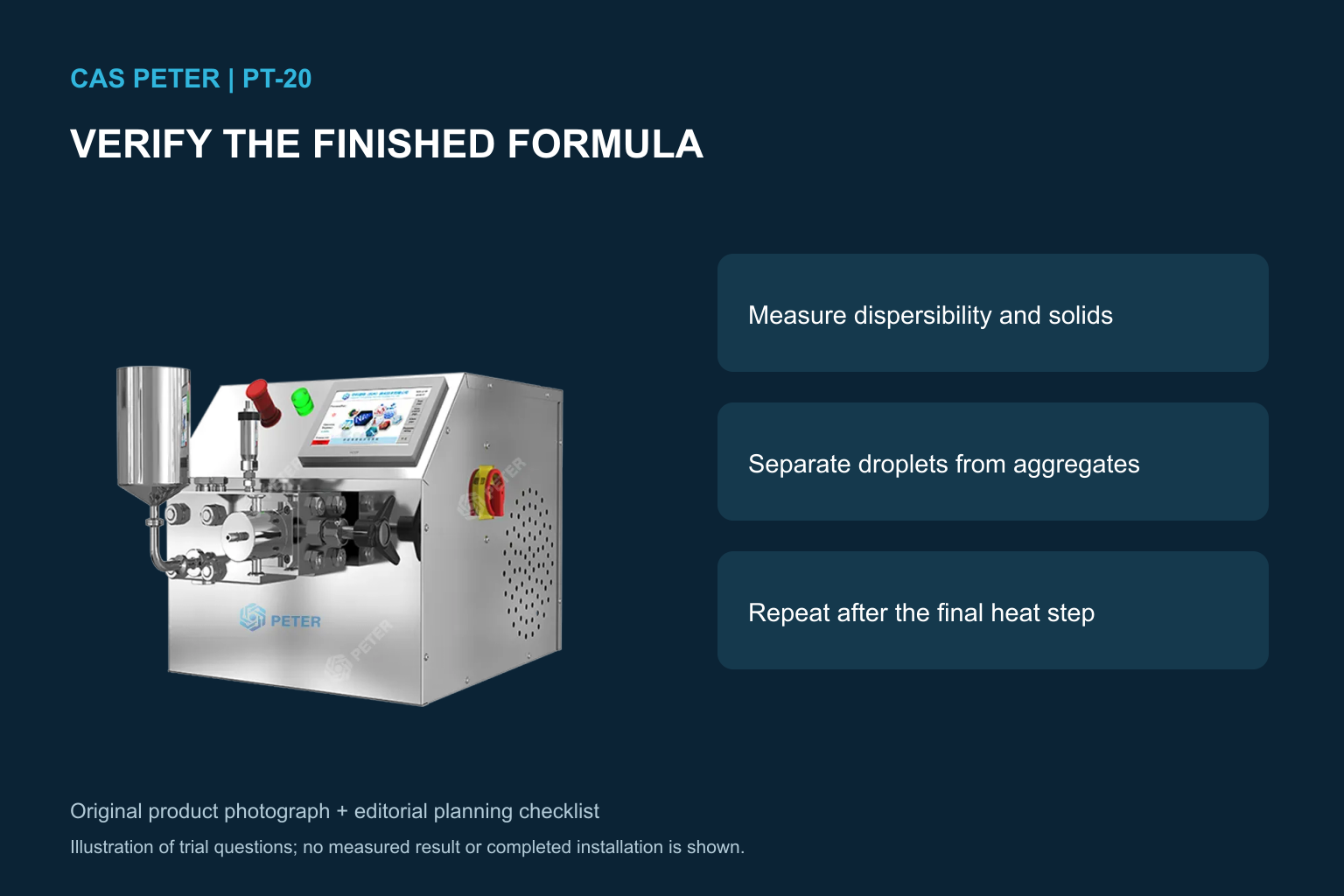
| Does the process survive final heating? | Heating, cooling, package and observation time | Post-heat aggregation, sediment and product function | Whether the selected route meets the actual process requirement |
| Is the result practical at larger scale? | Defined material specification and endpoint | Thermal history, handling losses and repeatability | Whether a scale trial is justified |
Do not combine all outcomes into an unexplained stability score. A dispersion can become easier to suspend while giving an emulsion with unacceptable viscosity. Conversely, a change in apparent particle size may accompany useful product performance. Define which property matters commercially and retain the supporting measurements that explain the trade-off.
Read dispersibility without overstating solubility
A reported soluble or dispersible fraction depends on how the sample was separated and analyzed. Record centrifugation conditions, temperature, sampling location and protein assay. Check that the assay is suitable for both ingredient matrices. Non-protein constituents and differences in sample preparation can complicate a comparison that otherwise appears precise.
Use consistent language in the development report. If protein was measured in a supernatant after a defined separation, report that operational result. Do not describe every protein molecule as individually dissolved unless the method supports that conclusion. The guide to protein dispersion and dissolution offers complementary measurement context without replacing ingredient-specific testing.
Inspect the material excluded from the supernatant as well. Its amount, appearance and behavior after gentle redispersion can help explain texture or sediment problems. Keep photographs under consistent conditions and connect each image to a sample identity. A photograph is a useful observation, but it cannot replace quantitative protein analysis or a documented particle measurement.
Measure complete distributions and identify the particles
Particle measurements can include protein aggregates, oil droplets, flocs and other solids. State what is in each sample and how it was diluted. When an emulsion measurement changes, use microscopy or another suitable method to investigate whether droplets themselves changed or whether aggregation altered the apparent distribution.
Retain the distribution and its coarse portion, not just a single mean. Use the same measurement settings for a valid comparison and document any necessary deviations. If dilution changes the state of aggregation, that change belongs in the interpretation. An attractive diluted result does not automatically describe the concentrated beverage in its package.
Compare immediately after processing and after the defined rest or storage period. Sample systematically when separation occurs, recording whether the test represents the whole container or one layer. If remixing is allowed in the intended use, define the remixing procedure and evaluate recovery. If remixing is unacceptable, test the product as supplied.
Include temperature and the final formula
Record inlet and outlet temperatures, cooling arrangements, actual processing sequence and sample hold times. Pressure alone does not describe a complete treatment. If heating is part of the proposed process, include suitable controls that help distinguish its effect from the pressure-processing step. Confirm the temperature limits of the ingredient and selected equipment before testing.
Repeat the useful candidates in the final formulation, including the intended minerals, acidulants or other ingredients. Add them in the actual sequence. A model protein-water dispersion is valuable for investigation but cannot establish the behavior of a formulated drink through heat treatment, cooling and storage. Evaluate the endpoint after the final relevant manufacturing step.
Include application observations such as sediment, pourability and texture with the analytical results. Use a defined assessment procedure rather than informal descriptions from different observers. Keep product safety and microbiological qualification as separate requirements; homogenization performance should not be represented as proof of sterilization or shelf-life safety.
Turn the experiment into an equipment inquiry
Use the CAS PETER PT-20 product page as a starting point for discussing a trial configuration. Provide the ingredient specifications, batch size, actual solids and protein levels, preparation procedure, viscosity information, feed distribution and target endpoint. Ask the supplier to confirm feed suitability, wetted materials, cleaning approach and achievable operating conditions for that material.
Include the intended thermal step, available cooling and planned sampling points. State whether the goal is ingredient pretreatment, complete emulsion processing or both. These details make a trial proposal more useful than requesting the highest possible pressure. The product photograph illustrates the referenced model; it is not evidence of a validated faba bean installation.
For wider application context, consult the food homogenization support guide. Keep the final selection tied to representative material trials and repeatable finished-product results. Preserve unsuccessful runs as well as successful ones so that the operating window reflects actual variability rather than one favorable sample.
Educational background: forming an emulsion
The following NPTEL lesson introduces emulsion technology. It supports the distinction between preparing an ingredient and creating an oil-water interface; it is not a demonstration of this model or a validated faba bean recipe.
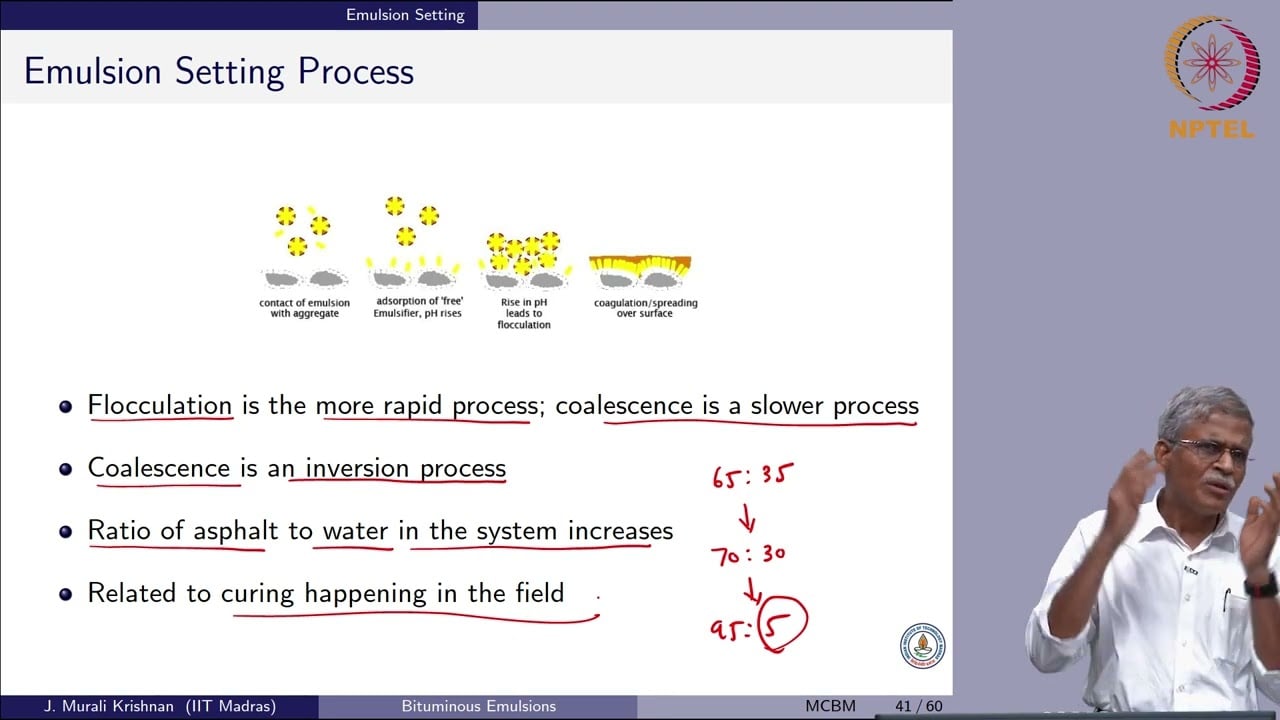
Educational source: NPTEL-NOC IITM. Watch the lesson on YouTube.
Frequently asked questions
Can an isolate trial predict concentrate performance?
It can suggest questions to test, but it cannot establish the concentrate’s response. Compare the actual ingredients under matched protein and preparation conditions, then evaluate their residual solids, dispersibility and final emulsion performance separately.
Should the smallest protein particle result win?
No. Select the route that meets the finished product’s requirements. Review the particle distribution together with dispersibility, sediment, texture, downstream heating and handling, using measurements appropriate to the particular ingredient matrix.
Does an improved dispersion establish beverage shelf life?
No. A dispersion trial addresses only part of product development. The final formula, processing sequence, package, storage conditions and independent safety assessment must also be qualified for the intended product.