

Hesperidin Nanocrystal Homogenization: Separate Premilling from Final Size Control
Hesperidin nanocrystal homogenization should be evaluated as a defined stage in a particle-size reduction route, with premilling documented separately. Compare the feed entering the homogenizer with the resulting suspension, then verify the coarse particle population, recovered hesperidin and behavior in the intended formulation. A small average particle size does not establish that homogenization alone produced the result. It also does not demonstrate chemical stability, microbiological quality or suitability for a particular use. The practical objective is a repeatable process whose contribution can be distinguished from ingredient preparation and stabilization.
Define the material and the claim
Hesperidin and hesperetin are different compounds. Confirm the identity of the starting material, its supplier documentation, assay basis and lot number before using a publication to support a trial. A paper about hesperetin should not be treated as direct evidence for a hesperidin formulation merely because the names and application areas are similar.
Define whether the target is a suspension of solid hesperidin particles, an emulsion containing an oil phase, or a more complex delivery system. These structures require different measurements. A scattering instrument does not identify chemical composition simply by returning a size value. Record the formulation components so the result can be interpreted in terms of the material actually present.
The nanocrystal and nanoemulsion comparison guide helps distinguish these targets. For this article, the focus is a solid-particle suspension and the contribution of premilling before homogenization. It does not provide a medical formulation, a recommended preservative system or instructions for clinical use.
What the published combination route establishes
An original hesperidin preparation study using antisolvent recrystallization describes a double homogenate system with rotating-speed settings. That route is distinct from pressure homogenization of an existing solid suspension. Its optimized preparation conditions cannot be transferred as a pressure recipe, and its results should not be attributed to a pressure homogenizer processing an arbitrary powder.
An original study of hesperidin isolation and nanocrystal formulations compares defined preparation systems, including a combination of premilling and high-pressure homogenization. Different compositions and processing histories are part of those comparisons. This is a reason to document each stage and excipient, rather than reduce the description to a single pressure setting. Findings in a particular formulation cannot establish a universal storage claim.
Treat these sources as evidence for experimental design, not as a specification for CAS PETER equipment. The machine configuration, feed properties, stabilizer system and downstream handling must be reviewed independently. In particular, do not transfer a premilling process’s contribution to the subsequent homogenization stage when describing the final result.
Preserve a sample before every size-reduction stage
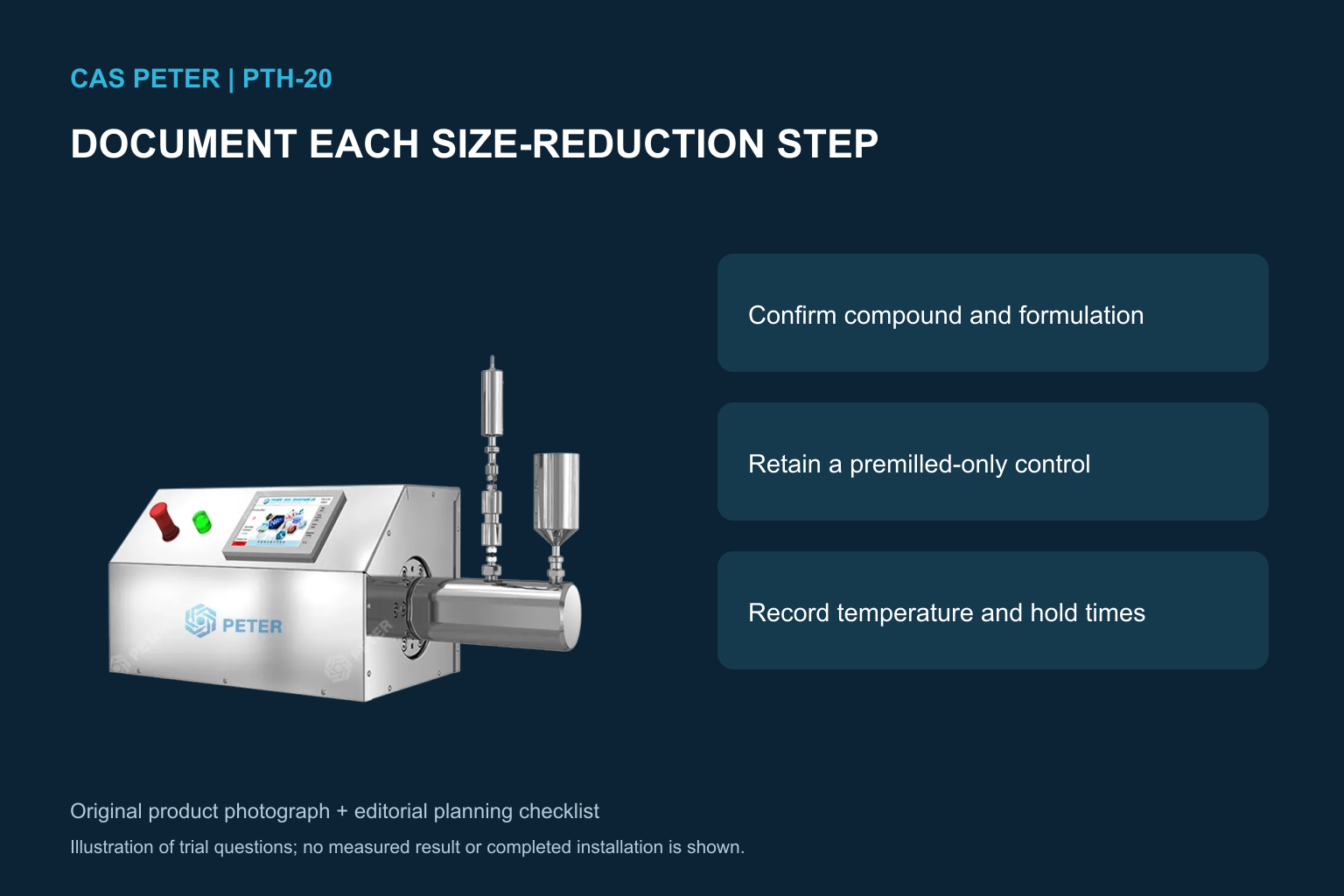
Create a material flow record from starting powder through wetting, premilling, homogenization and final blending. At each stage, record batch mass, formulation composition, temperature, residence or processing history and the retained sample identifier. A final sample without an identifiable feed makes it difficult to decide which operation was useful.
Use a premilled-only control when assessing the additional value of homogenization. Compare it with material from the same prepared batch that receives the pressure-processing step. If the two branches experience different hold times or dilution, include those differences in the report. Their effects should not be silently attributed to mechanical processing.
Where practical, retain an appropriately prepared non-premilled control to understand the route as a whole. Confirm its feed suitability before considering machine processing. A control is not an instruction to force unsuitable coarse material through a restricted passage. Discuss the allowable feed and preparation method with the equipment supplier first.
Build a stage-specific verification matrix
This matrix is a proposed development framework, not a published recipe. It deliberately separates particle measurements from formulation quality and equipment suitability. Set acceptance criteria for the intended application before selecting a process route.
| Stage or question | Evidence to retain | Main comparison | Interpretation limit |
|---|---|---|---|
| Starting material identity | Lot, assay, composition and initial particle observations | Feed lots used across trials | Identity alone does not establish processability |
| Premilling contribution | Sample before and after premilling with preparation history | Wet feed versus premilled feed | A premilled result cannot be assigned to homogenization |
| Homogenization contribution | Matched feed, operating record and outlet samples | Premilled-only versus premilled-and-homogenized | Temperature and handling differences must be considered |
| Physical quality | Full particle distribution and suitable microscopy | Fresh and stored samples | A mean alone may miss a coarse population |
| Material recovery | Representative assay, batch masses and retained fractions | Input versus recovered product | Apparent size improvement does not prove good yield |
| Final formulation | Defined matrix, package and relevant quality tests | Suspension versus intended finished system | Concentrate data do not establish final product performance |
Keep the identity of each sample consistent between particle analysis and assay. If one result describes a filtered supernatant while another describes the entire suspension, they cannot be combined as though they represent the same material. Record every separation or dilution that changes the sample presented to an instrument.
Read the coarse population as well as the average
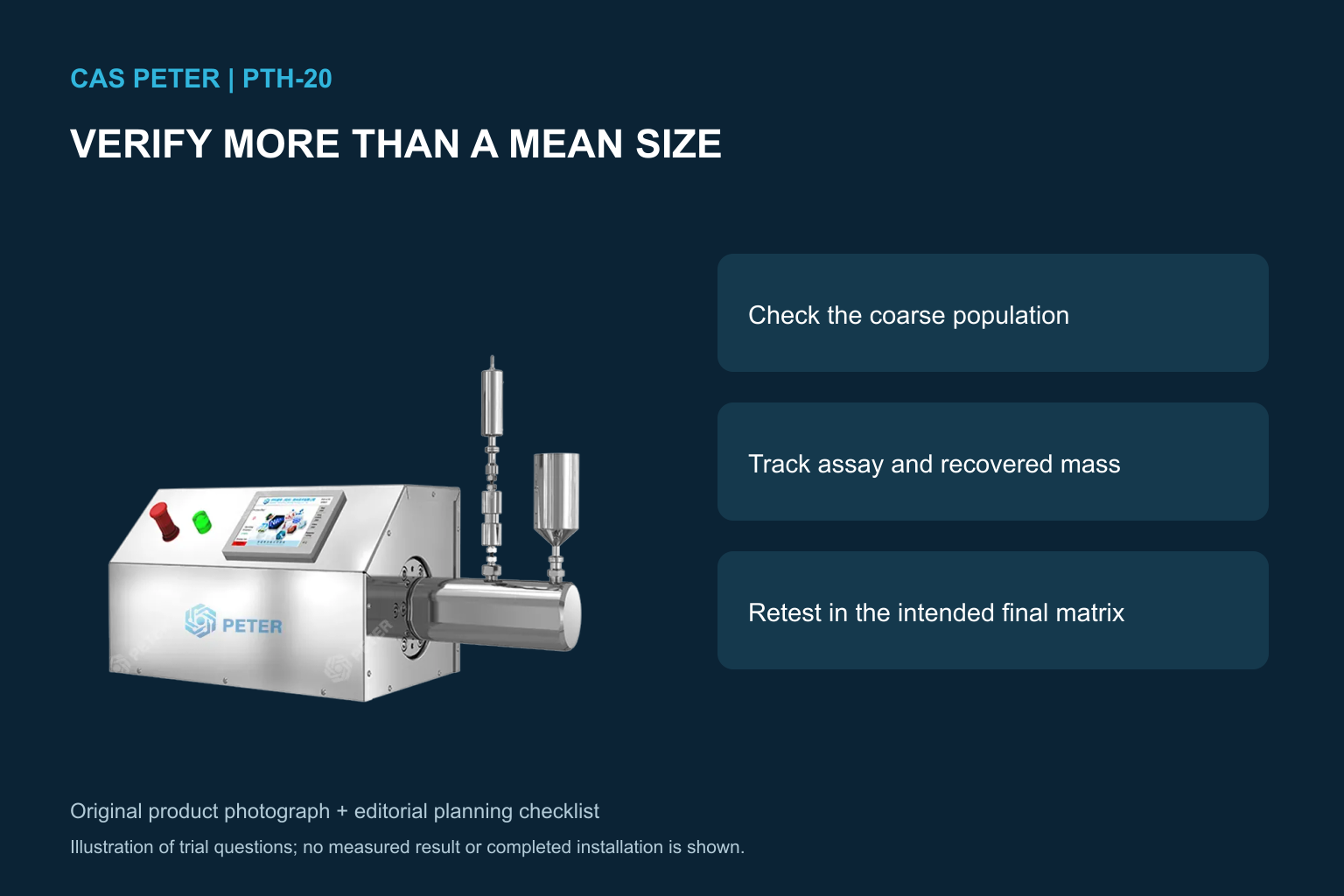
Use measurement methods appropriate to the expected range and sample properties. A small main population can coexist with a less abundant coarse fraction. Report the distribution and method, investigate visible particles and consider complementary measurements when one instrument cannot adequately describe the complete material.
The DLS and laser diffraction guide explains why measurement outputs should not be treated as interchangeable. Record dilution medium, dilution factor, dispersing method and any mixing before analysis. A result obtained after aggressive analytical dispersion may describe the test preparation rather than the product’s normal state.
Use microscopy where it can answer a specific question about aggregates or coarse particles. Keep the images associated with sample preparation details and recognize the limits of the observed field. Do not infer that the absence of a coarse particle in a few images proves its absence throughout the batch. Combine observations with representative sampling.
Repeat the measurements after the defined hold period. If the suspension settles, document whether it can be redispersed under an allowed procedure. Separate settling from irreversible aggregation and avoid calling every visible layer a failure of crystal size reduction. The required behavior depends on how the material will be handled and supplied.
Follow recovery instead of relying on appearance
A suspension may look finer after large particles are left in a vessel, trapped during transfer or excluded from the analyzed fraction. Track material retained in premilling equipment, homogenizer passages, transfer lines and sampling containers. Use a suitable analytical method to assess hesperidin in representative recovered material rather than assuming that the nominal addition equals the final concentration.
Define what the recovery calculation includes. Product collected for use, retained hold-up and analytical samples should have consistent mass records. If washing is used to recover material, record the resulting dilution separately. This makes a process comparison meaningful when two routes produce similar particle sizes but different practical yields.
Check assay suitability in the actual matrix, including stabilizers and other components. Sample extraction should recover the analyte being measured without silently excluding solid material. Select the analytical approach with qualified laboratory support. This article does not provide a validated assay or acceptance limit for pharmaceutical or cosmetic release.
Keep stabilizer and preservation decisions explicit
Document stabilizer identity, grade, concentration basis and addition sequence. When a stabilizer changes, repeat the feed and product characterization rather than assuming that only storage behavior has changed. The liquid’s composition can also influence processing and measurement, so retain formulation information with every operating record.
Preservation is a separate development requirement. A paper’s preserved formulation does not justify a preservative-free version or a different use category. Obtain an appropriate microbiological assessment for the intended system, container and handling conditions. Mechanical particle-size reduction should not be described as sterilization or a substitute for preservation validation.
Distinguish chemical retention from physical stability. A size distribution can remain similar while the amount or quality of the intended compound changes. Conversely, an assay may remain acceptable while particles aggregate. Set separate tests for the endpoints that matter, and ensure that the test method and sample preparation are suitable for the final matrix.
Evaluate the material after downstream processing
If the intended route includes concentration, blending, drying or reconstitution, test the material after those steps. Record the proportion of suspension added, the mixing procedure and the resulting composition. A concentrate that behaves well by itself may respond differently when exposed to the ingredients or conditions of a finished formulation.
When drying is planned, retain a suspension sample for comparison with the reconstituted material. Define the reconstitution medium, mixing and time before measurement. Do not count successful drying as proof that the original particle state has been recovered. Track the relevant coarse fraction and material recovery after the downstream operation.
Use a storage plan that reflects the proposed use and distribution conditions. Specify sampling times and containers in advance, including whether containers are repeatedly opened. Keep development observations separate from a commercial shelf-life claim. The duration and conditions reported in an original study belong to the tested formulation and cannot simply be transferred.
Prepare a useful homogenizer trial request
Discuss the CAS PETER PTH-20 model with a defined feed dossier: compound identity, actual concentration, stabilizer system, liquid composition, premilling history, viscosity, feed distribution, batch size and the required final endpoint. Ask for confirmation of feed limits, wetted-material compatibility, cooling and cleaning for the proposed configuration.
State whether the trial is intended to compare routes or optimize an already selected route. Include the samples required before and after homogenization and the mass needed for independent analysis. Agree on what constitutes a successful result before testing. A supplier should be able to review the material and configuration without relying on an undefined request for a nanosized product.
The nanoparticle homogenizer buyer checklist gives broader equipment-selection context. Use representative material trials and documented analytical results for the final decision. The product photographs in this article identify the referenced model and illustrate trial questions; they do not show a verified hesperidin production installation.
Educational background: colloidal stability
This NPTEL lesson introduces colloidal stability as background for understanding why particle-size reduction and long-term suspension behavior are separate questions. It is not a hesperidin preparation demonstration or a replacement for formulation-specific testing.

Educational source: NPTEL-NOC IITM. Watch the lesson on YouTube.
Frequently asked questions
Does a combined milling and homogenization result prove homogenization alone works?
No. Retain a premilled-only control and compare it with the same feed after homogenization. Record formulation, temperature and handling so the additional contribution of the pressure-processing stage can be assessed.
Is a small average particle size enough to accept the suspension?
No. Review the full distribution, coarse particles, representative assay, recovery and behavior after the intended downstream steps. Physical size, chemical quality and microbiological suitability require separate evidence.
Can a published hesperidin storage result be used as a product shelf life?
Only a study of the relevant finished formulation and conditions can support its own claim. Published results guide development, but a changed stabilizer, preservation system, matrix or package needs appropriate independent qualification.