

Paclitaxel Nanocrystal Homogenization: Verify Crystal Identity Before Comparing Carriers
Paclitaxel nanocrystal homogenization should be judged by confirmed particle identity, recovered drug and solid-state behavior, rather than by a nanoscale size reading alone. A suspension of drug crystals, an albumin carrier and an oil-based nanoemulsion are different formulation systems even when all use high-pressure equipment. Define which system is being developed before comparing pressure, cycles or storage results. This guide concerns formulation research and equipment trial planning. It provides no preparation instructions for patient use and does not establish clinical equivalence, sterility, therapeutic benefit or regulatory acceptance for any formulation or CAS PETER machine.
Identify the particle that the process is intended to produce
A drug nanocrystal suspension contains a dispersed solid drug phase with a formulation-dependent stabilizing environment. A carrier system contains another structural component, such as a protein matrix, that changes the meaning of particle size, drug association and release. A formulation can also contain more than one population. Naming every small scatterer a paclitaxel crystal conceals these distinctions.
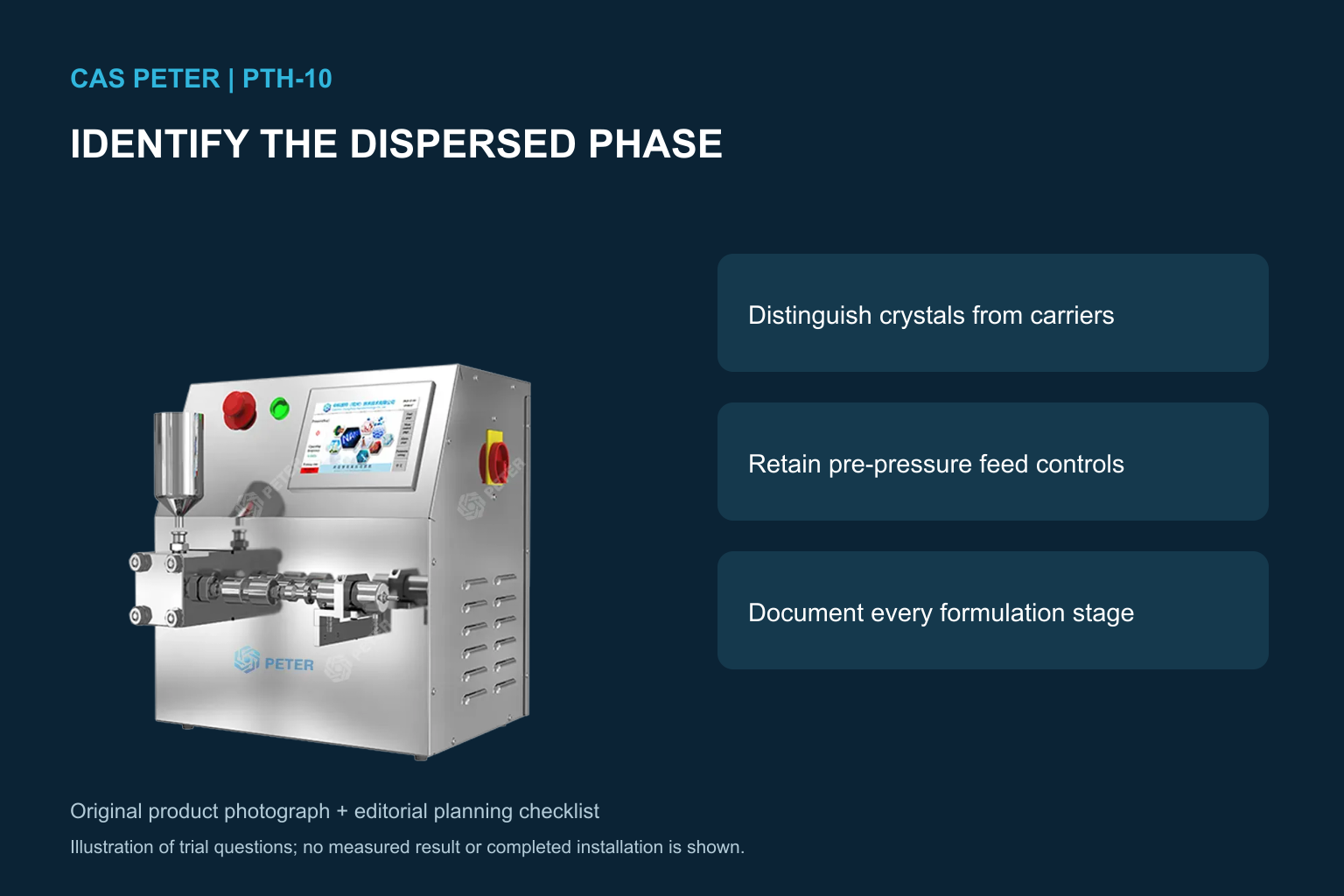
Begin with a material inventory: drug form, stabilizers, carrier materials, liquid phases and any solvent-removal or drying operation. Record which species are expected to remain in the finished sample. This inventory guides the analytical controls. If a carrier is included, prepare and characterize an appropriate carrier-only control so its signal is not mistaken for drug particles.
Use a clear formulation description in the trial record and purchasing brief. “Paclitaxel nanoparticles” is too broad to define an acceptance test. State whether the target is a crystalline drug dispersion or a drug-loaded carrier, and identify the evidence required to demonstrate that identity. Do this before asking an equipment supplier for a guaranteed size.
What the two original studies contribute
The paclitaxel nanosuspension study investigated a multistep formulation and evaluated particle characteristics, dissolution and solid state. It supports the narrow point that a reported homogenization outcome belongs to a particular formulation and analytical program. It does not establish that another feed, stabilizer system or pressure device produces an equivalent dispersion.
A separate human serum albumin nanoparticle study developed a paclitaxel-loaded carrier using an emulsion and solvent-removal route. Its formulation identity differs from a drug-crystal suspension. The two papers therefore offer a useful comparison of the questions that must be asked, rather than a single size target to copy. Their research results do not validate a commercial product made on different equipment.
Keep the clinical and manufacturing claims separate from the engineering discussion. Particle measurements can describe a research sample, while patient suitability requires a much wider body of evidence. A model photograph, a laboratory size result or a successful processing run cannot establish that wider evidence.
Separate feed preparation from the homogenizer contribution
A multistep process may include dissolving, precipitation, mixing, solvent removal, pressure processing and drying. The material entering the high-pressure step can already differ substantially from the original drug. Without intermediate samples, the final result cannot show how much change came from each operation.
Retain a representative feed sample immediately before pressure processing, plus appropriately matched samples from earlier stages when they are central to the research question. Record the hold time and temperature before collection. A suspension that continues to evolve while waiting can create a misleading before-and-after comparison.
Compare pressure treatments within a defined formulation. Changing the stabilizer, drug concentration and process sequence while changing pressure makes attribution difficult. For an initial engineering screen, prioritize a reproducible feed and a manageable set of conditions. Expand the study only after the controls and analytical methods can resolve meaningful differences.
Use complementary measurements to test identity
Dynamic light scattering reports hydrodynamic behavior of scattering species under the measurement conditions. It does not identify chemical composition or prove crystallinity. A small reading could arise from drug particles, carrier structures, droplets or a mixture. Record the dilution and analysis procedure and investigate unexpected populations with an appropriate complementary method.
Use a validated chemical assay to establish drug quantity and a suitable solid-state method to evaluate the solid phase. Depending on the research question, diffraction, thermal analysis or other qualified methods may be useful. Sample drying can itself affect the result, so state how the specimen was prepared and whether it represents the wet dispersion or a recovered solid.
Microscopy adds morphology information, but specimen preparation and limited fields of view matter. Select representative regions using a documented method rather than only showing the most uniform image. Neither a single micrograph nor one thermal trace should carry the entire identity claim. The aim is agreement between methods that answer different questions.
The following table is an editorial comparison framework informed by the two original studies. It supplies no clinical, release or manufacturing specification.
| Question | Useful comparison or control | Evidence needed | Interpretation to avoid |
|---|---|---|---|
| Are the measured objects drug crystals? | Drug feed, final dispersion and relevant blank formulation | Chemical identity plus suitable solid-state and morphology evidence | Calling every nanoscale light-scattering signal a drug crystal |
| Is a carrier contributing to the signal? | Carrier-only preparation and drug-loaded formulation | Composition, particle characterization and a qualified association method | Treating carrier size as the size of a drug crystal |
| Did pressure processing change the material? | Matched pre-pressure feed and collected treated samples | Distribution, assay, solid state and recorded temperature history | Assigning precipitation or solvent-removal effects entirely to homogenization |
| Was the drug recovered? | Input, collected product and retained system fractions | Assay-supported mass balance with documented sampling | Reporting a uniform aliquot while ignoring material left in equipment |
| Does drying preserve the intended dispersion? | Wet feed and reconstituted product at defined concentration | Redispersion, distribution, assay and solid-state comparison | Calling visual resuspension full recovery of the original formulation |
Measure recovery before celebrating a smaller size
Track the amount of paclitaxel charged, collected in product and retained in sampling or equipment fractions. Use a method appropriate to each matrix. An apparently stable dispersion with unexplained drug loss is not an accepted process outcome. A loss might reflect retention, sampling bias, incomplete analytical extraction or another cause that needs investigation.
Distinguish total drug from any operationally defined “free” or associated fraction. Separation methods can alter the equilibrium, adsorb material or incompletely separate particles. Confirm recovery through the analytical preparation so a low result is not automatically interpreted as efficient encapsulation. For a crystal suspension, carrier-style encapsulation terminology may be inappropriate in the first place.
Compare results on a common concentration basis. Diluting a difficult sample until it measures well can improve the analytical appearance while changing the formulation being evaluated. Preserve the original concentration in the record and justify the analytical dilution. Where practical, include behavior of the undiluted dispersion in the decision.
Test drying and reconstitution as additional operations
A dried powder is a new process output. Its ability to disperse again should be measured after a defined reconstitution procedure, with the intended liquid, concentration, mixing history and waiting time. A powder that disappears from view may still contain a changed distribution or a different solid state.
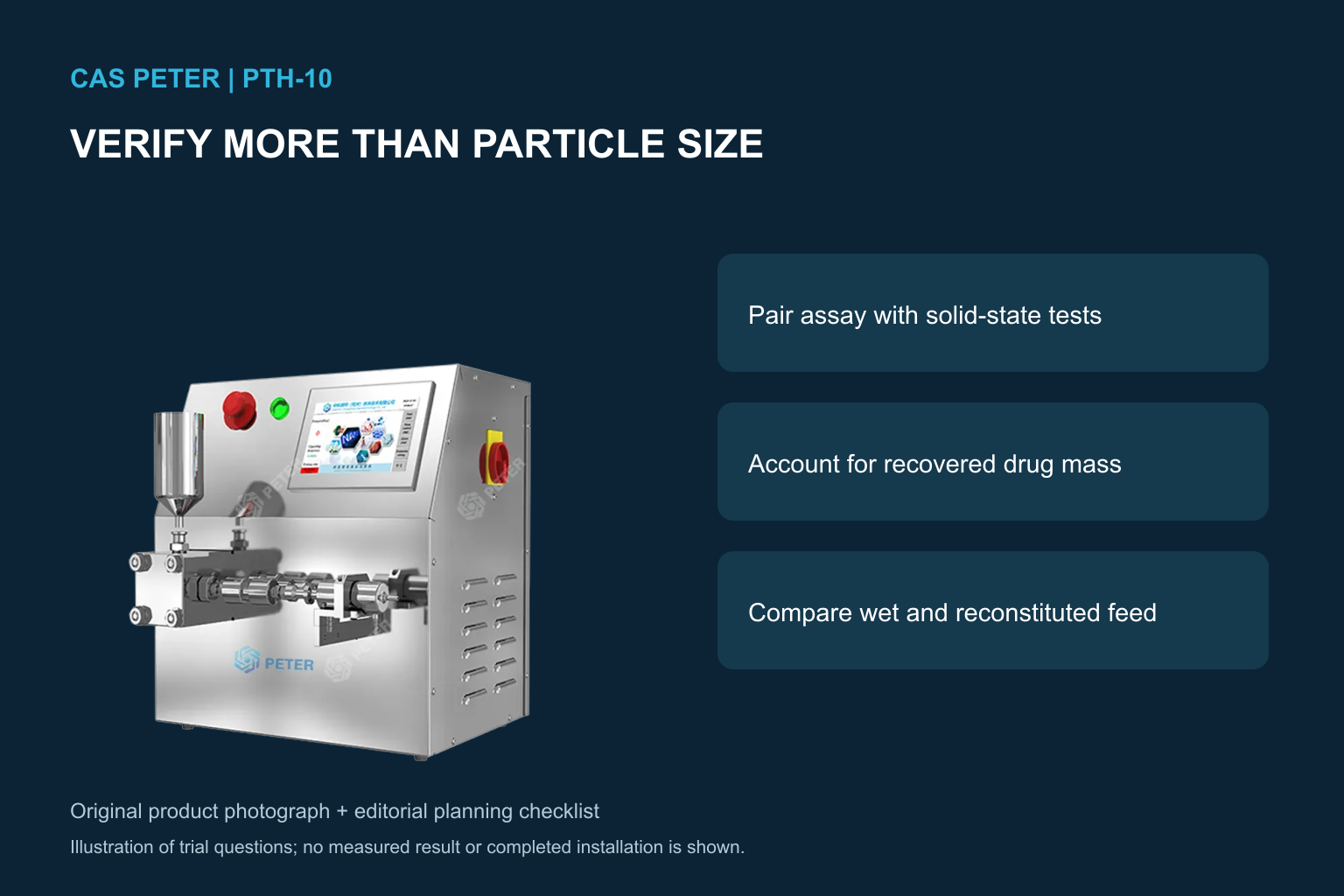
Compare the reconstituted sample with its own wet feed, not only with raw drug. Check recovered assay, coarse material, distribution and the identity measures selected for the project. If the reconstitution liquid differs from the original continuous phase, recognize that the test combines a process comparison with a matrix change.
Storage evaluation should distinguish physical change from chemical change. A distribution can remain similar while assay or impurity results change, and a chemically stable sample can aggregate. Define conditions and sampling intervals from the research objective. There is no universal storage period established by an attractive initial particle result.
Keep particle size and release behavior in separate records
A release or dissolution experiment depends on the test environment as well as the formulation. Report the medium, sample introduction, separation method and analytical recovery. Ensure that the method distinguishes the intended endpoint from transport through a membrane or other experimental limitation. Smaller particles alone do not explain every release curve.
For a carrier system, drug association and carrier behavior may influence the result. For a crystal suspension, solid state and the surrounding stabilizer environment require attention. A direct ranking across unrelated tests can be misleading even when the graphs share the same percentage axis. Use a matched method when the purpose is to compare research candidates.
The drug nanocrystal versus nanoemulsion guide provides a broader classification framework. The liposome retention guide illustrates why a carrier-specific measurement must follow the actual formulation. Those pages complement this particle-identity discussion; they do not establish interchangeable processing settings or biological performance.
Confirm the process system before requesting a trial
The CAS PETER PTH-10 product page provides a reference for an equipment discussion. Suitability for a paclitaxel research process must be confirmed against the actual formulation, containment needs, compatible wetted materials, cleaning strategy and process limits. No oncology-handling, aseptic-processing or clinical-production capability is established by this article or the product illustration.
Provide a process description and the intended feed, rather than only the name of the drug. Include phase composition, coarse material, viscosity information, operating temperature constraints, sample quantity and the selected analytical endpoints. If the work includes solvents, confirm their compatibility and handling requirements for the complete configured system before use.
Ask how representative samples and retained material will be collected and reconciled. Agree which measurements the laboratory supplies and which the equipment trial can document. The nanoparticle equipment buyer guide helps organize this conversation. A useful trial report should preserve formulation identity and uncertainty instead of reducing acceptance to one pressure and one size value.
Educational background on colloidal stability
The NPTEL lesson below explains general stability concepts for colloidal systems. It is relevant to understanding aggregation and the limits of a single particle measurement. It is not a paclitaxel manufacturing protocol, a pharmaceutical qualification course or evidence for the performance of the illustrated equipment.

Educational source: NPTEL-NOC IITM. Watch the lesson on YouTube.
Frequently asked questions
Does a small DLS result prove that paclitaxel nanocrystals were produced?
No. DLS does not identify the chemical composition or crystal state of scattering objects. Confirm the intended drug phase with appropriate chemical, solid-state and complementary particle measurements, including relevant blank formulations.
Can albumin nanoparticle results define a paclitaxel nanocrystal target?
Not directly. Albumin carriers and drug-crystal suspensions have different particle identities and analytical questions. Compare results only after establishing formulation composition, method comparability and the intended research endpoint.
Does successful homogenization establish that a formulation is suitable for patients?
No. A successful research processing run does not establish sterility, clinical equivalence, therapeutic benefit or regulatory acceptance. Those conclusions require a separate and substantially broader qualification program.