

Emulsion Freeze-Thaw Stability After Homogenization: Qualify the Thawed Product
Emulsion freeze-thaw stability after homogenization must be tested on the thawed product, using a defined freezing history and a matched unfrozen control. Small droplets immediately after processing are useful evidence, but they do not establish that an emulsion will resist oil release, clustering or unacceptable texture after frozen distribution. Qualify the recipe, homogenization process, container and thawing procedure together. The right development target is a product that performs after its intended cold-chain exposure, rather than the smallest initial particle-size number. The comparison below is a trial framework, not a universal frozen-food recipe or a machine performance guarantee.
Separate the frozen-distribution question from ordinary shelf stability
Begin by defining what the customer actually does with the product. A frozen ingredient that is thawed and mixed into another formula faces a different requirement from a ready-to-pour beverage or a concentrated sauce base. Specify whether mixing after thawing is allowed, what mixing equipment is available, and how long the thawed material must remain usable. A product that can be restored only by laboratory high shear may not meet a customer’s simple stir-and-use requirement.
Document the anticipated freezing, frozen holding and thawing sequence. If repeated freezing is plausible, include it as a separate challenge. Do not present one short freeze-thaw cycle as proof of long-term frozen storage. Likewise, a refrigerated control can help isolate the effect of freezing, but its stability does not establish that a frozen shipment will arrive with the same structure.
What research says about droplet size and formulation
Lai and colleagues studied whey-protein-isolate emulsions, comparing initial particle size and ionic strength in relation to freeze-thaw behavior. Their findings connect resistance to destabilization with both the prepared emulsion and the protein interface. A smaller starting size helped within their system, while selected salt conditions changed the result further. This is evidence for testing processing and formulation together, not permission to apply the reported salt range to unrelated products.
A separate study of whey-protein, polyphenol and gum-acacia conjugates compared freeze-thaw responses of beta-carotene emulsions with different emulsifiers. The conjugated system performed differently from the comparison formulations. Its specific ingredient chemistry and preparation route are not a general recommendation for food manufacturing, but the study demonstrates why emulsifier identity cannot be omitted from a freeze-thaw trial record.
Neither source establishes a universal minimum droplet size that guarantees success. The decision framework below combines these limited research findings with a proposed application-based comparison. It does not claim that the same ingredient treatment or outcome has been demonstrated on CAS PETER equipment.
Hold recipe and feed preparation constant first
Record oil type and lot, oil fraction, emulsifier identity and amount, aqueous-phase ingredients, pH and preparation order. Include protein hydration conditions and any deliberate heat treatment. If a trial changes protein source and pressure at the same time, it cannot cleanly identify which change affected the thawed product. Start with one representative formula and vary a limited number of processing conditions.
Prepare a consistent pre-emulsion before pressure processing. Check for unmixed oil, undissolved material and excessive air. Retain a pre-emulsion sample if it helps distinguish poor feed preparation from later damage. Review the proposed feed viscosity and particle condition with the equipment supplier before running it. The complete formula, including abrasive or incompatible ingredients, belongs in that review.
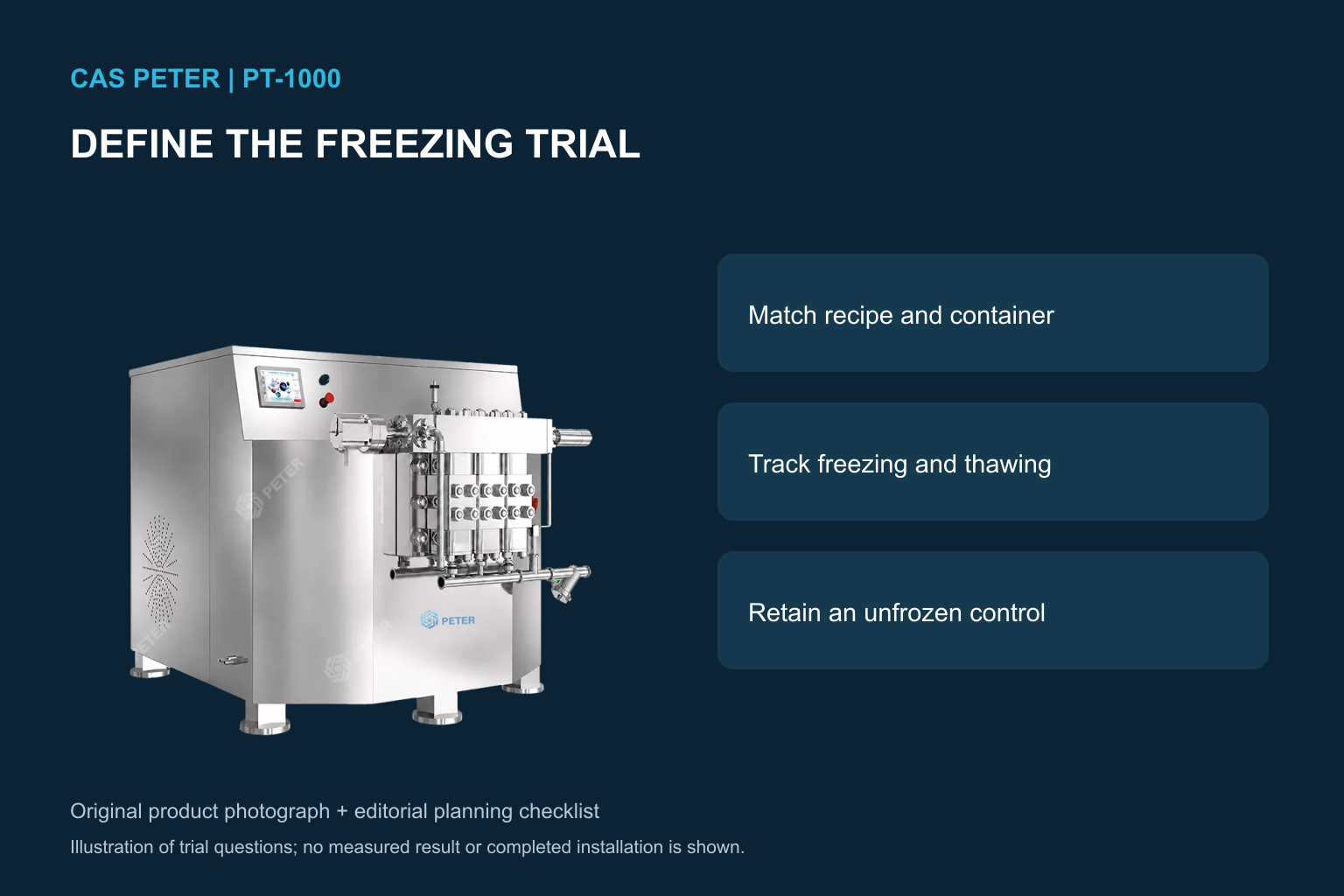
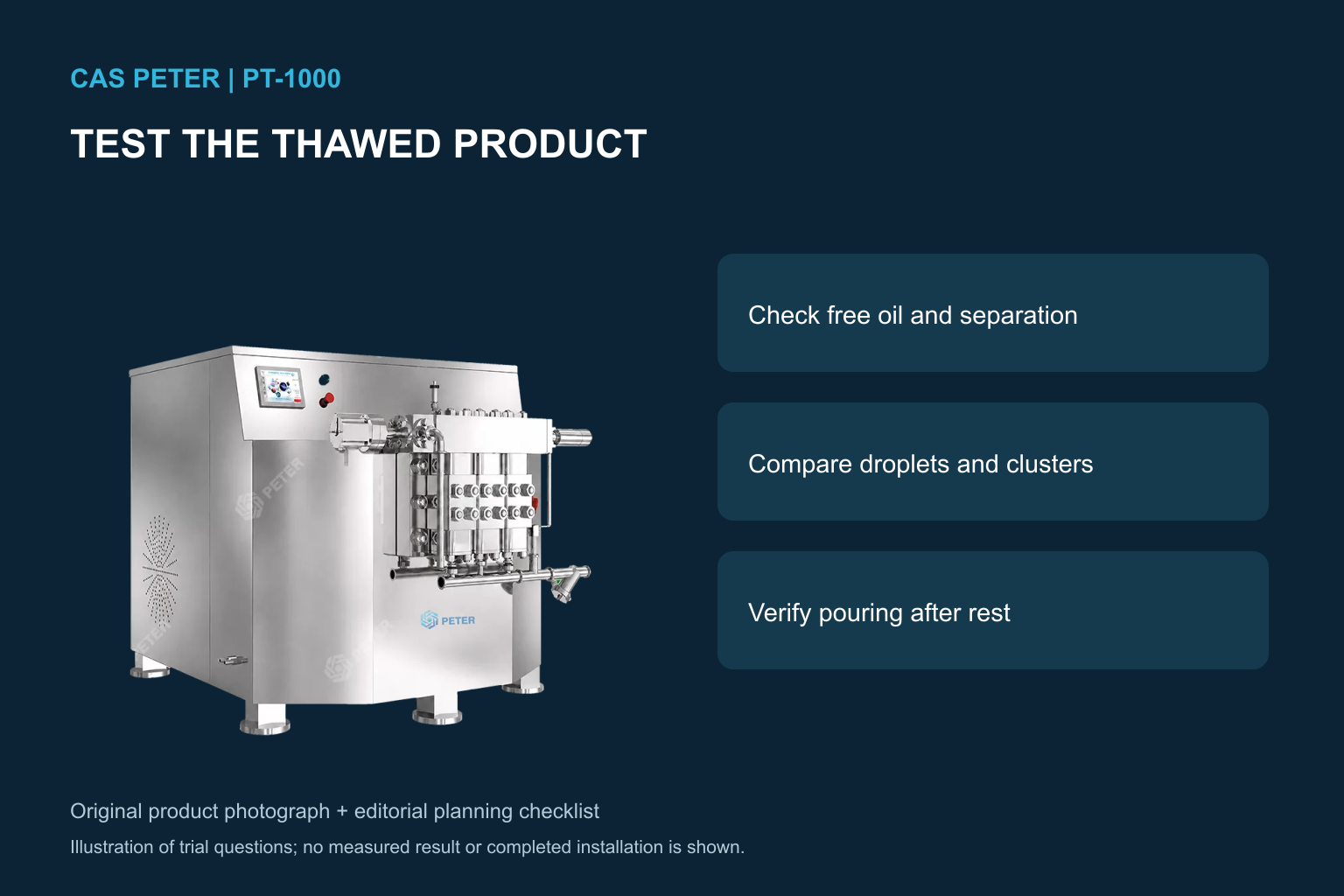
For a larger-scale discussion, the CAS PETER PT-1000 product page is a real production-equipment reference. Confirm the exact flow path, available configuration, cooling, feed requirements and cleaning arrangement for the proposed material. The product photograph in this article identifies the equipment reference; it is not evidence of a completed frozen-emulsion installation or validated capacity for this recipe.
Record homogenization and cooling as a complete history
Compare defined process treatments while keeping the recipe and pre-emulsion preparation matched. Record actual pressure, pass arrangement, feed temperature, discharge temperature and cooling conditions. Note pauses and recirculation, especially if different portions of a batch receive different histories. A nominal pressure setting does not describe how much thermal exposure the emulsion experienced.
Sample the final emulsion before freezing and retain enough material for all planned comparisons. Record initial appearance, particle-size distribution and flow behavior using documented methods. Check independent batches where practical. Repeated instrument readings from one sample improve measurement confidence, but do not show whether production preparation is reproducible.
Choose the trial endpoint before reviewing the results. It might combine acceptable free-oil level, a defined separation observation and a functional pouring or mixing test. Without an agreed endpoint, a team can unintentionally select whichever measurement happens to make one sample look best. A successful candidate must satisfy the complete intended use, including any important quality checks outside physical emulsion stability.
Control freezing and thawing instead of treating them as a black box
Use matched containers, fill levels and sample positions. Record freezer conditions and, where feasible, sample temperature over time. The freezer setpoint alone does not describe how quickly the center of a filled container cools. Avoid comparing a shallow laboratory tube with a deep container as though they had experienced the same freezing history.
Apply a defined frozen holding period, then thaw by the intended route or a justified laboratory simulation. Record the endpoint used to declare thawing complete. Do not aggressively heat one sample to speed up the trial while leaving another to thaw slowly. If handling differs, identify the comparison as a combined freezing-and-thawing change.
Keep separate, untouched portions for observations before mixing. Photograph the container, inspect for a free-oil layer and note visible serum separation or a changed texture. Only then apply the permitted remixing procedure to another portion or a clearly documented stage. Otherwise, vigorous laboratory mixing may erase the very failure the customer will encounter.
Diagnose what changed in the thawed emulsion
| Thawed-product observation | Follow-up comparison | What to avoid concluding |
|---|---|---|
| A visible free-oil layer | Compare oil release and microscopy with the unfrozen control | A small initial size guaranteed freeze-thaw protection |
| Larger measured particle population without obvious oil release | Examine clusters and individual droplets with a suitable method | Every size increase must be irreversible coalescence |
| Thick or gel-like texture after thawing | Compare flow after matched rest and permitted mixing | Greater thickness always means better stability |
| Acceptable appearance immediately after mixing, followed by separation | Recheck after the required thawed holding time | Remixing restored lasting product performance |
| Different results in different containers | Review fill, position, freezing and thawing histories | Pressure processing alone caused the difference |
The table proposes qualitative troubleshooting questions. It does not contain published pass limits. The cited studies support considering formulation, interfacial behavior and post-thaw measurements together; each product needs its own acceptance criteria.
Distinguish droplet aggregation from droplet coalescence when the analytical method permits. Sample preparation matters: dilution, dispersion aids or intense stirring can change clusters before measurement. If an analytical dispersant is used to investigate reversible associations, label that result as an analytical treatment. Do not describe it as the condition of the edible product or recommend laboratory surfactants as formulation additions.
Check whether the thawed product still works
Repeat the operation that matters to the customer. A concentrate might need to disperse into water using a defined mixer. A pourable product might require a flow test after resting. A filling ingredient might require a consistent deposited amount and texture. Keep that operation identical for processed candidates and the unfrozen control, and record any extra mixing needed.
Allow the thawed sample to stand for the period relevant to use and inspect it again. A formulation that looks acceptable immediately after stirring can still fail during a working shift or later holding. Test the intended dilution or final recipe if that is part of the commercial route. Success in the undiluted ingredient does not automatically qualify the diluted product.
Physical stability is only one part of product release. This trial does not establish microbiological safety, nutritional retention, permitted ingredient use or a commercial shelf life. Those questions require the applicable product-specific controls. Keep the scope of a physical freeze-thaw result clear so that it can support, rather than overstate, the development decision.
Choose the next trial from the failure pattern
If different homogenization treatments give similar initial droplets but different thawed texture, examine process history and formula interactions before simply adding pressure. If every treatment fails after freezing, investigate the recipe and cold-chain conditions. If one candidate passes only with a very specific remixing step, decide whether that step is realistic for the intended user before selecting it.
Use the food homogenization overview for the broader process context and the nanoemulsion stability testing guide for complementary measurement planning. The separate article on ice cream partial coalescence concerns a structured frozen product where controlled fat interactions serve a different objective. A liquid emulsion intended to return to its original state after thawing should not borrow ice cream performance criteria without justification.
The NPTEL lesson below introduces emulsion technology. It supports understanding the dispersed system, but is not a freeze-thaw acceptance standard or a recipe for a particular machine.
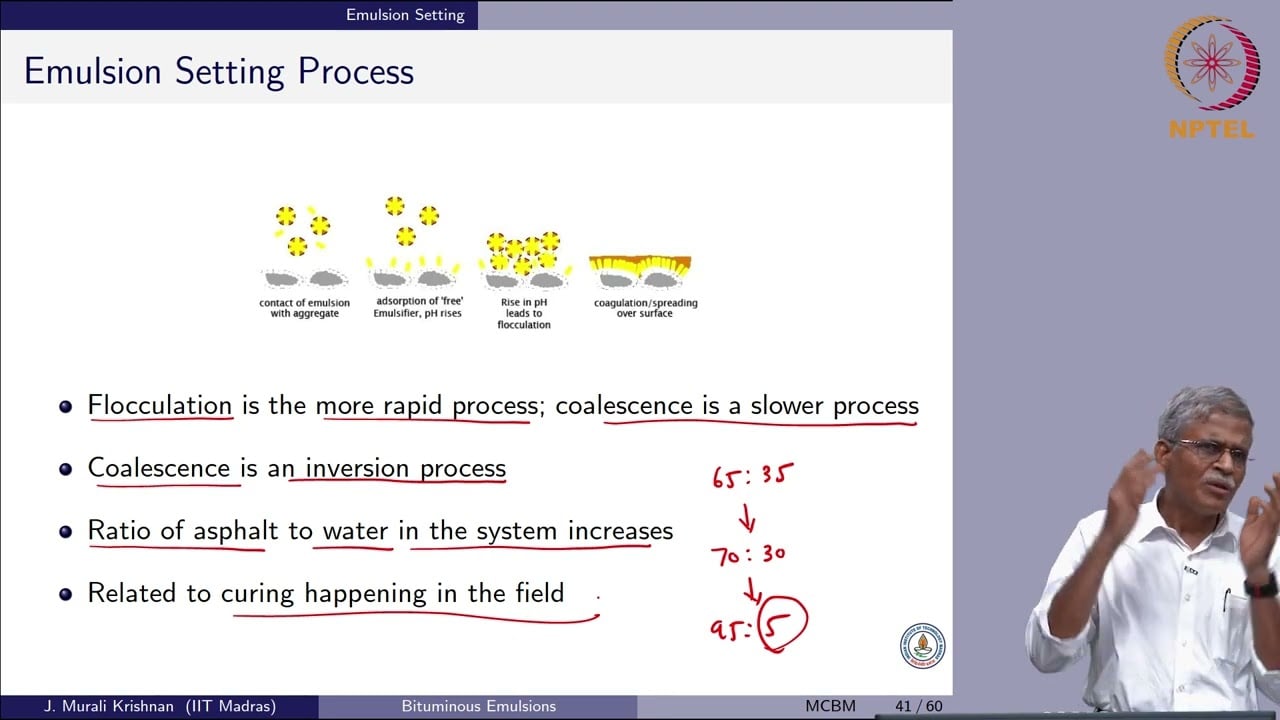
Educational source: NPTEL-NOC IITM. Watch the lesson on YouTube.
Frequently asked questions
Will the smallest initial droplets always give the best freeze-thaw stability?
No. Initial droplet size is one variable. Emulsifier identity, recipe, processing history and freezing conditions also matter. Compare the thawed product against its intended function instead of selecting a candidate from size alone.
Can salt addition be copied directly from a whey-protein study?
No. A salt response belongs to the tested formulation and conditions. Ingredient suitability, sensory requirements and the complete product recipe must be reviewed before a separate formulation trial is designed.
Is an emulsion stable if it looks normal immediately after stirring?
That observation is insufficient. Check the permitted mixing method, free oil, particle behavior and performance after the intended thawed holding period. Record any extra treatment needed to restore the product.