

Ice Cream Homogenization and Partial Coalescence: A Product Trial Guide
Ice cream homogenization and partial coalescence belong to different stages of structure development. Homogenization prepares the mix’s fat dispersion, while controlled fat association during freezing and whipping helps build the finished product. Choosing a process only because it produces the smallest fresh droplets can miss the texture, air structure and melting behaviour that matter to customers. Compare the prepared mix, the aged mix and the frozen dessert under consistent conditions. Select a homogenization condition from the performance of the complete process, rather than treating an attractive particle-size result as proof of a successful ice cream.
Start with the frozen product requirement
Write the intended texture, handling and melting requirements before changing pressure. Define which observations represent an acceptable product and which defects must be avoided. A product intended for one serving temperature or distribution system may require a different balance from another. Keep these requirements connected to the actual recipe and intended commercial process.
A scientific review of ice cream structural collapse discusses the contribution of the fat network alongside air, ice and the unfrozen phase. It explains why melting behaviour cannot be assigned to a single ingredient or one unit operation. Use that perspective to structure a trial, not to claim that one pressure setting will produce a universal melting outcome.
Identify the specific question being tested. “Does the candidate homogenization condition improve the finished product at unchanged recipe and freezing conditions?” is answerable. “What is the best pressure for ice cream?” lacks the formula, equipment and acceptance criteria needed for a useful decision. Keep the broader pressure-selection question separate from this article’s focus on fat structure.
Understand the two stages without treating them as opposites
The mix must first be prepared as a usable emulsion. Later, during freezing and whipping, some fat globules associate to contribute to structure. This partial coalescence should not be confused with complete separation into a bulk fat phase. The development objective is an appropriate final structure, rather than maximum resistance to every form of fat association at every stage.
The Dreyfus Foundation’s educational explanation of ice cream chemistry highlights the combined roles of emulsifier, cooling and churning in this process. The accompanying film is useful background for understanding why the freezer and formulation remain part of a homogenization trial. It does not supply an operating recipe for a commercial line.
Use precise sample labels. “After homogenization,” “after ageing” and “after freezing” refer to different material histories. If a report combines those samples under one general label, it becomes difficult to identify when a structural change occurred. Keep the sample history visible even when the same measurement is repeated at several stages.
Hold the formulation constant during the first comparison
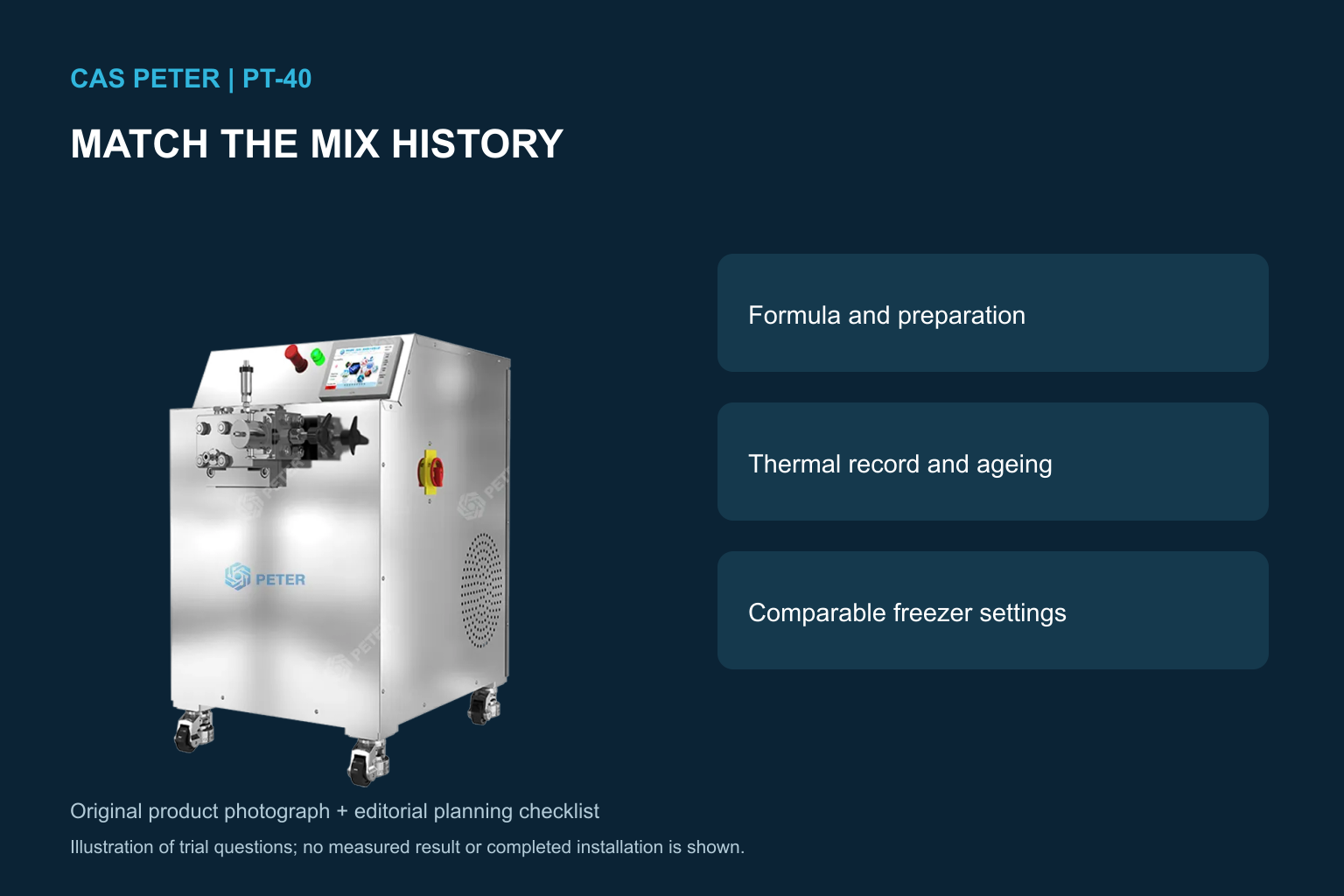
Record the fat source and amount, protein ingredients, sugars, emulsifiers, stabilizers, water and additions. State the basis for each ingredient quantity and preserve lot identities. Do not compare two homogenization conditions while silently changing the emulsifier blend or substituting a different fat. That would combine process and formulation effects in one result.
Document how the mix was blended and hydrated before the trial. Identify the time and temperature history used for ingredient preparation, and collect a representative feed sample. A change in the feed can alter the trial even when the homogenizer setpoint remains unchanged. Keep the approved food-safety process under the control of the responsible production team.
For later formulation development, vary a small number of ingredients in a planned comparison and clearly separate that work from the initial process test. A recipe change may be the right solution, but its contribution must be identifiable. The aim is a reproducible production decision, not a collection of attractive samples whose differences cannot be explained.
Preserve the thermal and ageing history
Record the actual inlet and outlet temperatures during homogenization along with pressure, flow and processing arrangement. Use supplier-approved feed conditions and configuration. A setpoint comparison without temperature observations can leave an important difference unexplained. Do not assume that two runs have equivalent thermal histories because their tanks began at the same temperature.
Keep cooling and ageing conditions consistent across the comparison. Document when ageing begins, how long each sample is held and the relevant temperature record. Use equivalent containers and handling. The samples should enter the freezing step with comparable histories unless ageing itself is the variable being tested.
If the intended line cannot reproduce the laboratory sequence, identify that limitation before treating the trial as a scale-up result. A small experiment can screen candidate conditions, but transfer to another configuration still requires verification. Our dairy and food homogenization overview supplies the broader equipment context for that discussion.
Compare the process at defined sampling points
Use a sampling plan that shows the feed, the freshly homogenized mix, the aged mix and the finished dessert. Decide in advance which sample is needed for each test and how it will be stored before analysis. Sampling only the final product can reveal a difference without explaining where that difference developed.
The table below is an editorial development checklist. The linked scientific and educational sources explain why emulsion preparation and later structure formation both matter; the measurements and acceptance limits must be chosen for the particular formula and product.
| Sampling point | Question to answer | Record to keep | Interpretation limit |
|---|---|---|---|
| Prepared feed | Were the candidate runs given comparable material? | Formula, blending and thermal history | A similar appearance does not prove equivalent preparation |
| Freshly homogenized mix | What physical change did the treatment produce? | Distribution method, actual conditions and sample handling | A smaller average does not establish finished texture |
| Aged mix | Did the candidates reach the freezer with comparable histories? | Hold duration, temperature and relevant mix tests | Ageing differences can confound the pressure comparison |
| Freezer discharge | Was freezing and whipping comparable? | Freezer settings, draw condition and overrun method | A freezer change cannot be assigned to homogenization alone |
| Hardened product | Does the complete process meet the target? | Storage history, texture and controlled melting test | One fresh sample does not establish distribution performance |
Avoid using one fat measurement as the whole decision
Agree a suitable method for fat destabilization or association with the testing laboratory. Keep sample preparation and calculation basis consistent across the comparison. The result is method-dependent evidence, not an independent description of every part of the ice cream structure. Record how the value was obtained so it can be interpreted alongside other measurements.
Where droplet or particle distributions are measured, state the sample stage and any preparation used before analysis. A method that changes the sample during dilution or handling may not represent the structure present in the dessert. Keep raw reports and method notes rather than copying only the most favourable average into a summary.
Pair the analytical result with the actual defect being investigated. If the problem is greasy perception, unstable shape or an undesirable melting pattern, include a suitable test of that outcome. Do not use a movement in one laboratory number to declare success while the original product problem remains unresolved.
Keep freezing and air incorporation comparable
Record the freezer configuration, feed history, operating conditions and collection point. Use a consistent method for determining overrun and identify the stage at which it was measured. A change in incorporated air can alter how the product behaves and can confuse a comparison intended to isolate the homogenization step.
Maintain a comparable hardening and storage sequence after collection. Identify container dimensions, fill method and sampling location for texture or melting tests. Samples that have experienced different storage histories are not an equivalent basis for judging a process change. Where the intended supply chain matters, include a later validation step that represents it.
If an operating interruption occurs, mark the affected sample instead of merging it with the normal run. Startup, steady operation and shutdown material may have different histories. The record should make it possible to distinguish a reproducible process result from a transient observation that happened during one trial.
Use a controlled melting comparison
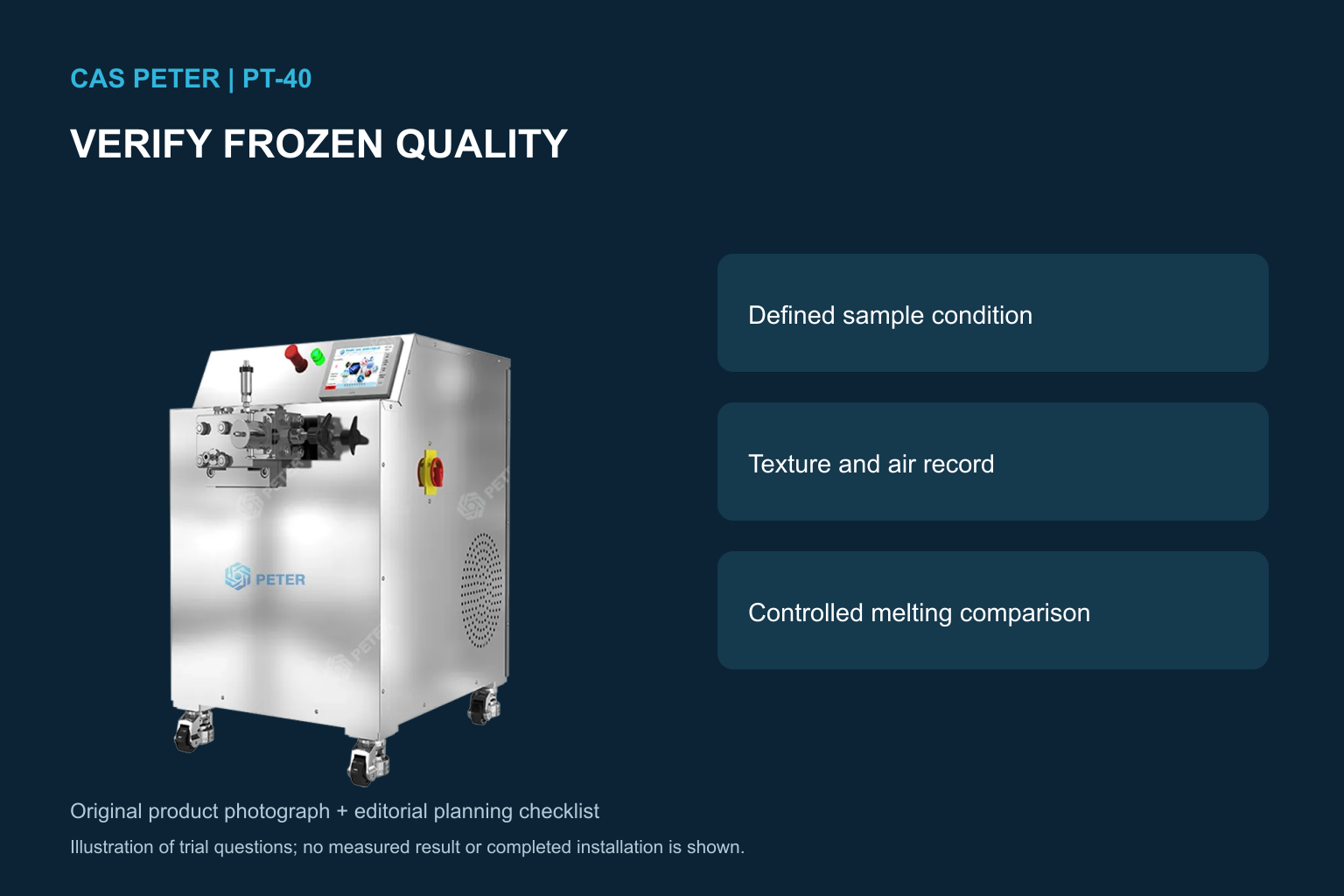
Define the starting sample condition, sample mass or geometry, support arrangement, ambient conditions and observation schedule. Keep the method identical for all candidates. Record both the observed loss of shape and the collected melt if those outcomes are relevant. A photograph taken at an unspecified time is useful documentation but insufficient as a reproducible acceptance test.
Interpret melting alongside texture and the intended serving experience. A sample that retains shape longer is not automatically the preferred product if other required qualities deteriorate. Agree how conflicting outcomes will be weighed before selecting the candidate condition. Keep sensory evaluation under an appropriate product-development procedure rather than relying on one informal opinion.
The Chemistry Shorts film below explains the multiphase nature of ice cream and the role of partial coalescence. It is an independent educational resource associated with the Dreyfus Foundation. The process and sampling checks in this article stand on their own; the video is additional learning material, not proof of a CAS PETER test or customer result.

Educational source: Chemistry Shorts®. Watch the lesson on YouTube.
Translate the result into an equipment discussion
Present the chosen formula, feed condition, intended throughput, thermal constraints, cleaning requirements and complete acceptance test to the supplier. Include the successful and unsuccessful trial observations. These details give the supplier a clearer basis for reviewing the proposed configuration than a request for a maximum-pressure machine alone.
The CAS PETER PT-40 product page provides a pilot-format starting point for discussion. Its photograph identifies a real catalogue product; it does not show a completed ice cream installation. Confirm the actual configuration, hygienic requirements, feed limits and suitability for the proposed formula before planning the trial. Do not infer approvals or application performance from the product image.
For complementary reading, use our single-stage and two-stage comparison when discussing the proposed arrangement, and our plant-protein trial guide when reviewing a separate ingredient-development programme. Neither article replaces the full frozen-product comparison described here. Equipment arrangement, formulation and downstream processing need to be evaluated together.
Repeat the preferred condition on an independently prepared mix. Review whether the result survives normal preparation variation and whether the operating record can be reproduced by another operator. Only then define the next validation stage. A successful pilot comparison supports further development; it does not establish every future recipe, storage condition or production rate.
Frequently asked questions
Is partial coalescence always a defect in ice cream?
No. Controlled fat association during freezing and whipping contributes to the desired structure. It is different from uncontrolled bulk separation or excessive churning. Evaluate it through a suitable method together with texture, air incorporation and the finished product’s melting behaviour.
Should the smallest homogenized droplets always be selected?
No. Fresh droplet size is one observation from one stage. Select the condition that meets the complete product requirements after comparable ageing, freezing, hardening and storage. A favourable average size cannot establish that the final fat structure or texture is acceptable.
How can a trial separate homogenization effects from freezer effects?
Hold the formula, preparation, ageing and freezer conditions consistent while changing the approved homogenization condition. Record the relevant actual conditions and collect samples at defined stages. If a freezer or formulation change is necessary, identify it as a separate comparison rather than assigning its effect to pressure.