

Essential Oil Nanoemulsions: Track Aroma Retention and Droplet Growth
Essential oil nanoemulsions need two separate acceptance decisions: whether the droplets remain dispersed and whether the intended aroma survives processing and storage. A small initial size does not answer the second question. Build a trial that follows oil composition, recovered quantity, temperature, container closure and the final diluted product alongside droplet distribution. Compare samples from the same formulation and oil lot before changing pressure or pass count. The practical endpoint is a repeatable product that meets its intended sensory and analytical specification, rather than the smallest number available from a sizing instrument.
Define which aroma you intend to retain
An essential oil is a mixture, so a total oil percentage alone cannot describe its aroma. Start with the supplier identity, botanical source, extraction method and available composition certificate. Agree which constituents or analytical fingerprint will represent the intended oil. Do not assume that a new delivery system preserves every constituent equally, or that an attractive smell immediately after preparation proves acceptable storage behavior.
The study of Camphora essential oil nanoemulsions combined composition analysis with droplet characterization and stability testing. Its specific formulation and biological results belong to that investigation. They do not establish an operating recipe, approved use or performance guarantee for another essential oil. Use the analytical separation of questions as the useful lesson: identify the starting material, characterize the dispersion, and test the property that matters for the proposed application.
Specify whether the saleable product is a concentrate or a ready-to-use dispersion. A concentrate that appears acceptable in its own bottle can behave differently after addition to a beverage, fragrance base or other formulation. Record the destination medium, mixing sequence and dose before screening the equipment.
Keep formulation screening distinct from equipment screening
Choose an oil loading, aqueous phase and permitted emulsifier system before comparing processing conditions. Record the basis of every concentration, including whether the value refers to total batch mass or only to a phase. If a carrier oil is included, distinguish it from the essential oil in the batch record and analytical calculations.
A useful formulation control is the coarse emulsion before high-pressure treatment. It helps show what the homogenization step changes. Prepare it consistently, record the mixing history and avoid an unstable feed that separates between sampling and processing. A visibly separated feed makes pass-to-pass comparisons unreliable because the material entering the machine may no longer represent the nominal recipe.
For the underlying distinction between mixing and stabilization, the Royal Society of Chemistry emulsifier activity provides a simple educational explanation. Its kitchen experiment is not an industrial recipe. In a manufacturing trial, ingredient suitability, allowed use levels and compatibility with the final application require their own review.
Track the process in a closed material balance
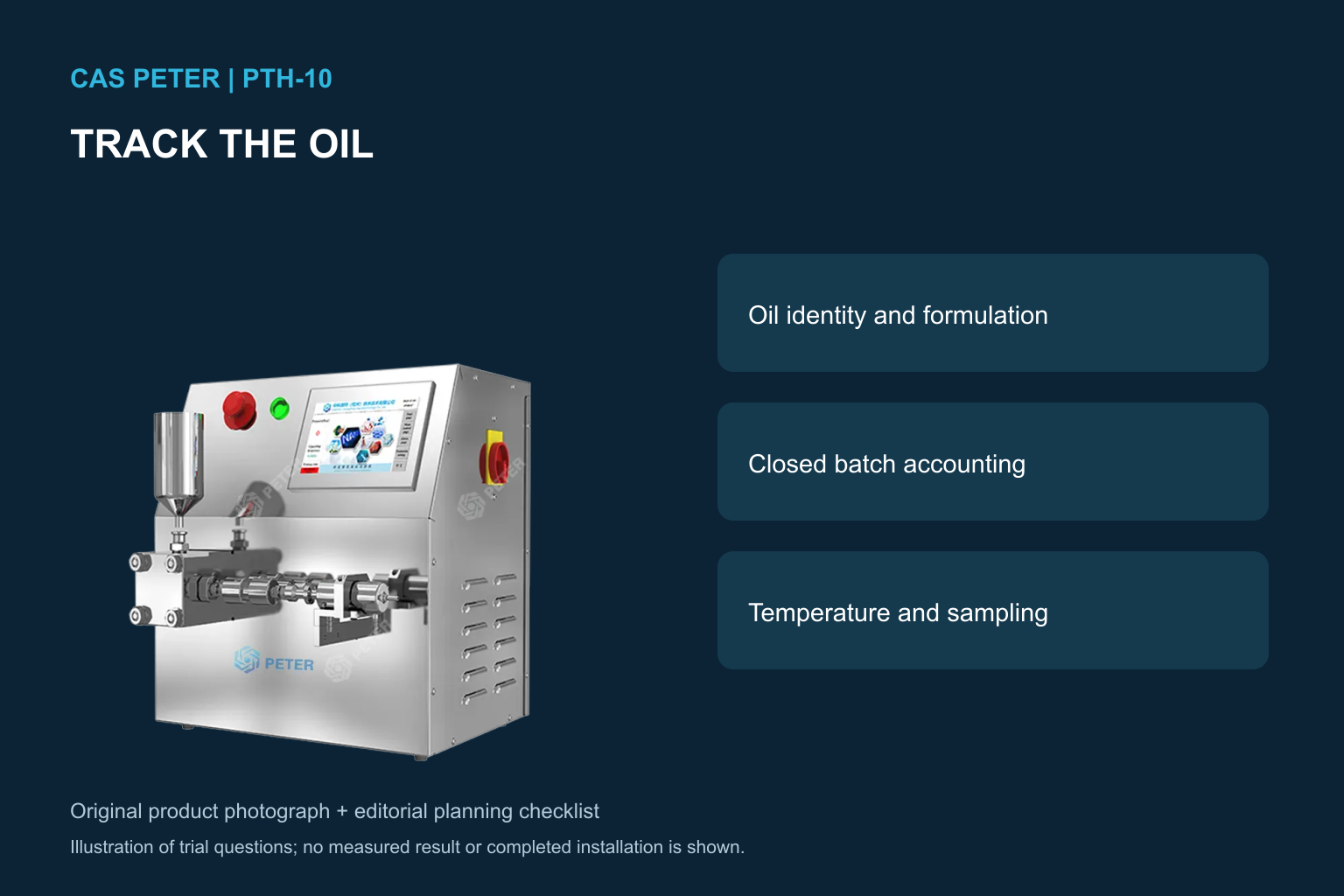
Weigh the starting batch and collect identifiable output fractions. Include the normal product outlet, retained material, samples, any rejected startup fraction and any permitted recovery rinse. Record the rinse separately so that an apparently improved yield is not created by diluting the finished product without accounting for it.
A batch can lose aroma-related constituents without producing an obvious change in its total mass. Conversely, an apparent decrease in analytical concentration can arise from dilution rather than selective constituent loss. Use both batch mass and a validated constituent assay where aroma retention is a critical requirement. Define the sampling bottle, fill level and storage interval consistently so that handling does not overwhelm the difference between processing conditions.
For each run, record inlet and outlet temperatures, elapsed processing time, pressure, pass definition, cooling arrangement and interruption periods. A pass should mean a documented transfer of the intended batch through the processing zone. Recirculation time alone does not establish that every portion received the same exposure. Preserve these distinctions when comparing a laboratory result with a proposed production arrangement.
Use a decision table before increasing pressure
The following table is an editorial trial-planning framework, not a specification derived from one essential oil or a set of equipment limits. Choose measurable acceptance criteria with the formulation owner before testing.
| Trial question | Evidence to retain | Decision it supports |
|---|---|---|
| Is the feed representative? | Oil lot, phase recipe, coarse-emulsion history and sampling location | Whether processing runs can be compared |
| Did droplet distribution change? | Full distribution, measurement settings and sample dilution | Whether another processing step has a useful physical effect |
| Is aroma composition retained? | Selected constituent assay and recovered batch quantity | Whether a physical improvement compromises the intended oil profile |
| Is the final application stable? | Defined dilution, container, storage conditions and repeat observations | Whether the concentrate works in its destination product |
| Is the route repeatable? | Independent preparation and run records | Whether a promising result can justify a larger trial |
If droplet size improves but constituent recovery declines, do not automatically accept the extra pass. Review the complete temperature and handling history first. If composition is retained but the diluted product separates, investigate the destination formulation and its mixing sequence. These are different failure modes and should lead to different next experiments.
Measure physical stability and chemical change separately
Use the same sizing method, preparation procedure and reporting basis throughout the screening series. Preserve the full distribution rather than copying only its average into the report. When possible, review representative microscopy or another complementary observation if the distribution develops an unexpected coarse population. Visible separation, turbidity changes and size growth should be recorded as observations, without assigning a mechanism that the available measurements cannot establish.
Research on flaxseed oil emulsions containing clove essential oil evaluated physical behavior and oxidative stability separately during storage. The study illustrates why similar initial sizes do not make all formulations chemically equivalent. Its comparisons involved particular oils, antioxidants, fabrication methods and storage conditions; they should not be converted into a universal claim that one processing method protects every aroma.
For a new product, select an oxidation or composition method appropriate to the ingredients and intended shelf life. A general antioxidant screening assay is not a substitute for measuring retained aroma constituents. Sensory assessment also needs a defined sample presentation and suitable controls. Do not ask a panel to taste or smell an unreviewed laboratory mixture merely because its ingredients are described as natural.
Include the bottle and the destination medium
Prepare storage samples in the intended packaging where feasible. Record closure, fill quantity, light exposure, storage temperature and sampling schedule. Repeatedly opening a single bottle creates a different exposure history from keeping separate sealed bottles for each measurement point. Choose the approach intentionally and document it so that apparently different stability results are not simply differences in sampling.
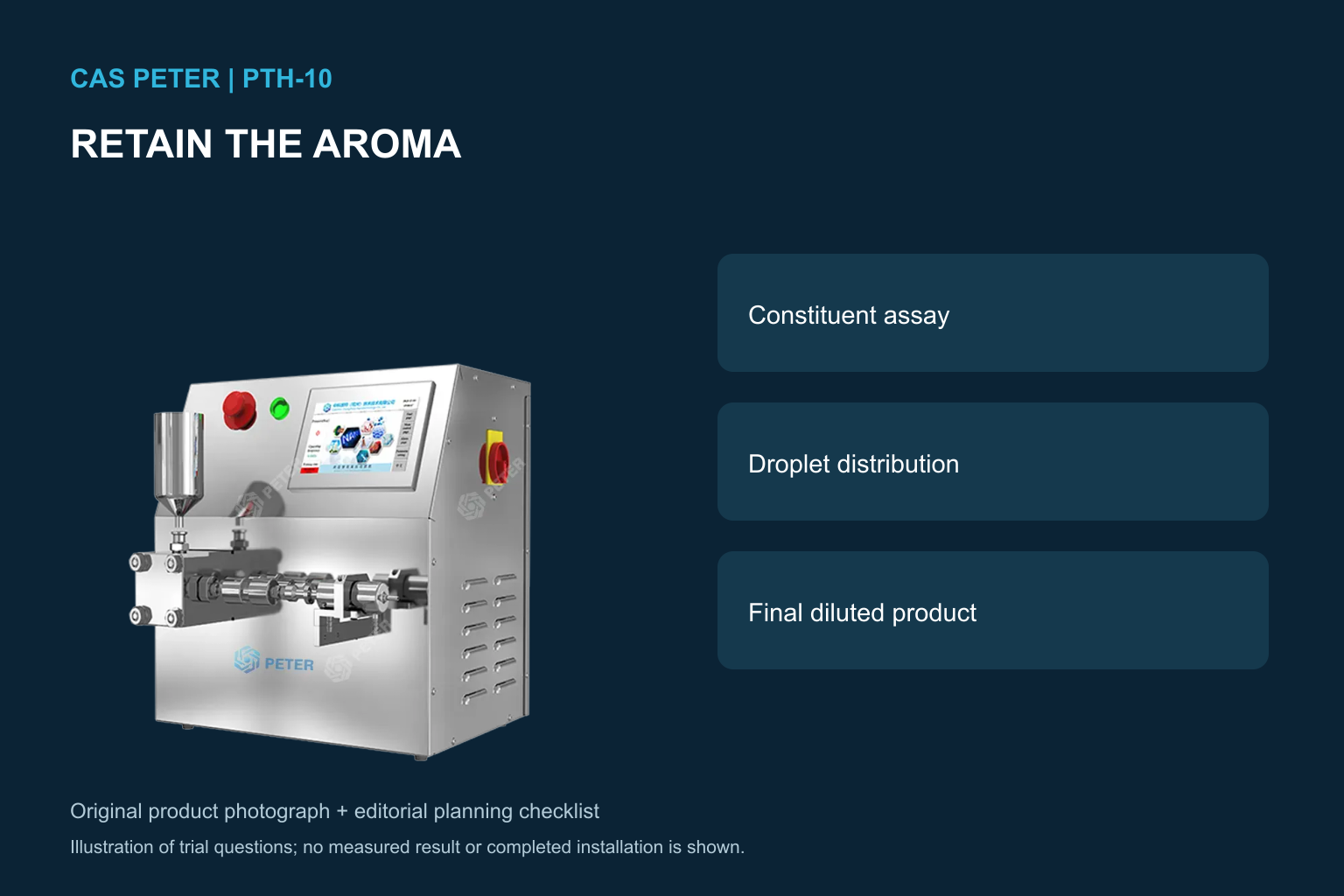
Test the relevant destination medium with its actual ingredient sequence. A useful report states the concentration of the emulsion concentrate and the final concentration after dilution. Record whether the product was mixed into water first or added directly to a formulated base. Photograph samples against the same background and at the same time after preparation, using photographs as a record of appearance rather than a quantitative droplet measurement.
Do not extrapolate a short accelerated test directly to a commercial expiry date. Use accelerated observations to rank candidates and identify likely weaknesses, then establish the intended storage performance through an appropriate validation program. Define acceptable aroma change with the product owner before interpreting the results.
Set a stopping rule that protects the product objective
An efficient screening sequence changes one deliberate factor at a time while holding the recipe and sampling method constant. Start from an equipment-approved feed and operating window. Compare a limited set of conditions, retain an untreated reference, and stop increasing exposure when additional processing gives no useful improvement against the agreed criteria.
For example, suppose two conditions give similar droplet distributions but one requires longer processing and a larger cooling load. The shorter route may be the better candidate if constituent recovery, storage behavior and repeatability also meet the specification. This is a decision example, not a claim about a CAS PETER machine or a predicted numerical outcome.
Repeat the chosen condition with a fresh preparation before requesting scale-up. A second pass through the same original batch is not an independent formulation replicate. Report both the best observed result and the range across repeat preparations. Include unsuccessful conditions so that the next trial does not repeat work already shown to be unhelpful.
Prepare the equipment discussion around the actual oil
The CAS PETER PTH-10 product page can support an initial discussion of a microfluidizer trial. Confirm the actual configuration, permitted ingredients, wetted materials, pressure range, cooling provision and cleaning method with the supplier. The presence of an essential oil in a published experiment does not establish compatibility with an unspecified machine configuration.
Send the formulation description, intended batch quantity, feed condition, analytical plan and acceptable temperature history together. State whether the oil includes a solvent or other ingredient that changes the safety assessment. Follow the equipment documentation and site procedures for handling, containment and cleaning. Do not infer suitability for a flammable formulation from the generic term essential oil.
Use the broader emulsion homogenization guide for process context, the nanoemulsion stability guide for a complementary storage framework, and the DLS versus laser diffraction comparison when selecting the sizing method. This article focuses specifically on preserving the intended oil profile while evaluating the dispersion.
Educational video: the dispersed phase and its interface
Harvard University’s lecture introduces how emulsions are formed and stabilized. Use it to understand the role of the dispersed phase and interface. It does not supply an essential oil manufacturing recipe or validate the trial proposed here.

Educational source: Harvard University. Watch the lesson on YouTube.
Frequently asked questions
Does a smaller initial droplet size prove better aroma retention?
No. Size describes a physical property of the dispersion. Retention requires a suitable composition or constituent measurement, interpreted alongside batch recovery and handling history. Establish separate acceptance criteria for both questions.
Can one essential oil study determine our pass count?
No. Oil composition, emulsifier, loading, feed preparation and processing geometry all affect the result. Use published studies to plan relevant measurements, then qualify the operating route with your actual formulation and equipment.
Should the concentrate or the diluted product be tested?
Test both when the concentrate is intended for later dilution. Preserve a concentrate control and prepare the destination product using its actual mixing sequence, ingredient concentrations and storage conditions.