

Milk Lipolysis After Homogenization: Track Free Fatty Acids Alongside Physical Quality
Milk lipolysis after homogenization should be evaluated with a free fatty acid timeline, not inferred from a smaller fat globule size or a more uniform appearance. Record the milk source, enzyme history, heat treatment, homogenization step and every subsequent holding period. Then compare chemical fat quality with the physical benefit required by the product. A process can improve dispersion while creating a different environment for enzyme action. The useful question is whether the complete manufacturing sequence delivers acceptable milk at the end of its intended storage and use, under conditions your team has actually tested.
Define the purpose before changing the process
For a beverage producer, unwanted fat breakdown and inconsistent foaming may be concerns. For a flavor ingredient producer, controlled enzymatic hydrolysis may be deliberate. These are different projects even when both start with milk fat and use pressure processing. Write the intended endpoint into the trial brief before choosing samples or interpreting free fatty acid results.
This guide concerns quality verification around homogenization. It does not provide a food safety process, a pasteurization schedule or a universal acceptable fatty acid concentration. Those decisions require the appropriate product specification, analytical method and responsible dairy specialists. For the broader process context, see the dairy and food homogenization guide.
A practical acceptance statement might require a physical dispersion benefit together with no unacceptable increase in fatty acid content over a defined manufacturing and storage sequence. State how the increase will be measured and what commercial product the comparison represents. Avoid changing the goal after seeing which result looks best.
What the research can and cannot establish
A study of shearing-induced lipolysis and milk foaming compared different physical treatments and controlled fatty acid levels. Its results show that foam behavior depends on the treatment and the foaming method as well as the fatty acid level. The researchers deliberately induced lipolysis, used specified holding and heat steps, and compared prepared samples. Their results should not become a universal failure threshold for commercial milk or a guaranteed outcome from any particular machine.
A separate original study of homogenization temperature, pressure and milk lipase, by Aarhus University researchers, compared lipase activity and fatty acid accumulation using two analytical methods. It reported that fatty acid accumulation did not imply increased enzyme activity, and that the methods did not give identical treatment comparisons. This supports keeping enzyme activity, available substrate and analytical method distinct. It does not supply a universal pressure ranking or an acceptable fatty acid limit for finished beverages.
These studies justify separating physical processing, enzyme conditions and final application testing. Neither supplies a transferable CAS PETER operating recipe. Keep their formulations, methods and endpoints attached to their findings rather than copying an isolated pressure or percentage into a production specification.
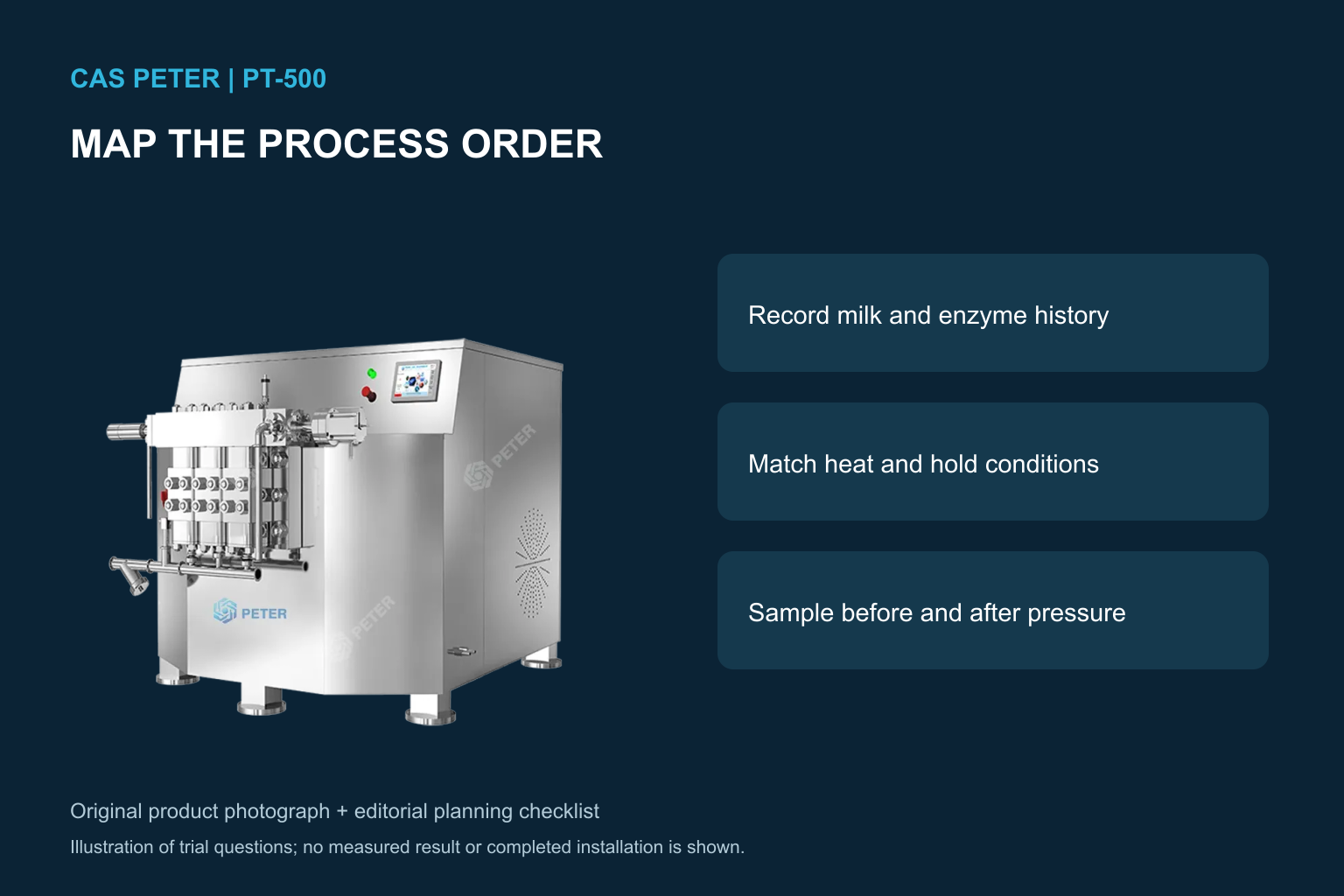
Build a process map with actual times
Start at milk receipt rather than at the homogenizer inlet. Record source, collection or receipt date, composition, storage conditions and relevant prior treatment. Use the same batch for paired comparisons whenever practical. Otherwise, a difference attributed to homogenization may already have existed between incoming milk lots.
Mark sampling locations before pressure processing, immediately afterward, after the next manufacturing operation and during the planned storage study. Specify how samples will be collected and handled. If one sample waits on a bench while another is cooled immediately, the comparison includes a handling difference that may be more important than the machine setting.
Include tanks, pumps, bypasses and recirculation paths in the map. A label such as “two passes” is incomplete if some material spends substantially longer in a warm holding vessel. Record actual inlet and outlet temperatures and the elapsed time before the next step. Keep a record of start-up and shutdown material rather than mixing it silently into the steady-operation sample.
The process map also helps distinguish an equipment trial from a whole-line trial. Both can be useful, but they answer different questions. First establish what the individual pressure step changes under controlled handling; then verify that the complete line preserves the desired result.
Choose controls that answer a specific question
A matched unhomogenized control helps show the effect of the proposed sequence. However, it should receive comparable transfers, temperature exposure and sampling delays. Keeping the control in a refrigerator while the treatment goes through a warm loop creates a combined thermal and mechanical comparison, not a clean assessment of homogenization.
Where process order is the concern, design separate, clearly named sequences with the dairy process specialist. Do not interchange the position of heating and homogenization casually. The guide to homogenization and sterilization limits explains why a mechanical dispersion step cannot be assumed to replace a validated microbial control operation.
Keep independently prepared trial runs separate from repeated laboratory measurements. Several assay readings from one bottle describe analytical repeatability; they do not establish that another production run will behave the same way. Repeat the promising sequence with a new preparation before selecting it for scale-up.
Measure free fatty acids with consistent reporting
Use a laboratory method appropriate for the milk matrix and the decision being made. Ask the laboratory to state the extraction or assay basis, calibration, units, precision and known interferences. Keep that basis constant across the trial. Values expressed per volume of milk and values normalized to fat cannot be compared simply because both reports use the term free fatty acids.
Report both the starting value and the change during the defined interval. A small final difference can conceal a different starting condition. Conversely, a high initial result that remains unchanged does not demonstrate that homogenization generated additional hydrolysis. Plot the complete timeline for each preparation instead of selecting the most favorable endpoint.
Arrange sample preservation and shipment with the laboratory before collecting material. The aim is to measure the intended sampling point rather than reactions occurring during an uncontrolled delay. Do not invent a preservation procedure from a paper about another matrix. Include handling blanks or recovery checks where the laboratory identifies a need.
Read chemical and physical results together
The following table is a proposed trial interpretation framework, not a set of measured limits. It uses the distinction between physical processing and enzyme-dependent outcomes demonstrated by the two studies above. Set product-specific acceptance criteria before using it for a release decision.
| Observed pattern | What remains uncertain | Useful next comparison |
|---|---|---|
| Smaller globules with little fatty acid change | Whether the result persists through the full holding sequence | Repeat the complete process and storage timeline |
| Smaller globules with rising fatty acids | The contribution of enzyme history, temperature and delay | Compare matched histories and each sampling interval |
| Similar fatty acids but different foaming | Whether interfaces, composition or foaming conditions differ | Standardize the application method and examine structure |
| Fatty acids rise in control and treatment | Whether the incoming material or handling dominates | Review receipt values and matched control handling |
| Results vary between nominally identical runs | Whether exposure and sampling are truly comparable | Audit the time map and repeat independent preparations |
Do not treat particle size as a chemical assay. Use size measurements to document the physical purpose of homogenization and chemical measurements to investigate fat breakdown. A combined report is more informative than forcing either result to stand in for the other.
Test the application using the intended milk
For a foamed beverage, standardize milk volume, initial temperature, foaming device, endpoint, transfer procedure and observation time. Report initial foam formation and subsequent change separately. Photograph the foam under consistent lighting and magnification if structure matters. A large starting foam volume is not the same outcome as a persistent fine foam.
For a packaged beverage, use the intended storage conditions and packaging in the verification stage. Include appearance, physical separation and the relevant quality tests alongside the chemical timeline. Sensory evaluation must follow the company’s safe and approved procedure; raw trial material should not be tasted merely to make an informal equipment comparison.
If the product is a controlled hydrolysate, define the downstream endpoint and how the reaction will be stopped or otherwise managed. That project needs its own enzyme and ingredient specifications. Do not describe deliberately generated fatty acids as evidence that the same route will preserve a fresh milk flavor.
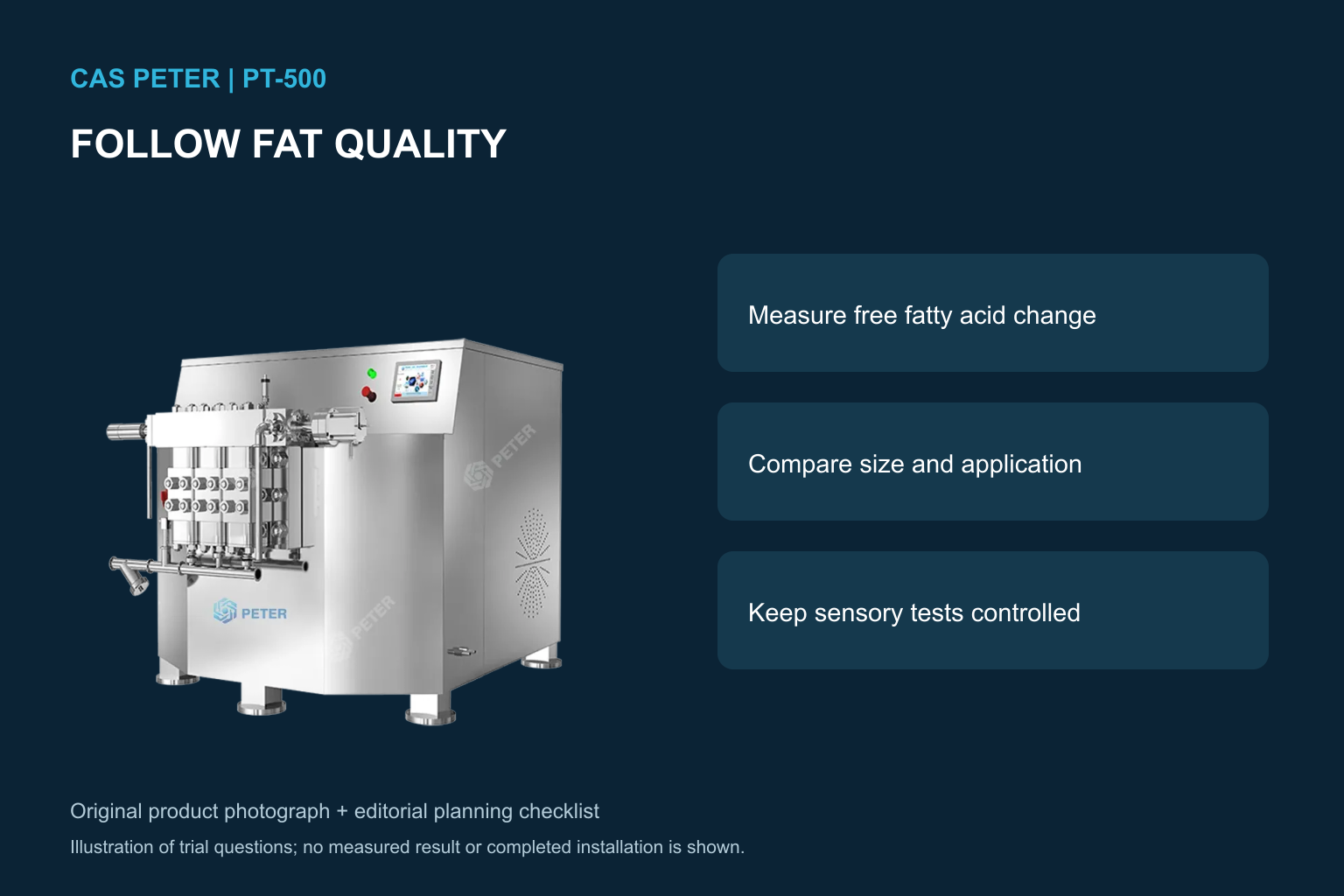
Translate the result into an equipment trial brief
The CAS PETER PT-500 product page is a starting point for discussing a production-scale homogenizer configuration. It is not evidence that a particular dairy formulation, sanitary arrangement or process sequence has already been qualified. Provide the actual feed, process order, temperatures, required throughput and cleaning expectations for a configuration review.
Ask which samples can be collected during stable operation, how start-up material is identified and how the cooling or downstream hold is represented. Clarify the pressure stages and their purpose rather than selecting a configuration from its name alone. The single-stage versus two-stage guide provides a separate framework for that discussion.
Agree on the records that accompany trial material: batch identity, machine configuration, pressure history, temperature history, processing time, sample location and storage instructions. A supplier comparison is more meaningful when each supplier receives the same brief and the analytical laboratory receives traceable samples.
Decide on the complete sequence
Choose the least complicated sequence that repeatedly meets the stated physical and chemical requirements. If a promising pressure condition fails after the actual hold or package stage, investigate that failure before requesting more pressure. Additional processing is not a substitute for understanding when the unwanted change occurs.
Keep the final evidence as paired timelines with the method and units attached. Record any limits of the study, such as a single milk source or a storage period shorter than the proposed product life. A successful short trial supports the next verification stage; it does not by itself establish shelf life for all incoming milk.
Educational background on emulsion processing
This neutral lesson introduces emulsion technology and helps explain why physical dispersion deserves its own set of observations. It does not provide a dairy safety schedule or replace the milk-specific chemical and application tests described above.
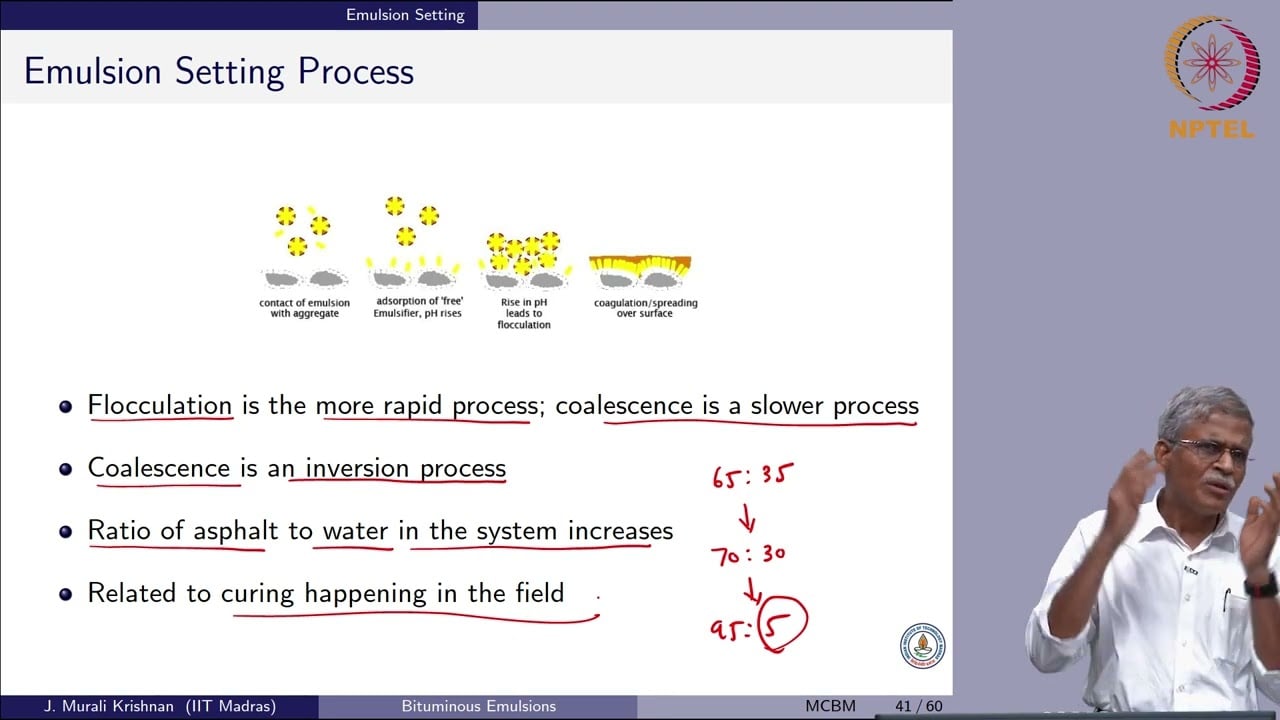
Educational source: NPTEL-NOC IITM. Watch the lesson on YouTube.
Frequently asked questions
Does homogenization automatically cause unacceptable milk lipolysis?
No universal outcome can be assumed. Evaluate the complete milk and enzyme history, process sequence, temperature exposure and holding time. Measure free fatty acid change and the intended product quality with matched controls rather than judging from the pressure setting alone.
Can a smaller fat globule size prove that the milk has better storage quality?
No. Size documents a physical change. Storage quality needs its own chemical, physical and application measurements across the intended process and storage conditions. A more uniform appearance does not establish acceptable fat quality or microbial safety.
Can published fatty acid thresholds be copied into a factory specification?
Only after establishing their relevance to the product, analytical basis and application method. Research thresholds belong to the milk and conditions studied. Use a product-specific specification and a suitable laboratory method rather than treating a paper’s value as a universal limit.