

Quercetin Nanoemulsion Storage: Separate Crystal Formation from Droplet Stability
Quercetin nanoemulsion storage stability requires separate checks for oil droplets, quercetin crystals and chemical retention. An emulsion can retain a similar droplet distribution while dissolved quercetin crystallizes, and an unchanged appearance does not establish unchanged active content. Define the loading basis, document how the active was dissolved and cooled, then follow matched samples through the intended storage conditions. Homogenization should be evaluated as one part of that formulation history, with acceptance based on the stored product rather than the fresh particle-size result alone.
This guide addresses formulation development and analytical decisions. It makes no therapeutic claim and provides no ready-to-use pharmaceutical or food recipe. The appropriate ingredients, analytical methods and product requirements must be established for the intended application.
Distinguish three different meanings of stable
Physical droplet stability concerns whether the dispersed oil maintains the intended distribution without unacceptable growth, clustering, creaming or oil separation. Quercetin physical state concerns whether the active remains dissolved in the selected environment or appears as crystals. Chemical stability concerns whether the amount and identity of quercetin are maintained during preparation and storage.
These endpoints can move independently. A clear-looking sample may still need a chemical assay. A sediment may contain active crystals, carrier material or aggregated droplets. A shift in light-scattering results may reflect more than one particle population. Identify the question before selecting an instrument or interpreting a single average size.
The distinction also separates a nanoemulsion from a deliberately prepared drug nanocrystal suspension. See the drug nanocrystals versus nanoemulsions guide when the intended physical form is unclear. A batch that unexpectedly forms active crystals has not automatically become an acceptable nanocrystal product; its structure, dose uniformity and process would require separate qualification.
Establish the loading and cooling history
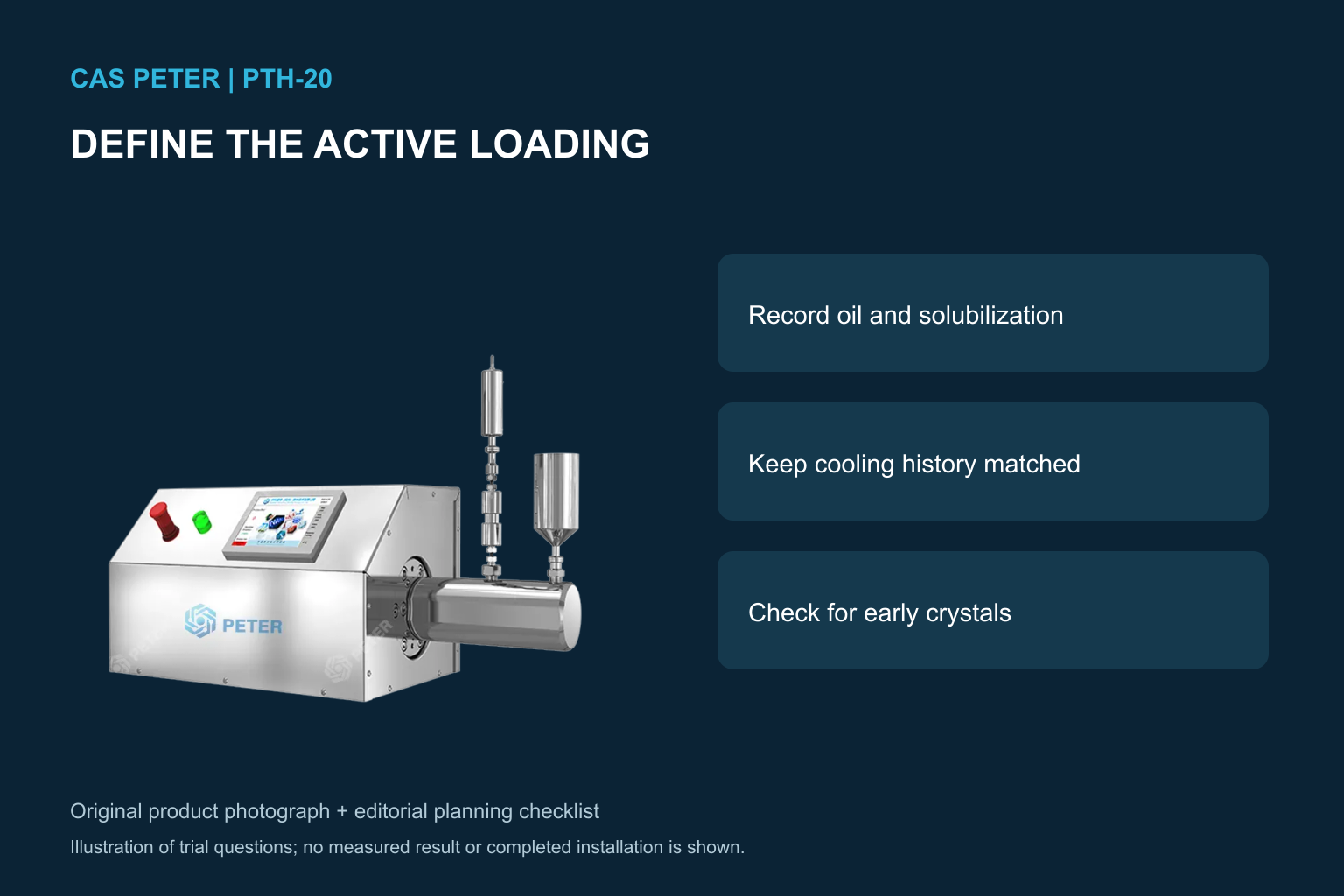
Record quercetin identity, purity information, supplier lot and the mass added. State whether loading is expressed per mass of oil, per mass of complete formulation or per final volume. Keep those bases separate in laboratory sheets and supplier discussions so that two apparently equal percentages are not compared incorrectly.
Document the oil phase, emulsifier system, aqueous phase, pH and any cosolvent. If heat is used during preparation, record the actual temperature and holding time, followed by the cooling sequence. A sample inspected while warm does not establish its physical state after storage at a lower temperature.
A primary study on quercetin physical form and bioaccessibility reported that crystals could appear during storage at loadings above the tested carrier oil’s solubility limit even when the emulsions did not show droplet growth or creaming. The accessible research abstract supports the need to distinguish crystal formation from emulsion breakdown. It does not provide a solubility limit for another oil, emulsifier system or finished formula.
Build the initial comparison around the actual intended loading and, where useful, a lower-loading control. Give both the same heating, cooling and handling history. This helps reveal whether the proposed loading is robust rather than temporarily clear immediately after preparation.
Design controls that explain what changed
Prepare an unloaded carrier with the same oil and emulsifiers but without quercetin. It can reveal background turbidity, carrier instability and interference in the assay. Retain an appropriate active reference for chemical analysis and verify that sample extraction recovers quercetin from the complete matrix.
Compare a representative coarse premix with the homogenized formulation. Where the experimental question requires it, include a matched formulation exposed to similar handling and temperature without the same pressure treatment. Explain any unavoidable difference. A process control is useful only if its preparation answers the intended comparison.
Use consistent vessels, filling levels and closures during the screening stage. Record headspace and exposure to light. If the container changes between conditions, its influence becomes mixed with the formulation and process effects. Keep a protected reference when assessing light exposure, while avoiding claims that a short accelerated challenge establishes the entire commercial shelf life.
Independently prepared batches are more informative than repeated measurements of the same tube. Repeat the promising condition and its control using a fresh preparation. This catches variation in dissolution, premixing or cooling that instrument repeat readings alone will miss.
Record the complete homogenization route
Document the state of the feed before pressure treatment, including any visible undissolved material, viscosity concerns, temperature and coarse-emulsion condition. Review that feed with the equipment supplier. Do not use the homogenizer as an assumed solution to an unidentified solubility problem or feed a formulation outside the confirmed compatibility envelope.
During processing, record operating pressure, the definition of a pass, inlet and outlet temperatures, sample recovery and the interval before cooling. In a recirculating setup, describe the processing arrangement and residence history. Avoid giving every portion an identical pass count unless the routing establishes that history.
For a controlled screening trial, vary the selected condition systematically while holding loading and preparation constant. If the formulation itself changes, identify that as a separate factor. Otherwise a lower stored crystal count could result from a changed oil ratio rather than an improved homogenization step.
The CAS PETER PTH-20 product page is an equipment reference for discussing a proposed trial. Confirm the intended formulation, wetted materials, temperature management, cleaning and analytical sample requirements with the supplier. The model image does not establish suitability for every solvent or that a published research setting is available in the proposed configuration.
Follow droplets, crystals and active content separately
Choose methods capable of addressing each endpoint. Microscopy can help identify larger structures and visible crystals, while droplet-sizing methods need validation for the formulation and any dilution. Chemical analysis needs a representative sample and an extraction procedure appropriate for the matrix.
The checklist below is an editorial decision aid based on the physical-form study and the pH study discussed later. It contains no universal release limits. Set acceptance criteria for the specific product before examining the results.
| Storage observation | Check to add | What the combination can resolve | What it cannot establish alone |
|---|---|---|---|
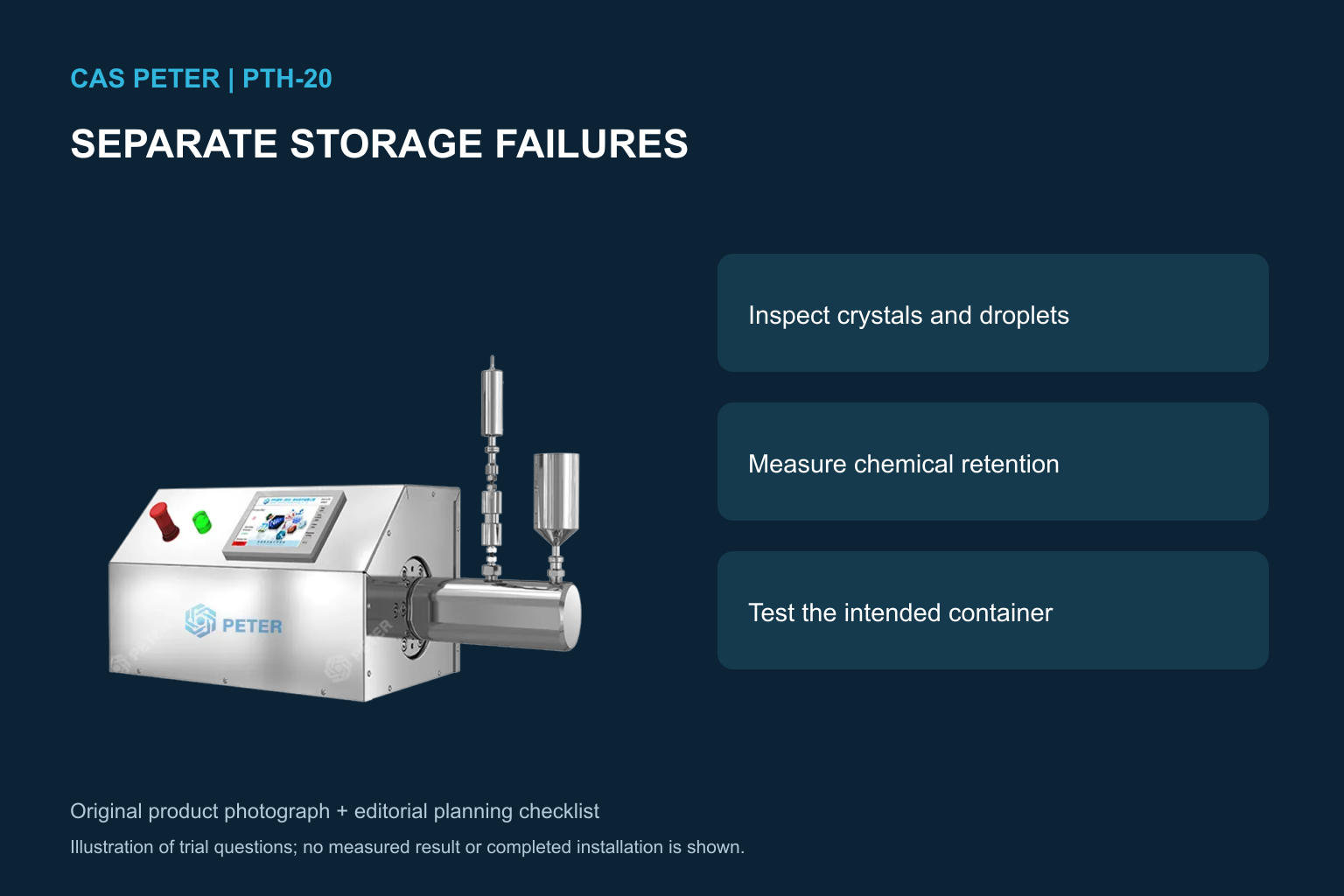
| Droplet size appears unchanged | Inspect for crystals with a suitable method | Whether a second solid population is emerging | Retention of chemically unchanged quercetin |
| Sediment forms | Examine sediment and the surrounding liquid separately | Whether settling involves crystals or carrier structures | The identity of the sediment from appearance only |
| Color or clarity changes | Compare blank carrier and chemical assay | Whether the change accompanies loss of active content | A degradation mechanism without further evidence |
| Mean particle size rises | Review distribution and microscopy | Whether large structures or a second population affect the result | That every measured particle is an oil droplet |
| Total active assay is retained but dosing varies | Sample defined positions before and after prescribed mixing | Whether distribution within the container is acceptable | Long-term uniformity at all later storage times |
When chemical extraction dissolves crystals, a total-content assay can still recover the active. Report that result as total recoverable quercetin under the validated method, not proof that the active remained dissolved throughout storage. Use separate aliquots for the physical-state examination and extraction so that sample preparation does not erase the evidence being investigated.
Test pH and storage in the actual formulation
A study of quercetin-loaded oil-in-water nanoemulsions evaluated pH-dependent preparation and followed physical characteristics during storage. Its formulation included a specific combination of carrier oil, surfactant, alginate and lecithin. It used high-speed mixing and subsequent formulation steps rather than demonstrating a high-pressure treatment recipe. Its results support checking pH and composition in the stored emulsion; they cannot be transferred directly to a different carrier or CAS PETER machine.
Measure pH using a method suitable for the formulation and record the measurement temperature. If dilution is required for an analytical test, disclose the diluent and the extent of dilution. An analytical environment that dissolves crystals or changes droplet interactions can make the measurement look more favorable than the undiluted product.
Store matched samples at the intended conditions and any justified challenge conditions. Use planned sampling times and separate containers for observations that disturb the sample. Record how long a removed sample equilibrates before measurement. Compare stored samples against their own initial state and the reference formulation, rather than comparing unrelated measurements collected under different conditions.
Include the container and intended use
After the formulation survives screening, repeat the selected condition in the intended packaging or a justified representative system. Document closure, headspace, fill level, handling and expected light exposure. A result obtained in one laboratory vial is evidence for that test arrangement, not an automatic claim about another container.
If use involves dilution into a beverage, gel or another carrier, perform that dilution explicitly and repeat the relevant observations. State the mixing sequence and the delay before use. A concentrate that appears satisfactory during storage may behave differently after dilution, especially if the surrounding composition changes.
Define whether settling is allowed and what mixing is realistically available to the user. A laboratory vortex procedure may not represent normal package handling. If the product requires redispersion, evaluate content distribution after the specified practical action and retain the undisturbed observation as part of the record.
Turn the results into a development decision
Accept the condition only when the required physical state, distribution and active retention are demonstrated together for the intended test period. A favorable result for one endpoint should not conceal failure of another. When the mechanism remains uncertain, keep the batch in development and choose the next measurement that distinguishes the competing explanations.
For general test organization, use the nanoemulsion stability testing guide. The high-pressure emulsion support guide helps frame equipment and process questions. Bring the actual formula, feed observations, processing log and stored-sample results to the review so that loading, carrier selection and treatment intensity are assessed together.
Educational background: emulsion formation
This university lesson introduces the emulsion principles behind droplet formation and stabilization. It supports the physical interpretation above without replacing quercetin-specific measurements or formulation development.
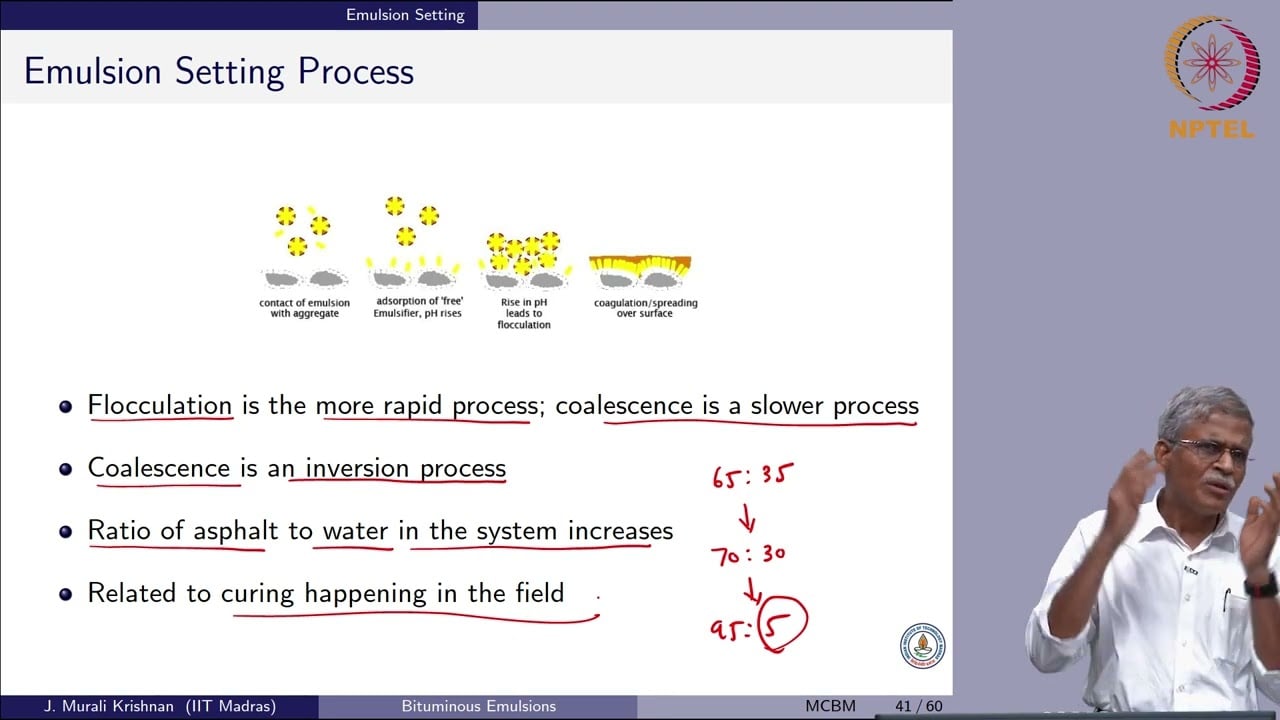
Educational source: NPTEL-NOC IITM. Watch the lesson on YouTube.
Questions about quercetin emulsion storage
Can quercetin crystallize while droplet size remains similar?
Yes. The active’s physical state and the stability of the oil droplets are separate questions. Inspect for crystals using a suitable method alongside droplet measurements, and compare samples with a documented loading and cooling history.
Does a retained total quercetin assay prove it stayed dissolved?
No. Extraction for total-content analysis can dissolve material that was crystalline in the stored product. Examine physical state separately and describe the chemical result according to the validated sampling and extraction method.
Can a published stable pH range be used for any quercetin nanoemulsion?
No. Published behavior belongs to the tested oil, emulsifiers, loading and preparation route. Establish the acceptable range in the intended formula and packaging, with physical and chemical endpoints assessed separately.