

Tomato Juice Homogenization: Balance Serum Separation and Texture
Tomato juice homogenization should be judged by serum separation and the intended texture together. Treating the clear liquid layer as the only defect can lead to a product that is inconvenient to pour or feels wrong in use. Compare juice from the same raw-material and preparation history, measure whole-juice flow under defined conditions, and follow separation during storage in a consistent container. Select the least intensive qualified route that meets both targets. A pressure quoted in a research paper is a condition for that study, not a universal setting for every tomato formulation or homogenizer.
Start with the product that will actually be sold
Distinguish a drinkable juice from a puree, sauce base or concentrate. They have different expectations for pouring, mouthfeel and processing. Write the intended use and the acceptance decision before choosing the trial conditions. A sample can look impressively thick in a laboratory beaker yet be unsuitable for a filling line or a beverage specification.
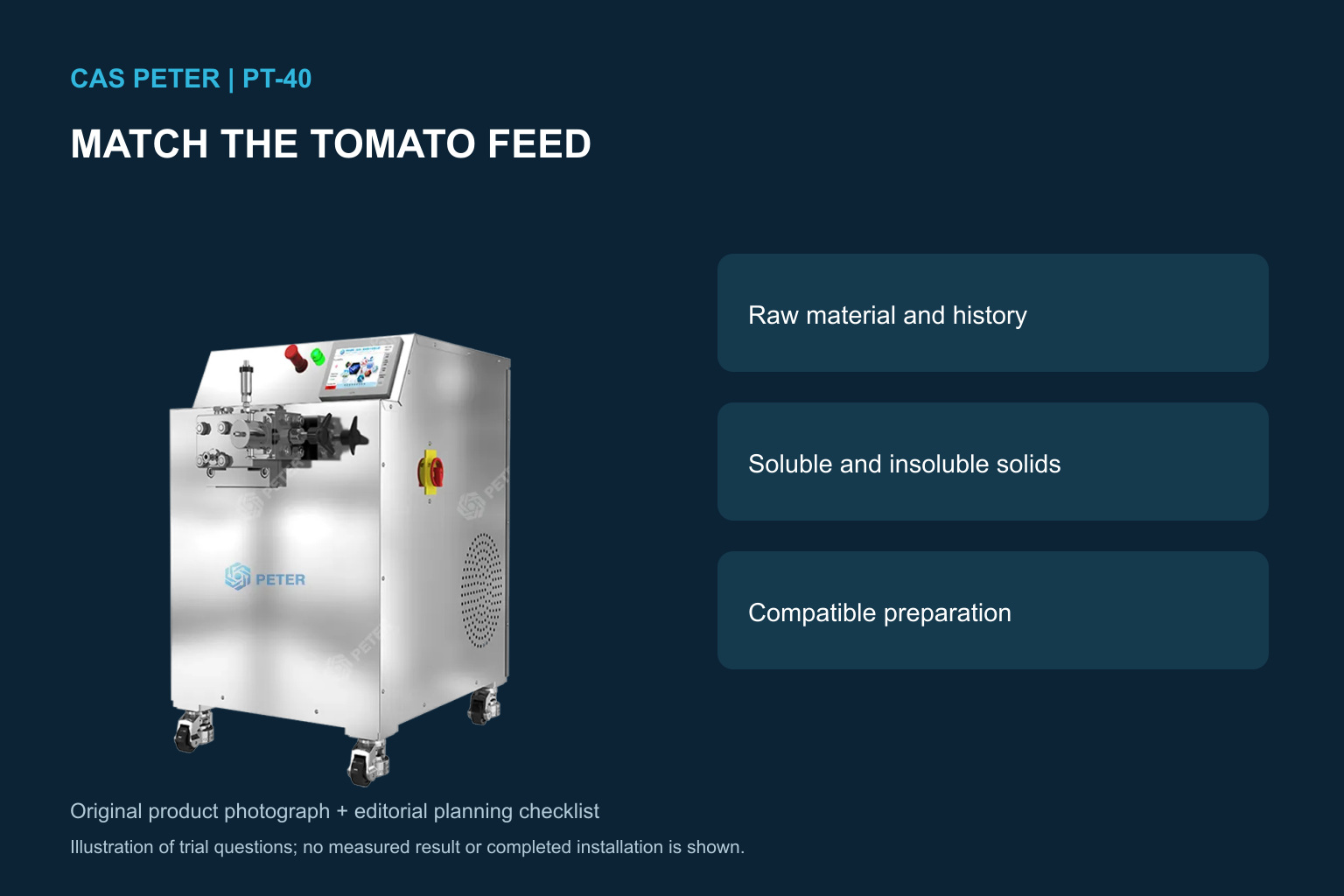
Record the tomato source, lot, concentration history and whether the feed comes from fresh juice or reconstituted paste. Preserve the heat-treatment and finishing history where known. Do not compare a newly prepared fresh juice with a diluted concentrate and attribute every difference to the homogenizer. Such a comparison changes the material as well as the processing step.
Wageningen research on tomato suspensions reports that concentration history influenced rheology and serum separation even when suspensions were standardized on selected solids measures. The useful practical implication is that matching a single concentration number does not establish identical feed structure. That finding is specific to the studied suspensions and should guide control selection rather than predict a numerical response for your product.
Describe the feed beyond its Brix value
Measure and record soluble solids, pH and the available total or insoluble-solids indicators. State how each measurement was prepared and performed. Brix is useful for batch identification and consistency checks, but it should not be treated as a full description of the pulp population or the juice structure.
Keep the preparation sequence constant: thawing if relevant, dilution, mixing, hydration or rest period, and the interval before processing. If the laboratory must remove coarse material to protect the selected machine, weigh and describe the removed fraction. A smoother output after a coarse fraction has been discarded is not solely a homogenization result.
Discuss the actual feed with the equipment supplier before trial execution. The maximum compatible particle, viscosity and solids conditions belong to the specified configuration. Do not infer them from a model name or from an experiment performed on another brand of equipment. Use a representative feed sample rather than a convenient dilute substitute when the decision concerns production handling.
Separate the whole juice from its serum measurement
Whole-juice consistency and serum viscosity answer different questions. The whole product contains suspended material and its interactions with the liquid phase. A serum measurement follows a separated liquid fraction produced by a stated preparation method. Retain both identities in the report so that the measurements are not accidentally compared as if they described the same sample.
The ISHS study on tomato consistency measurements explicitly distinguishes juice, serum and paste methods. It describes limitations of applying an empirical paste consistency method to lower-solids juice. This supports choosing a method suitable for the actual product, rather than assuming that one convenient flow test can replace all rheological measurements.
If serum is separated by centrifugation or another laboratory step, document the procedure and use it consistently. Label it as a prepared serum fraction, not the natural liquid layer observed during storage. The latter is an appearance and separation outcome in a container; the former is an analytical preparation. Both may be useful, but their meanings differ.
Set up a trial matrix with two acceptance axes
Use a control from the same prepared feed and a limited set of equipment-approved conditions. Keep the batch quantity, sampling method and measurement temperature consistent. Record pressure, actual flow arrangement, pass definition, temperatures and any interruption. If an operating condition changes several of these at once, acknowledge that the comparison cannot isolate pressure alone.
The following table is a proposed trial worksheet. It provides qualitative decision criteria, not food specifications or validated operating limits.
| Question | Record | Interpretation boundary |
|---|---|---|
| Is the feed comparable? | Lot, preparation history, Brix, pH and solids information | A matched Brix value alone does not establish a matched structure |
| Is separation acceptable? | Container geometry, storage time, temperature and layer observations | A single photograph cannot establish shelf-life behavior |
| Is the texture appropriate? | Flow curve or suitable consistency method with temperature and timing | A thicker result is useful only if it meets the intended product specification |
| Does the process transfer? | Feed compatibility, pass route, cooling and representative sampling | A laboratory result does not automatically qualify a production configuration |
| Is the result repeatable? | Fresh-batch confirmation and analytical repeat measurements | Instrument repeats do not replace independent preparation repeats |
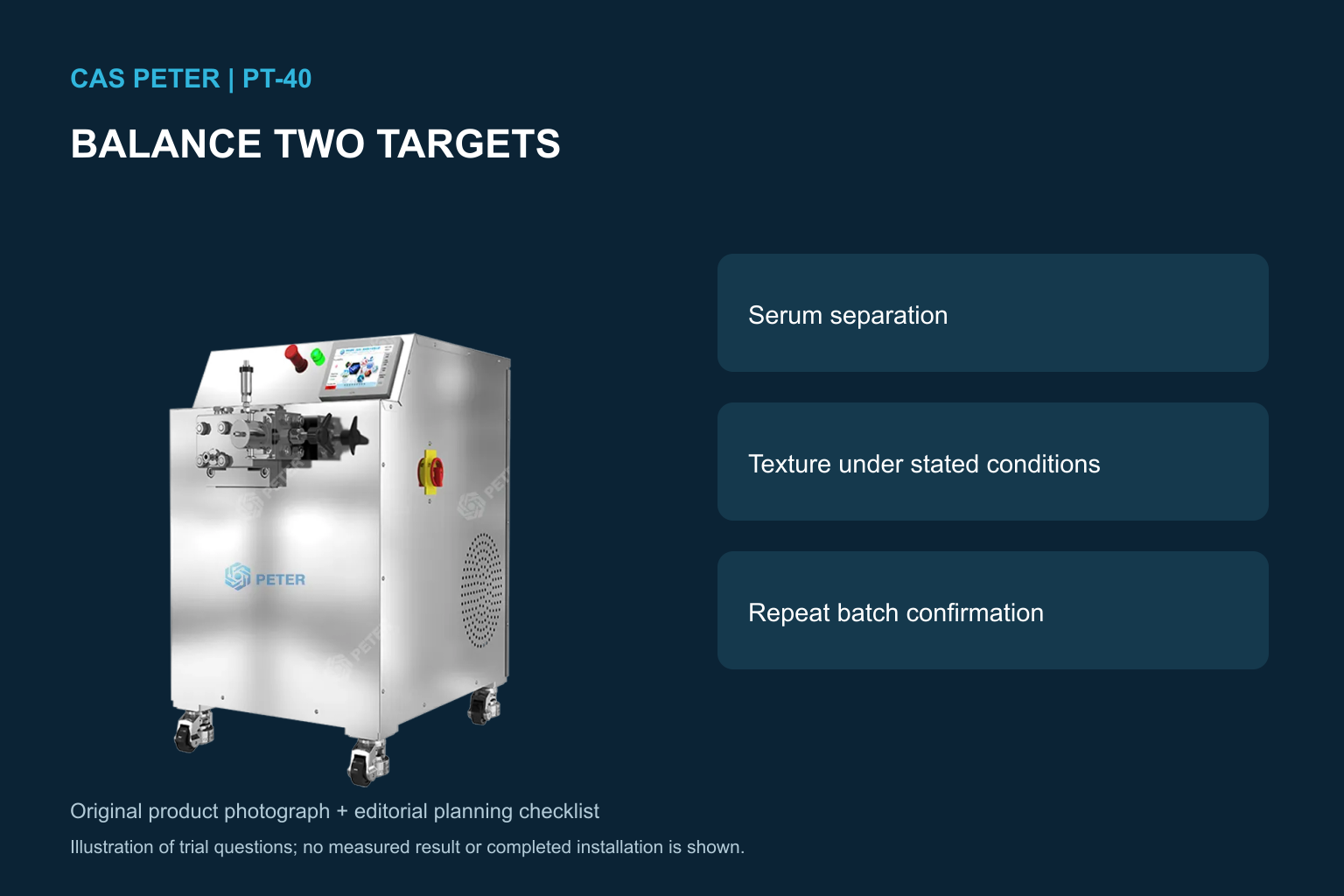
Agree on the desired region of both axes before selecting a winner. For instance, a formulation team may accept a small visible change if the pouring behavior is substantially better, or require very little separation while keeping a defined flow response. Those decisions belong to the product specification and must be explicit.
Measure texture under repeatable shear history
Set the measurement temperature and sample rest period. Document whether the sample was stirred, shaken or transferred through a narrow opening immediately before testing. Where a rheometer is available, retain the measurement program and flow curve. Reporting viscosity without the shear rate and temperature can hide a material difference between samples.
Use the same loading method and check for practical measurement problems such as a nonrepresentative pulp fraction or entrained air. If the instrument requires a particular gap or geometry, make sure it is suitable for the suspension under evaluation. Do not force a heterogeneous product into a method whose assumptions are not met simply to obtain a clean number.
When a production consistency test is used, record the actual method and its preparation conditions. Keep its result separate from a rheometer result unless the relationship has been established for the product. A simple routine test may be valuable for factory control while still being insufficient to explain the mechanism behind a trial difference.
Observe separation without changing the sample
Use matching containers with the same fill quantity, orientation and storage environment. Photograph the samples against a fixed background and record the elapsed time. A measurement plan should state whether bottles are left undisturbed or remixed between observations. Repeatedly remixing one sample and leaving another untouched invalidates a straightforward separation comparison.
Record the character of the separated layer and any sediment, without diagnosing the cause from appearance alone. A clear upper region, a compact bottom region and a loose settled fraction should not all be reduced to the word unstable. Their handling consequences can differ, and the next measurement should be chosen to distinguish plausible explanations.
If accelerated separation testing is included, report its conditions separately from ordinary storage. It can help screen candidates, but it does not establish commercial shelf life by itself. Pair the screening result with storage observations under the intended packaging and distribution conditions before making a finished-product claim.
Keep thermal processing and food safety as separate qualifications
A successful texture trial does not prove a food-safe preservation process. Homogenization, pasteurization, hygiene and packaging each require the appropriate process assessment. Do not infer commercial sterility or a new shelf-life claim from a change in serum separation, particle appearance or viscosity.
For a fair comparison, preserve the intended upstream and downstream thermal history. Record where homogenization occurs relative to heating and cooling, along with relevant holding intervals. A trial on cold laboratory material can help answer a narrowly defined physical question while still leaving the real production sequence unqualified.
Follow site food-handling procedures for all trial material. Keep laboratory samples out of consumer use unless released through the normal quality process. Where sensory assessment is appropriate, make sure the material and testing procedure have already passed the necessary review. Technical appearance alone is not a release criterion.
Translate the result into a pilot-scale request
The CAS PETER PT-40 pilot product page provides a starting point for discussing a representative trial. Confirm the actual configuration, compatible feed, cooling, cleaning provisions and desired flow arrangement. Ask the supplier to assess the real tomato material and process objective rather than quote only a nominal capacity.
Supply the trial matrix, accepted product measurements, unsuccessful conditions and representative feed history. State the desired batch size and how the product will move through downstream piping, cooling and filling. Keep the accepted condition traceable to a retained sample and its measurements, so that the scale-up conversation has an agreed reference product.
Use the broader food homogenization guide for application context. The plant-protein trial guide illustrates how material preparation affects another food system, while the homogenizer feed and capacity guide helps frame equipment compatibility questions. Those pages complement the tomato-specific separation and texture decision here.
Educational video: why a viscosity number needs context
Victor Ugaz’s chemical-engineering lecture explains non-Newtonian fluid behavior. It helps interpret why measurement conditions matter when comparing structured liquids. The lecture is background education and does not prescribe a tomato processing pressure or certify a food formulation.
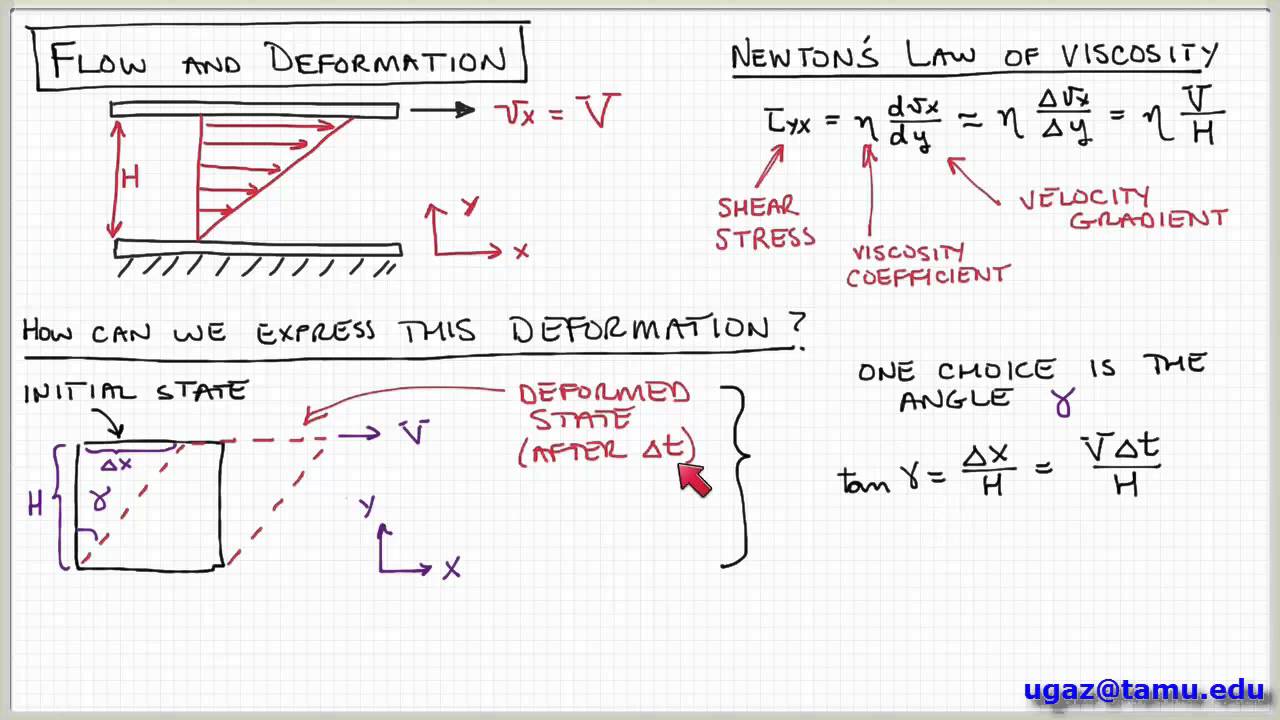
Educational source: Victor Ugaz. Watch the lesson on YouTube.
Frequently asked questions
Does less serum separation always mean a better tomato juice?
No. Evaluate it alongside the intended pouring behavior, texture and product specification. A condition that reduces visible separation can still produce an unacceptable finished product or fail other quality requirements.
Can Brix matching make two tomato feeds equivalent?
No. Preserve information about raw material, concentration and preparation history, pulp and insoluble solids. Matching soluble solids is useful, but it does not prove identical suspended structure or rheological behavior.
Can a pilot texture trial establish shelf life?
No. Texture and physical separation measurements answer limited product-quality questions. Shelf life and food safety require appropriate validation of the formulation, processing route, hygiene, packaging and intended storage conditions.