

Yogurt Syneresis After Homogenization: Test the Finished Gel
Yogurt syneresis after homogenization must be judged in the finished fermented product, because a uniform milk feed does not prove that the resulting gel will retain whey. Compare milk composition, heat history, acidification, gel handling and storage before attributing separation to homogenizer pressure. A useful trial measures visible whey release, water holding and texture separately. It also distinguishes set yogurt from stirred yogurt, since breaking and transferring the gel changes the product being evaluated. The aim is a reproducible finished texture with acceptable separation throughout the intended distribution period.
Define the separation defect before changing the milk process
Start with the actual complaint. A puddle on an unopened set yogurt, drainage after spooning and liquid appearing in a stirred product after transport are different observations. Record where the whey appears, when it becomes visible and what handling occurred beforehand. Photograph intact packages before opening them; an image taken after stirring cannot document the original surface condition.
Select the intended product format before designing the experiment. For set yogurt, preserve the gel in its retail container through incubation, cooling and testing. For stirred yogurt, define the gel breaking, smoothing, transfer and filling sequence. For drinking yogurt, establish the desired pourability as well as separation. A treatment that produces a softer gel may be useful for one format and unsuitable for another.
Use the broader dairy and food homogenization guide to place milk pretreatment within the production sequence. This article focuses on diagnosing whey release after fermentation, rather than selecting a generic milk homogenization setting.
What published yogurt research actually establishes
An experimental study of buttermilk and skimmed milk yogurt found that the dairy source influenced the response to pressure treatment. Water holding, gel structure and stirred viscosity did not all move together. In that experiment, increasing treatment pressure did not provide a universal improvement across both milk sources. The finding supports product-specific trials; it does not establish a pressure recommendation for a CAS PETER machine.
The paper used its own milk preparation, equipment, heating and culture conditions. Its ultra-high-pressure treatments must not be assumed available on a proposed model. Ask the supplier to confirm the permitted operating range and food-contact configuration independently. Research settings describe an experiment, not a procurement specification.
A review of yogurt syneresis also identifies milk composition, heating, culture, fermentation and cooling as relevant variables. Use that wider context to avoid treating whey release as a single-machine fault. The practical comparisons below are a proposed diagnostic workflow, not a reproduction of one published recipe.
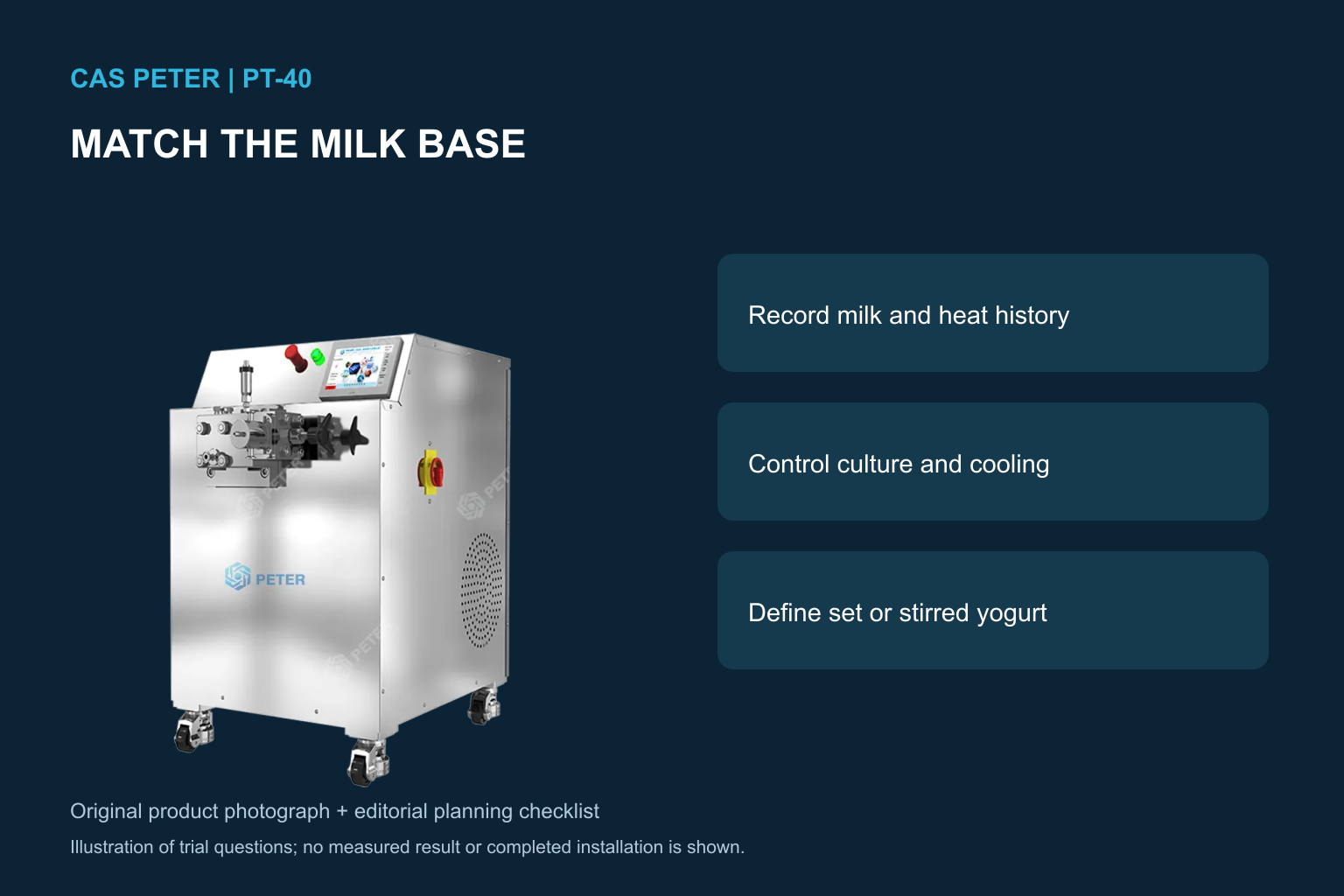
Hold the milk base and heat history constant
Take enough representative milk base for all treatments from one prepared batch whenever practical. Record total solids, fat and protein, together with the source and hydration history of added dairy powders. Document stabilizer identity and addition order. If the recipe changes between pressure treatments, the experiment cannot isolate the contribution of homogenization.
Follow powder hydration and blending consistently. A mixture that is still hydrating during the trial may change before it reaches the machine. Keep the interval between preparation, homogenization and fermentation comparable. Record mixing conditions and hold temperature rather than using an unqualified instruction to prepare every batch in the usual way.
Track heating before and after homogenization, including inlet and outlet temperatures and subsequent holding. Two treatments with different pressure settings may also experience different thermal histories. If the purpose is to compare the complete practical process, preserve and report that difference. If the purpose is to isolate a mechanical contribution, design suitable thermal controls with a dairy process specialist.
Separate pretreatment from fermentation and gel handling
Milk homogenization is normally evaluated as a pretreatment in this type of trial. Do not assume that putting a finished fermented gel through the same equipment is an equivalent correction. The material, structure and processing objective have changed. Any downstream smoothing operation needs its own suitability assessment.
Use the same culture preparation and inoculation procedure for matched batches. Monitor the acidification curve and record the endpoint used to begin cooling. Comparing samples only at an equal incubation time can leave them at different acidity. Comparing only at equal final pH can conceal substantially different fermentation histories. Keep both records so that the result can be interpreted.
For stirred yogurt, document the tool, duration, temperature and sequence of gel breaking and transfer. Sample before and after the most important handling steps if the defect appears downstream. This can locate a loss of structure that would otherwise be blamed on the milk pretreatment. Keep filling conditions and package headspace consistent for the storage comparison.
Choose measurements that answer different questions
Visible surface whey is the observation closest to a consumer complaint, but it is not interchangeable with a laboratory drainage or centrifugation test. A forced separation method challenges the gel under specified conditions. It can support comparisons when applied consistently, but it should not be presented as the amount a consumer will see in an unopened package.
Define the sample mass, geometry, temperature, drainage period and collection method for each separation test. If centrifugation is used, report relative centrifugal force and duration together with the equipment configuration. Keep the sampling location and disturbance consistent. Scooping a top layer from one cup and mixing another cup before testing introduces a handling difference.
Texture also needs an explicit method. For set yogurt, a penetration result depends on probe geometry and test depth. For stirred yogurt, apparent viscosity depends on temperature, shear history and the measurement procedure. Report these conditions with the result. An increase in apparent viscosity alone does not prove improved water retention.
The qualitative comparison table below combines the product-specific lesson from the experimental paper with the broader process variables discussed in the review. It contains no universal acceptance limits.
| Observation | First comparison | Evidence to retain | Interpretation boundary |
|---|---|---|---|
| Whey on an intact set yogurt | Matched cups cooled and stored without disturbance | Surface photographs and collected whey using one method | Do not compare with a stirred sample |
| Good firmness but visible drainage | Texture and separation from separate matched cups | Probe method, drainage conditions and storage age | Firmness alone does not establish water holding |
| Acceptable vat sample, poor packaged product | Samples before transfer and after filling | Handling sequence, temperature and package records | A downstream change may dominate the outcome |
| Different result after pressure changes | Same milk base, culture and heat history | Pressure, passes, temperatures and acidification curves | Pressure is only one changed exposure unless controls prove otherwise |
| Separation grows during distribution | Matched stored and handled package groups | Storage conditions and time of first visible defect | A short laboratory hold does not establish shelf life |
Build a small trial with a clear decision rule
Keep the current successful process, or the best available baseline, as the reference. Compare a limited number of supplier-approved changes rather than altering pressure, stabilizer, heat treatment and culture simultaneously. Use independent batch repeats so that package-to-package variation is not mistaken for manufacturing reproducibility.
Before starting, agree on the evidence required for a useful improvement. For example, the development team may require reduced visible whey without unacceptable changes in spoon texture, mouthfeel or filling performance. Those acceptance criteria should come from the product brief and validated test methods, not from a generic percentage copied from an unrelated publication.
Retain unsuccessful samples in the analysis. If one treatment reduces separation but produces an unsuitable pour or inconsistent filling, document the tradeoff. Report the full set of measured outcomes rather than highlighting the single metric that improved. Repeat the selected condition with a fresh milk base before planning a larger run.
Check storage and distribution in the intended package
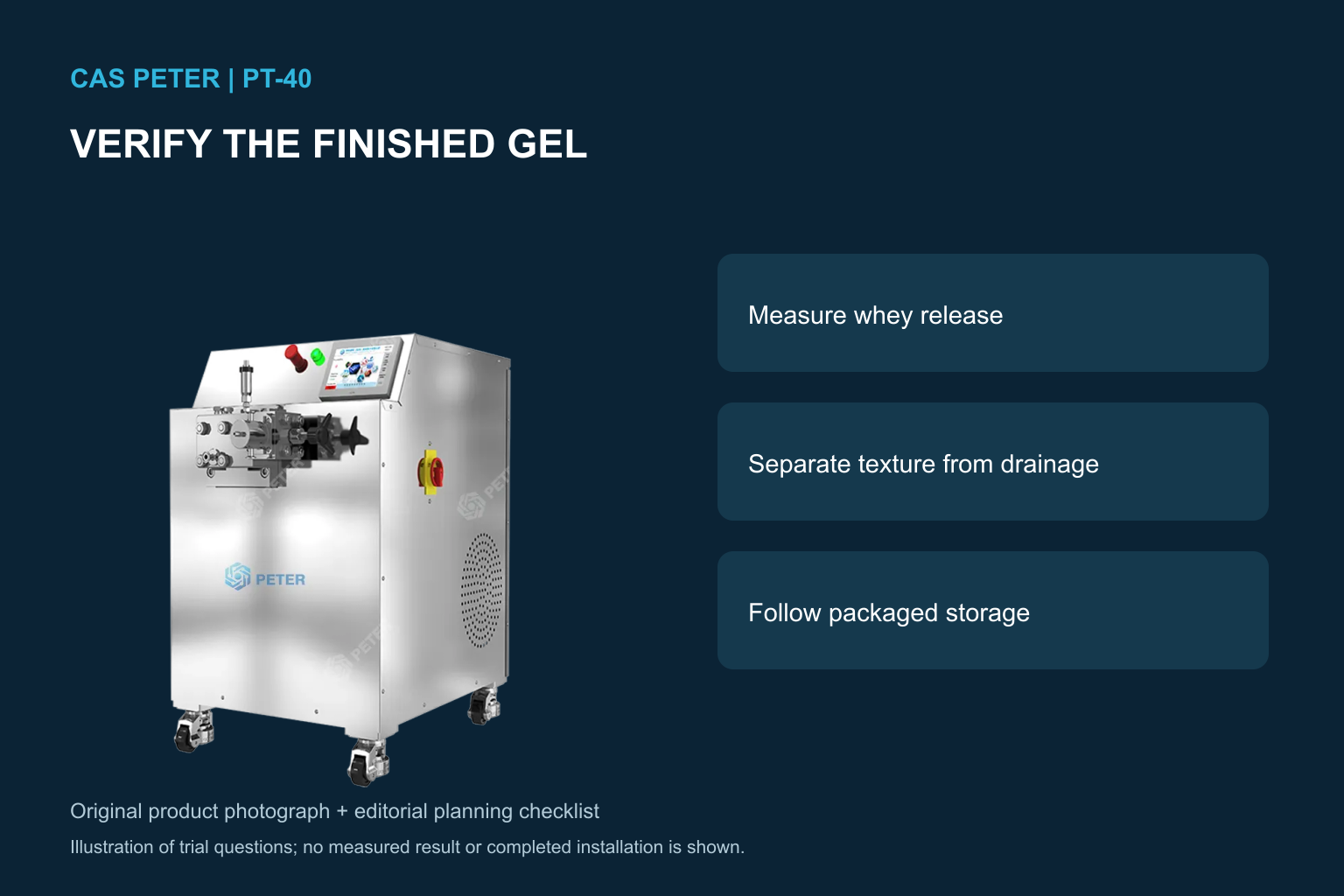
Prepare separate containers for destructive tests at each observation point. Repeatedly opening and mixing one cup changes the material being stored. Include the actual packaging when possible, and record fill amount, closure, cooling history and storage position. Label every sample so treatment identity survives transfer between processing, laboratory and sensory teams.
Include the expected handling route when evaluating a distribution complaint. Compare an undisturbed group with a defined handling group, using an appropriate simulation developed for the product. A transport challenge should be described as a challenge; it is not automatically equivalent to a complete commercial distribution study.
Observe appearance and separation before preparing material for texture testing. Then apply the same preparation procedure to each group. Keep microbial safety and shelf-life validation under the site’s approved food safety process. Homogenization and a physically stable gel do not independently establish that the product is safe to sell.
Translate the result into an equipment discussion
The CAS PETER PT-40 product page is a starting point for discussing a pilot-scale configuration. Confirm the actual feed viscosity, allowed particles, batch requirements, cooling arrangement, cleanability and food-contact materials with the supplier. The product photograph illustrates the model; it does not verify that a particular yogurt process or trial has been completed.
Bring the milk base specification, intended product format and measured processing temperatures to that discussion. Explain whether the goal is a firmer set gel, a smooth stirred product or a drinking yogurt. Ask which variables can be controlled on the proposed configuration and what sample quantity is required to generate representative evidence.
Review single-stage and two-stage homogenizer selection before changing the stage arrangement. For recipes containing plant proteins, the plant protein trial guide addresses additional formulation questions, but its conclusions should not be transferred directly to dairy yogurt. Choose equipment around the validated process target and total production sequence.
Further learning: food rheology
The following NPTEL lesson explains rheological concepts useful for distinguishing viscosity and gel behavior. It is background education rather than a yogurt manufacturing recipe or proof of any machine’s performance.

Educational source: NPTEL IIT Kharagpur. Watch the lesson on YouTube.
Frequently asked questions
Does increasing homogenization pressure always reduce yogurt syneresis?
No. The outcome depends on the milk base and the complete process. Compare finished yogurt under matched fermentation, handling and storage conditions before selecting a pressure change.
Is a thicker stirred yogurt necessarily better at holding whey?
No. Apparent viscosity and whey separation answer different questions. Measure both with defined procedures and evaluate them against the intended texture and package appearance.
Should milk homogenization be tested before or after fermentation?
For the pretreatment question discussed here, test the milk base before fermentation and then evaluate the resulting yogurt. Treat any processing of finished yogurt as a separate operation requiring its own product and equipment assessment.